
Players should prepare themselves for a Call of Duty experience that feels much closer to high-speed movement shooters like Apex Legends or Titanfall than traditional tactical military games. The leaked footage reveals a movement system where transitions between crouching, sliding, jumping, and running are completely seamless. In previous titles, landing a jump or sliding into cover came with a brief deceleration penalty, designed to simulate the physical weight of a soldier carrying heavy gear. In Modern Warfare 4, that weight seems to have vanished entirely. How does this change the basic flow of a gunfight? It means that players holding defensive angles will no longer have the massive advantage they once enjoyed. With the introduction of a refined lateral diving mechanic, attackers can fly around corners sideways while keeping their weapons aimed down sights. This will force players to constantly stay mobile, as sitting behind a crate or holding a choke point will make you an easy target for high-speed flankers. Additionally, we can expect map designs to shift dramatically to accommodate this new velocity. Traditional, tight three-lane maps will likely feel too small, forcing the developers to create larger arenas with more verticality and wider lanes to prevent matches from turning into chaotic, uncontrollable spawn traps. Weapon handling will also need to adjust, with faster aim-down-sights speeds and tighter hip-fire spreads to match the lightning-fast pacing.
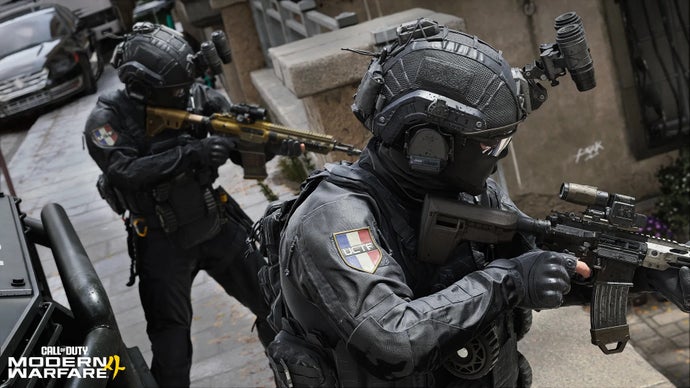
Image: courtesy of EuroGamer
The Six-Second Slip: How Infinity Ward’s Hidden Gameplay Teaser Signals a Massive Speed Revolution for Modern Warfare 4
It started with a blink-and-you-miss-it moment hidden deep inside a routine developer update video. While the presenters talked about studio pipelines and asset creation, a tiny monitor in the background showed real, unedited gameplay of what is clearly Modern Warfare 4. Within minutes, the Call of Duty community did what it does best: they clipped, zoomed, and slowed the footage down to analyze every single frame. What they discovered has sent shockwaves through the entire first-person shooter community. The player character in the footage didn't just walk or run; they slid, dived laterally, and transitioned between states with zero deceleration. This is a massive departure from the heavy, grounded style of play that Infinity Ward spent years perfecting. It looks like the studio is throwing out its old tactical playbook to build a game that is entirely about speed, momentum, and high-velocity movement. For a developer historically known for its stubborn dedication to military realism, this represents a massive strategic pivot. The era of slow, methodical gunfights is drawing to a close, replaced by a new philosophy of pure velocity.
Outlook
Background
To understand why Infinity Ward is taking such a massive gamble, you have to look at how Call of Duty makes its money. The franchise is no longer a simple annual release; it is a massive, interconnected machine tied directly to Warzone, a free-to-play battle royale that generates billions of dollars through microtransactions. Warzone requires constant player engagement to stay profitable, and that engagement is heavily driven by the modern creator economy. Slow, methodical, tactical gameplay might feel rewarding to a small group of purists, but it is notoriously boring to watch on a livestream. High-speed movement, flashy slide-cancels, and rapid-fire squad wipes make for incredible short-form video content on platforms like TikTok and YouTube. By giving players the tools to pull off highly cinematic, fast-paced plays, the developers are ensuring the game remains highly visible in social media algorithms. However, this focus on speed creates a massive risk of alienating the silent majority of the player base. The average Call of Duty player is not a professional streamer with a custom controller and a high-end monitor; they are a casual gamer playing on a living room TV after a long day of work. If the skill gap between casual players and hardcore competitive players becomes too wide, the casual player base will simply abandon the game, which would hurt the bottom line. Finding a way to balance these two wildly different audiences is the single biggest challenge facing the development team.
See also
Precedents
This is not the first time Call of Duty has struggled with its own speed limit. Back in 2019, Infinity Ward released a soft reboot of Modern Warfare that accidentally introduced a mechanic known as 'slide-canceling.' This exploit allowed players to reset their tactical sprint animation by rapidly sliding and crouching, allowing them to zip across maps at absurd speeds. While casual players struggled to keep up, competitive players and streamers embraced it as a vital skill gap. When Infinity Ward developed Modern Warfare II in 2022, they made a conscious decision to remove slide-canceling entirely, aiming for a slower, more realistic tactical shooter. The backlash was immediate and severe, with top streamers and professional players openly criticizing the heavy, sluggish movement. Sledgehammer Games was eventually tasked with speeding things up in Modern Warfare III, but the community has been waiting to see if Infinity Ward would revert to their slow-paced philosophy for their next major release. This leaked footage of Modern Warfare 4 is the definitive answer to that question. The studio has clearly surrendered to the demand for speed, designing their entire engine around fluid momentum rather than fighting against it. It proves that within the internal power struggle of Call of Duty design, the speed advocates have won a decisive victory.
The technical and design implications of this speed revolution are vast and highly complex. When players are moving at extreme speeds, sliding around corners, and diving through the air, the game's servers must work incredibly hard to calculate exactly where each player is at any given millisecond. Historically, the Call of Duty engine has struggled with hit registration during periods of rapid movement, leading to a frustrating phenomenon known as desync. This occurs when a player gets shot and killed after they have already run behind a solid wall on their screen, because the server is lagging behind their actual position. If Modern Warfare 4 increases the average player speed even further, the developer will need to invest heavily in upgrading their server infrastructure and netcode. Without high-tick-rate servers, the multiplayer experience will quickly devolve into a frustrating mess of ghost bullets and inconsistent gunfights, completely undermining the game's competitive integrity. Beyond the technical hurdles, there is also the risk of mechanical exhaustion. If every match requires constant, high-intensity button-mashing just to survive, players may quickly experience burnout, leading them to seek out slower, more tactical alternatives. The studio is betting that players want adrenaline over tactics, a decision that will redefine the mechanical expectations for the entire first-person shooter genre.
Scenarios
AnalysisAnalysis: Depending on how Infinity Ward balances these mechanics, the game's launch could play out in two very different ways.
In the first scenario, the new movement mechanics are a massive success, revitalizing both the traditional multiplayer scene and Warzone. By embracing high-speed gameplay, Infinity Ward creates a deep, rewarding skill gap that keeps hardcore players engaged for years. Streamers and content creators flood social media with high-skill gameplay clips, driving massive organic interest and attracting a new generation of players who grew up on fast-paced battle royales. Casual players adapt to the new mechanics thanks to robust matchmaking systems and improved in-game tutorials, allowing the franchise to enter a new golden era of high-velocity gameplay.
In the second scenario, the movement mechanics prove to be far too extreme for the average player. The skill gap becomes an uncrossable chasm, with casual players getting easily defeated by competitive players utilizing complex movement combos. Frustrated by the constant high-intensity matches, the casual player base—which represents the vast majority of the game's revenue—abandons the game within the first two months. Faced with cratering player counts and falling microtransaction sales, the studio is forced to release a series of post-launch patches that aggressively slow down the movement speed. This sudden shift alienates the competitive community and content creators, leaving the game in a state of identity confusion from which it never fully recovers.
Timeline
Frequently Asked Questions
Discussion
Be the first to share your thoughts.