
Under the previous administration’s landmark October 2023 executive order, tech companies were staring down a formidable regulatory apparatus. That order invoked wartime mobilization laws to force developers of advanced AI models to notify the government and share safety test results if their systems crossed a specific computational threshold. The new executive order wipes those mandates off the books. Instead of mandatory declarations, the new framework relies entirely on corporate goodwill. The core of the order is a "30-day look-ahead" window where the White House asks frontier AI labs to voluntarily hand over their models, training data parameters, and internal safety evaluations before launching a new product. Federal agencies will use this month-long window to check for catastrophic risks, such as the ability to design biological weapons or execute automated cyberattacks on critical infrastructure. However, if a company decides that 30 days is too long to wait in a hyper-competitive market, they can legally bypass the government entirely. The administration has stripped away the enforcement mechanisms, leaving federal departments with no power to halt a launch, seize code, or penalize firms that refuse to cooperate. We will likely see a wild-west environment where product launch cycles shrink from months to days. Speed is the new metric of success.
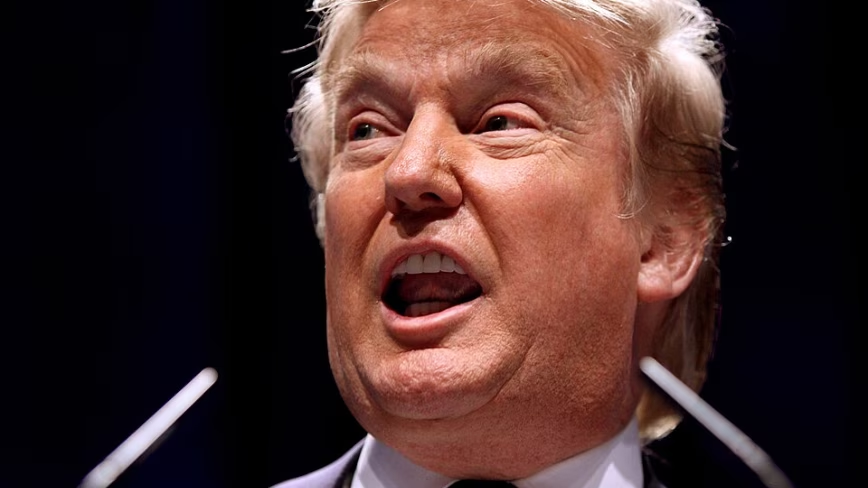
Image: courtesy of Thenextweb
The Great AI Deregulation: Trump Replaces Hard Safety Rules With a Polite Request
The era of aggressive federal oversight for artificial intelligence has ended not with a legislative showdown, but with a quiet stroke of a pen. President Trump has signed a downsized executive order on artificial intelligence, systematically dismantling the strict reporting requirements established by his predecessor. In their place, the new directive establishes a highly permissive, voluntary system where AI developers are merely asked to submit their most powerful models to the government for a 30-day review before releasing them to the public. There are no fines for non-compliance, no mandatory audits, and no threat of legal action for companies that choose to keep their code behind closed doors. This move marks a profound shift in how Washington intends to handle the most disruptive technology of the decade. By replacing federal mandates with a polite request, the administration is betting that the path to American dominance in AI lies in raw speed rather than precautionary guardrails. Washington has decided that the race against foreign adversaries is too urgent to be slowed down by federal red tape.
Outlook
Background
To understand why this shift is happening now, one must look at the changing of the guard in both Washington and Silicon Valley. The previous policy was built on the concept of "existential risk"—the idea that advanced AI could pose a threat to humanity if not strictly controlled from its inception. The current administration views that perspective with deep skepticism, treating it as a distraction from the real geopolitical race. The prevailing logic in the White House today is simple: the greatest threat to American security is not a rogue AI, but a Chinese AI. By removing the friction of federal compliance, the administration hopes to unleash a wave of private-sector innovation that will keep American technology ahead of state-subsidized competitors in Beijing. If a company must spend millions of dollars and months of engineering time proving to federal bureaucrats that its model is safe, that is time and capital not spent scaling up compute power. This deregulation represents a major victory for a specific coalition of Silicon Valley venture capitalists and open-source advocates who spent the last two years lobbying against heavy-handed rules. They argued that strict laws only served to protect wealthy incumbents while choking off the startups trying to challenge them. However, this hands-off approach introduces a distinct set of vulnerabilities. By relying on voluntary submissions, the government is essentially operating blind.
See also
Precedents
This is not the first time Washington has blinked when confronted with a powerful new technology. The structure of this new executive order closely mirrors the early days of commercial internet regulation in the late 1990s. During the Clinton administration, policymakers faced a choice: regulate the nascent World Wide Web to protect consumer privacy and prevent monopolistic behavior, or let it grow unchecked. The government chose the latter, codifying this hands-off approach through Section 230 of the Communications Decency Act. That decision allowed American tech giants to grow into the most valuable corporations on earth, but it also created the systemic privacy, misinformation, and antitrust challenges that governments are still struggling to resolve thirty years later. A more recent parallel can be found in the voluntary cybersecurity frameworks established by the Obama administration in 2014. Rather than forcing critical infrastructure operators—like power grids and water treatment plants—to adopt strict cybersecurity standards, the government created a voluntary framework. While the framework was widely praised for its technical merits, actual adoption was highly uneven. It took a series of devastating ransomware attacks on pipelines and food supply chains years later to force a realization that voluntary compliance rarely suffices when profit motives conflict with public safety. By reverting to a voluntary model for AI, the federal government is repeating a familiar playbook.
This policy shift directly impacts the financial survival and capital allocation strategies of the AI industry. Building state-of-the-art models has become an incredibly expensive game, with training costs soaring toward $1 billion per run by 2026. Venture capitalists are no longer writing blank checks; they want to see real profits and fast deployments rather than vague promises of artificial general intelligence. Under the old rules, a single safety audit could freeze a product for six months, costing a company millions in idle computing power and lost market share. By removing these regulatory speed bumps, the government is effectively giving tech companies a massive, indirect financial boost. However, it also means national security agencies are now flying blind, stripped of their early-warning system for dangerous new capabilities. Inside the Pentagon and the intelligence community, reaction is deeply divided. Some officials believe that a thriving, unregulated domestic AI ecosystem will naturally produce the best tools for national defense. Others are quietly alarmed, warning that without mandatory reporting, the government has lost its radar system for detecting dangerous capabilities before they are distributed globally.
Scenarios
AnalysisThe transition to a voluntary federal review process will trigger a series of cascading effects across the political and technological landscape. Two primary scenarios are likely to play out over the coming eighteen months.
Scenario 1: The Emergence of a "Quid Pro Quo" Alliance
Without the force of law, the 30-day review process will become a transactional tool. Elite AI labs will not submit their models out of civic duty; they will do so in exchange for lucrative federal contracts, access to government-held datasets, or expedited visas for foreign engineering talent. In this scenario, a two-tiered ecosystem emerges. A select group of "trusted partners" will voluntarily submit to government reviews to secure high-value defense and intelligence contracts. Meanwhile, consumer-focused startups, ad-tech companies, and foreign-backed developers will ignore the voluntary system entirely, creating a vast, parallel AI market that operates completely outside of federal oversight. This would leave the government with deep visibility into a few cooperative firms, but completely blind to the rest of the industry.
Scenario 2: The Rise of State-Level and International Friction
The federal government's retreat from AI regulation will create a power vacuum that other jurisdictions will rush to fill. California, which narrowly avoided passing the sweeping SB 1047 safety bill in 2024, will likely revive and pass even stricter state-level mandates. Because the vast majority of AI developers are headquartered in San Francisco and Silicon Valley, California could become the de facto regulator for the entire nation. Simultaneously, the European Union will likely enforce its AI Act with renewed vigor, viewing the US retreat as a threat to global safety. American companies wishing to operate globally will find themselves caught in a frustrating paradox: freed from federal oversight at home, but forced to redesign their systems to comply with a fragmented patchwork of strict state and international laws.
Timeline
Frequently Asked Questions
Discussion
Be the first to share your thoughts.