
We are moving away from the era of 'prompt engineering' where filmmakers hope for the best from a text box. Expect to see a new standard where 3D artists use familiar lighting and rigging tools to guide AI models. This shift prioritizes deterministic control over the chaotic, hallucinatory outputs currently common in consumer-grade generators. The goal is to make AI a sophisticated texture and lighting engine rather than a random director. Professionals will soon treat AI as a tool for efficiency rather than a black box that spits out unpredictable results. Control is the new currency.
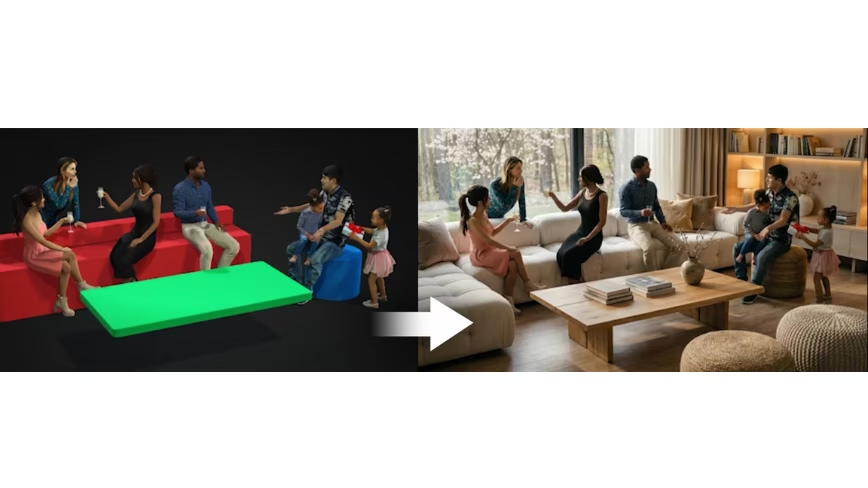
Image: courtesy of Thenextweb
Why Hollywood is betting on directed 3D over the prompt machine
The generative AI industry is currently split between text-based dreaming and rigid 3D precision. Reallusion is leading a push to keep filmmakers in the driver's seat by forcing AI to obey the laws of 3D spatial logic.
Outlook
Background
The primary problem with current text-to-video models is their inability to maintain spatial consistency. If a character moves between rooms, the AI often forgets the layout of the house, breaking the viewer's immersion. Reallusion is positioning itself as the vital middleware for independent professionals who need to manage intellectual property without massive VFX budgets. While giants like OpenAI focus on simplicity for the masses, the film industry requires precision. Studios simply cannot afford to have characters shifting their appearance or environments warping mid-scene. This is the difference between a novelty project and a professional production.
See also
Precedents
This transition mirrors the transition from command-line computing to graphical user interfaces in the 1990s. Before digital compositing tools like After Effects arrived, filmmakers were stuck with either primitive practical effects or prohibitively expensive hardware-locked systems. Just as the mouse and cursor made design accessible to non-programmers, 3D-directed AI is turning cinematography into a task of active manipulation. We are witnessing the maturation of a medium where the 'command line'—or the text prompt—is being replaced by visual, spatial interfaces. History shows that when professional tools become more accessible, the industry standard shifts entirely.
The stakes involve the very nature of creative intent in modern media. High-end advertising and cinema demand absolute control over every frame to ensure brand consistency and narrative flow. If a studio cannot guarantee that a character's face remains identical across multiple shots, they cannot use the footage. By grounding AI in 3D frameworks, producers reclaim the ability to dictate the final output rather than acting as mere curators of AI-generated luck. This shift ensures that creativity stays with those who understand spatial design and world-building.
Scenarios
AnalysisFirst, the role of the 'prompt engineer' will likely fade, replaced by the rise of the 'AI Technical Director' who understands 3D rigging and scene architecture. Second, studios will pivot their value proposition toward owning proprietary 3D asset libraries, which act as the 'seeds' for future AI models, effectively creating a new asset class for IP. Third, the persistent visual glitches and 'uncanny' errors that plague current AI video will likely diminish as spatial constraints force the models to stay within logical bounds, opening the door for mainstream film adoption.
Timeline
Next 12 months
Rise of the AI Technical Director
Professional studios begin hiring specialized talent capable of bridging the gap between 3D animation rigs and AI generation.
18-24 months
Mainstream Visual Integration
The decline of AI-induced spatial glitches allows for the integration of generative AI into mainstream television and film productions.
Frequently Asked Questions
Not for casual use, but it is effectively dead for professional, long-form storytelling where spatial logic and character consistency are non-negotiable requirements.
Discussion
Be the first to share your thoughts.