
On August 3, 2026, Microsoft will launch Project Perception into public preview, making its agentic security system available to a broader audience. This initial release will allow organizations to begin experimenting with AI agents that can autonomously hunt for vulnerabilities, investigate potential threats, and remediate security flaws within their networks. Users should expect a system designed to augment, rather than replace, human security operations, focusing on the speed and scale that AI can bring to defense. Early adopters will likely provide critical feedback, shaping the system's development as Microsoft pushes to integrate AI deeper into its security offerings.
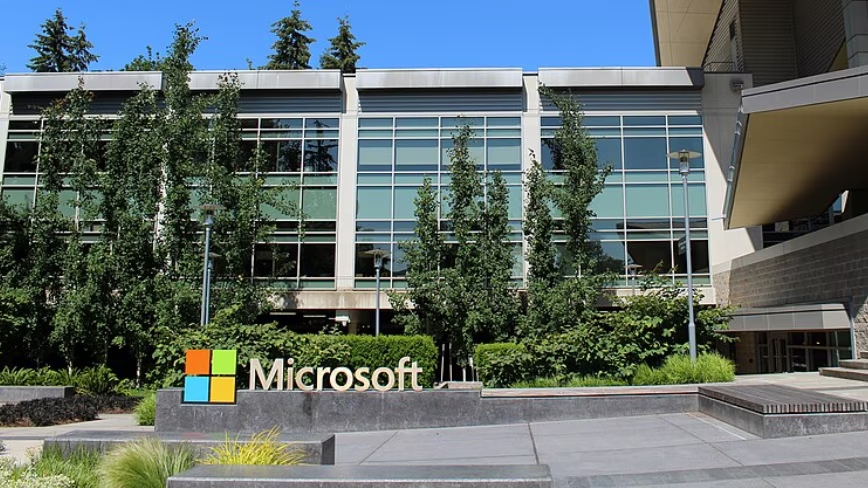
Image: courtesy of Thenextweb
Microsoft's AI 'Red, Blue, Green Team' System: What It Changes for Cyber Defense
Microsoft is rolling out Project Perception, an AI-powered cybersecurity system designed to defend against increasingly sophisticated AI-driven attacks. The system employs specialized AI agents, dubbed 'red, blue, and green teams,' which work together to identify vulnerabilities, assess risks, and automatically apply fixes. This marks a significant shift towards autonomous cyber defense, with the public preview set for August 3, 2026.
Outlook
Background
The cybersecurity landscape has been in a constant arms race between attackers and defenders. For years, human security teams have battled against increasingly automated threats, often struggling with the sheer volume and speed of attacks. The rise of advanced artificial intelligence has only accelerated this challenge, making it possible for malicious actors to launch more complex, adaptive, and rapid assaults. Microsoft's introduction of Project Perception, announced on July 27, 2026, represents a direct response to this evolving threat. The company is positioning the system not just as an incremental update, but as a foundational shift: fighting AI with AI.
Project Perception is built around the concept of 'agentic security,' where multiple specialized AI agents collaborate to perform tasks traditionally handled by human security professionals. Microsoft confirmed three initial types of agents: 'red team' agents that proactively seek out system weaknesses and potential attack paths; 'blue team' agents that monitor networks, detect suspicious activity, and triage risks; and 'green team' agents that automatically apply corrective actions and harden defenses. This 'closed-loop' system is designed to operate with minimal human intervention, continuously learning and adapting to new threats. Early results cited by Microsoft include the discovery of 16 new vulnerabilities across Windows networking and authentication components, four of which were critical remote code execution flaws, before the system even reached public preview. This suggests the technology has already demonstrated a tangible ability to uncover deep-seated issues that human-led efforts might miss or take longer to find.
See also
Precedents
The history of cybersecurity is marked by cycles of innovation in attack met by innovation in defense. In the early days, defense largely relied on signature-based detection, identifying known malware. As threats evolved, so did defenses, moving to heuristics, behavioral analysis, and eventually, machine learning-driven anomaly detection. Each step has aimed to reduce the time between attack and detection, and between detection and remediation.
Microsoft's Project Perception aligns with this historical trajectory but represents a significant leap in autonomy. Previous generations of security tools often provided data and alerts for human analysts to interpret and act upon. While powerful, these tools still relied on human speed and judgment. Project Perception, by contrast, is designed to automate the entire cycle—from vulnerability discovery to patching—at machine speed. This parallels the broader trend in software development towards 'DevSecOps,' where security is integrated throughout the development lifecycle, and the push for 'self-healing' systems.
Looking back, the industry has seen similar shifts, such as the move from manual penetration testing to automated vulnerability scanners, or from human-intensive security operations centers (SOCs) to those augmented with Security Information and Event Management (SIEM) systems and Security Orchestration, Automation and Response (SOAR) platforms. Project Perception takes this automation a step further, empowering AI itself to not just flag issues, but to actively probe, analyze, and fix them. This move is not entirely new in concept; the idea of autonomous agents in cybersecurity has been discussed in academic and research circles for years, but Microsoft's announcement marks a major commercial deployment by a dominant industry player, signalling that the technology is maturing enough for enterprise use.
The introduction of Project Perception changes the fundamental calculus of cybersecurity. For years, the advantage in speed and scale often lay with attackers, who could leverage automation to probe vast networks for weaknesses, while defenders, typically human teams, struggled to keep pace. Microsoft's agentic security system aims to level that playing field, or even tip it in favor of defenders, by matching AI-driven attacks with AI-driven defense.
This has several critical implications. First, it could dramatically reduce the 'dwell time' of sophisticated threats—the period an attacker remains undetected within a network. Faster detection and autonomous remediation mean less time for attackers to cause damage, exfiltrate data, or establish persistent footholds. Second, it shifts the role of human security professionals. Instead of manually sifting through alerts and performing routine tasks, these teams may be freed to focus on more complex strategic analysis, incident response for truly novel threats, and managing the AI systems themselves. This implies a need for new skill sets within cybersecurity, moving towards AI oversight and engineering.
For businesses, the promise is a more resilient and cost-effective defense. Reducing the reliance on human-intensive, round-the-clock monitoring could lower operational costs while improving security posture. However, it also introduces new risks: the potential for AI errors, misconfigurations, or even the possibility of the defense AI itself being compromised. The integrity and reliability of these autonomous systems will become paramount.
Ultimately, Project Perception represents a major escalation in the AI cybersecurity arms race. It signals that major vendors are moving beyond AI assistance in security to AI autonomy. This shift could redefine what is possible in cyber defense, forcing both attackers and other defenders to adapt to a new era where machines are not just tools, but active participants in the fight.
Scenarios
AnalysisThe deployment of Project Perception could lead to several distinct outcomes for the cybersecurity industry and its stakeholders.
One likely outcome is a significant acceleration in the speed of vulnerability discovery and patching. With AI agents autonomously hunting for flaws and applying fixes, organizations using Project Perception may experience a reduced attack surface and quicker response times to newly identified weaknesses. This could force attackers to develop even more sophisticated, zero-day exploits that are harder for AI to predict or detect, further intensifying the AI arms race. It also suggests that human security teams will need to evolve their roles, focusing less on reactive tasks and more on strategic threat intelligence, AI system management, and handling truly novel, unpredicted attacks that autonomous agents might initially miss.
Another potential outcome is a fragmentation of the cybersecurity market. As Microsoft brings its considerable resources to bear on agentic security, other vendors will be compelled to develop similar autonomous AI defense capabilities or risk being left behind. This could lead to a proliferation of competing AI defense systems, each with its own strengths and weaknesses, and potentially interoperability challenges. Organizations might find themselves navigating a complex ecosystem of AI tools, requiring new expertise to integrate and manage them effectively. Furthermore, the effectiveness of these systems will depend heavily on the quality and diversity of the data they are trained on, raising questions about data sharing, privacy, and the potential for 'blind spots' if training data is biased or incomplete.
Finally, there is a speculative outcome where the widespread adoption of such agentic systems could fundamentally alter the economics of cybercrime. If automated defenses become highly effective at mitigating common attack vectors, the cost and effort required for successful attacks may increase, potentially deterring less sophisticated threat actors. However, it could also push highly capable state-sponsored or well-funded criminal groups to invest even more heavily in offensive AI, leading to a more intense, AI-on-AI conflict where the stakes for system integrity and data security are higher than ever.
Timeline
2026-07-27
Microsoft Unveils Project Perception
Microsoft officially announced Project Perception, its new AI cybersecurity system, in response to the growing threat of AI-driven attacks. The system was detailed as an 'agentic security system' utilizing 'red, blue, and green team' AI agents.
2026-07-27
Initial Vulnerability Discoveries Announced
On the same day as the unveiling, Microsoft confirmed that its new agentic security system helped researchers find 16 new vulnerabilities, including four Critical remote code execution flaws, within Windows networking and authentication components.
2026-08-03
Project Perception Public Preview Begins
Microsoft will launch Project Perception into public preview, making the AI-powered cybersecurity system available for broader testing and adoption by organizations.
Frequently Asked Questions
Agentic security refers to a system where multiple specialized AI programs, or 'agents,' work together autonomously to perform security tasks. Instead of a single AI model, it's a team of AIs, each with a specific role, collaborating to achieve a larger security objective, such as finding vulnerabilities or responding to threats.
Discussion
Be the first to share your thoughts.