
Public market life will immediately force SpaceX to alter how it communicates its progress and manages its capital. Every launch delay, every regulatory dispute with the Federal Aviation Administration, and every Starlink subscriber fluctuation will now translate directly into stock price volatility. Analysts suggest that the company's executive team will face immediate pressure to clearly separate the highly profitable Starlink business from the capital-intensive Starship development program. This implies a looming corporate governance struggle as institutional investors demand predictable returns. Over the next twelve months, SpaceX is expected to report its first full-quarter public earnings, which will force the company to open its books and reveal the exact margins of its satellite operations. This disclosure will likely show whether the high valuation is justified by current cash flows or if it rests entirely on future promises. The era of private secrecy is over. Shareholders will now have a direct say in how the company allocates its vast resources.
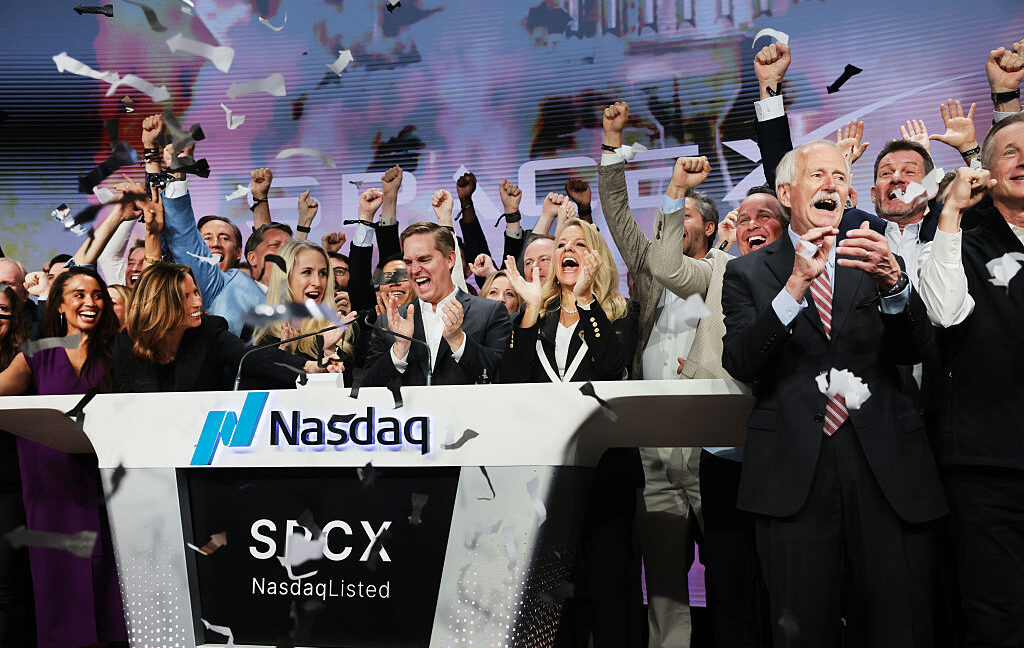
Image: courtesy of Ars Technica
Wall Street Just Valued SpaceX as an AI Powerhouse. Now Comes the Reality Check.
On June 12, 2026, SpaceX completed its highly anticipated transition to the public markets, closing its first day of trading at a valuation that places it among the world's most valuable corporations. Rather than being priced simply as an aerospace manufacturer or a satellite internet provider, the company is trading at a steep premium driven by its perceived role in the global artificial intelligence infrastructure. Investors are pricing in its potential to serve as the physical backbone for low-latency data transmission, orbital edge computing, and real-time planetary monitoring. This public debut marks a turning point for the enterprise, shifting it from a closely held private kingdom to a public entity subject to relentless quarterly scrutiny.
Outlook
Background
The financial engine of SpaceX has long been a black box to the public. Private funding rounds, which valued the company at roughly $210 billion prior to the listing, allowed management to run the enterprise with minimal public disclosure. The decision to list shares publicly indicates that the capital requirements of the Starship program and the planned Mars missions have outgrown the capacity of private venture capital. By positioning Starlink not just as an internet service provider but as a global data highway for artificial intelligence, the company has tapped into a vast pool of public market liquidity. This orbital network, consisting of thousands of active satellites, could serve as a low-latency routing system for distributed AI workloads, especially for real-time applications in autonomous logistics, defense, and maritime operations. The infrastructure is already in place. However, the technical challenge of integrating high-performance computing hardware into lightweight, power-constrained satellites remains a significant bottleneck. This suggests that the transition to a true orbital AI network will require years of additional engineering and billions in capital expenditure.
See also
Precedents
The market's treatment of SpaceX mirrors the valuation patterns seen during Tesla's rapid market ascent in 2020 and 2021. During that period, public markets valued the automaker not on its car manufacturing margins, but on its potential as an autonomous driving and robotics platform. Similarly, Nvidia's transition from a graphics chip designer to the foundation of the AI hardware market shows how quickly Wall Street will re-rate a company if it can position itself as an essential infrastructure provider. However, historical precedents also suggest that maintaining an AI premium requires continuous, high-margin revenue growth. If SpaceX cannot quickly monetize its orbital data and edge-computing capabilities, its valuation may experience a sharp correction, similar to the hardware pullbacks seen in previous technology cycles. The hype cycle is a powerful force, but it eventually bows to cash flow. Companies that fail to turn technological excitement into concrete earnings typically see their stock prices drop by half when the market's mood shifts.
The core tension of this public listing lies in the fundamental misalignment between long-term engineering ambitions and Wall Street's short-term financial expectations. The stated goal of SpaceX leadership has always been the colonization of Mars, an endeavor that requires hundreds of billions of dollars in capital expenditure with no clear timeline for financial return. Public investors, by contrast, operate on quarterly horizons, seeking margin expansion and capital returns through share buybacks or dividends. How does a public company balance the costs of building a fleet of reusable rockets for an unpopulated planet while satisfying retail and institutional investors who bought shares based on AI-driven data margins? This conflict suggests that SpaceX may eventually face pressure from activist investors seeking to spin off Starlink into a separate, pure-play utility company, leaving the speculative rocket development program as a privately held entity once again. Mars does not have a business model. This reality will test the patience of even the most optimistic public shareholders over the coming decade.
Scenarios
AnalysisOne possible outcome is the successful deployment of edge-computing hardware across the Starlink constellation, allowing real-time AI processing to occur in orbit. This would reduce data transmission latency for global enterprise clients, generating high-margin software-like revenue. This outcome suggests that the AI premium would be fully validated, providing the company with a steady stream of capital to fund its deep-space exploration programs without diluting existing shareholders.
Another potential scenario is that the immense operational costs of the Starship program overwhelm the profits generated by Starlink. If the development of the Mars-class vehicle suffers from prolonged technical delays or regulatory bottlenecks, the company's capital expenditure could exceed its cash flow. This would likely force SpaceX to seek dilutive capital raises, leading to a decline in its stock price as public investors realize that the high-margin AI business is being used to subsidize an expensive, long-term aerospace project.
A third outcome involves intense regulatory and shareholder scrutiny over transactions between SpaceX and other entities controlled by its leadership, particularly xAI and Tesla. If SpaceX provides discounted data services or computing resources to these sister companies, public shareholders may file lawsuits alleging a breach of fiduciary duty. This could lead to forced restructuring, operational silos, or independent oversight of the company's commercial contracts.
Timeline
Frequently Asked Questions
Discussion
Be the first to share your thoughts.