
Over the next two years, the private sector in Dubai is expected to undergo a rapid transformation as thousands of companies begin to integrate agentic AI into their operations. This will likely involve a surge in demand for specialized AI talent, new business models emerging around autonomous tasks, and a concerted effort by Dubai Chambers to provide ongoing support and resources. We can anticipate pilot programs, success stories, and, inevitably, challenges as businesses grapple with the complexities of deploying AI agents at scale. The 2028 deadline sets a clear benchmark for evaluating the initiative's success, which will be measured not just by the number of trained companies, but by the tangible economic impact and the city's perceived leadership in this specific AI domain.
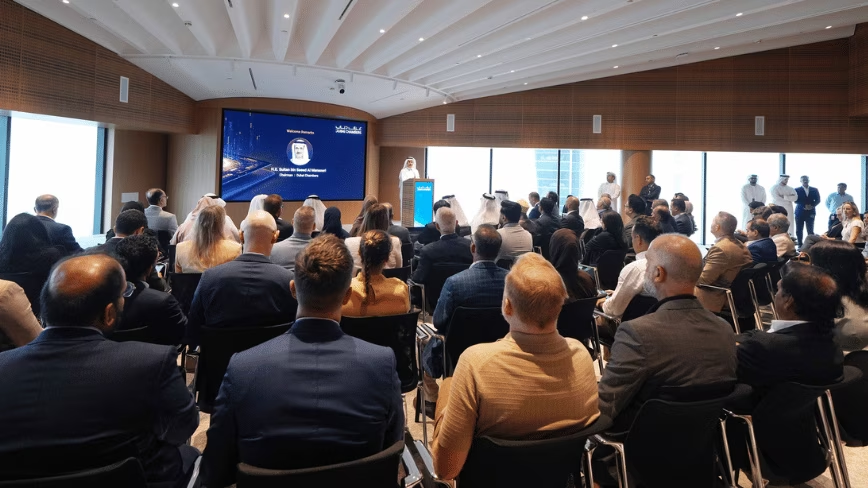
Image: courtesy of Thenextweb
Dubai's AI Agent Ambition: Can 14,000 Companies Reshape a Global Tech Race?
Dubai has launched an ambitious initiative to train over 14,000 private sector companies in 'agentic AI' within two years, with the explicit goal of becoming a global leader in the commercial adoption of this autonomous software by 2028. The program, spearheaded by Dubai Chambers, aims to equip businesses with the skills to deploy AI agents that can perform tasks independently, moving beyond traditional AI that merely answers questions. This move represents a significant push to diversify Dubai's economy and establish its position at the forefront of the next wave of artificial intelligence integration.
Outlook
Background
The announcement, made on September 7, 2026, detailed that Dubai Chambers began its specialized Agentic AI training program on September 1, 2026. The program is designed for more than 14,000 private sector entities. Agentic AI refers to a class of artificial intelligence systems capable of executing tasks autonomously, often interacting with other systems or data sources without constant human intervention. Unlike generative AI, which primarily responds to prompts or creates content, agentic AI can take initiative and perform a sequence of actions to achieve a defined objective. Dubai’s stated aim is to achieve global leadership in the commercial application of this technology by 2028. This initiative arrives at a moment when the broader AI industry is still grappling with the practicalities and ethical implications of increasingly autonomous systems. Industry analysts like Gartner have noted that a significant percentage, around 40%, of similar large-scale technology adoption programs face cancellation. Gartner also observes that many vendors currently marketing AI agents also offer other, less specialized AI solutions, suggesting a still-nascent market for purely agentic tools.
See also
Precedents
Dubai has a well-established history of launching ambitious, large-scale projects aimed at rapid economic diversification and global leadership in specific sectors. From developing world-class tourism infrastructure to establishing itself as a financial hub and a logistics gateway, the city-state has consistently pursued strategic investments to reshape its economy. These initiatives often involve significant government backing, targeted training programs, and the creation of specialized free zones to attract foreign investment and talent. Past efforts, such as the push into smart city technologies or blockchain adoption, have seen varied degrees of success, but they consistently demonstrate a willingness to invest heavily and move quickly. The current AI agent initiative follows this pattern: a clear, aggressive timeline, a specific technological focus, and the backing of a key government-affiliated entity like Dubai Chambers. Historically, such top-down directives can accelerate adoption, but they also face challenges in grassroots implementation, talent retention, and adapting to rapidly evolving global technological standards. The success of these past ventures has often hinged on Dubai's ability to attract international expertise and integrate it with local capabilities, a factor that will be crucial for this AI push.
Dubai's aggressive push into agentic AI is not merely another tech initiative; it represents a significant strategic pivot with implications for both the global AI landscape and the future of work. By focusing specifically on 'agentic' AI, Dubai is betting on a future where software can handle complex, multi-step tasks autonomously, potentially reshaping entire industries from logistics and finance to healthcare and customer service. If successful, this could establish Dubai as a critical testbed and innovation hub for autonomous enterprise applications, attracting further investment and talent. For the 14,000 companies involved, it offers a chance to gain a competitive edge by automating processes, reducing operational costs, and improving efficiency. However, the sheer scale of the program – 14,000 companies in two years – presents immense challenges. The practical implementation of AI agents requires not just technical training but also significant changes in organizational structures, data governance, and risk management. The Gartner observation about a 40% cancellation rate for similar programs highlights the inherent difficulties. This initiative will serve as a global case study on how effectively a government-backed mandate can drive advanced AI adoption across a diverse private sector, potentially offering lessons for other nations seeking to leverage AI for economic transformation.
Scenarios
AnalysisDubai's ambitious agentic AI program could lead to several distinct outcomes, each with its own set of consequences.
One possible outcome is that Dubai successfully entrenches itself as a leading global hub for commercial agentic AI adoption by 2028. This would involve a significant portion of the 14,000 targeted companies effectively integrating AI agents into their operations, demonstrating tangible benefits in efficiency and innovation. Such a success could attract further foreign direct investment into Dubai's tech sector, draw in specialized AI talent from around the world, and spur the creation of new AI-focused businesses within the emirate. This scenario would validate Dubai's top-down approach to technological transformation and could serve as a model for other economies.
Alternatively, the initiative might achieve partial success, with a notable but smaller number of companies fully adopting agentic AI, while others struggle with implementation. The sheer scale and speed of the program, coupled with the inherent complexities of AI deployment, could lead to uneven adoption rates. Some sectors or larger enterprises might integrate AI agents effectively, while smaller businesses or those with less digital maturity could face significant hurdles. In this scenario, Dubai would still gain valuable experience and some level of recognition in the AI space, but it might fall short of its 'global leader' ambition by 2028. The program could then require recalibration, focusing on more targeted support or extended timelines for specific industries.
A third outcome, though less likely given Dubai's historical commitment to strategic initiatives, is that the program encounters substantial operational and market resistance, leading to a significant portion of the efforts being scaled back or re-evaluated, aligning with Gartner's cautionary statistic. Challenges could include a shortage of skilled AI professionals, difficulties in integrating agentic AI with legacy systems, unforeseen ethical or regulatory issues, or a lack of immediate return on investment for participating companies. If this were to occur, Dubai might need to re-assess its approach, perhaps shifting focus to broader AI literacy or more foundational digital transformation, rather than the highly specialized agentic AI. This would represent a learning curve for the emirate, potentially delaying its aspirations for global AI leadership.
Timeline
Frequently Asked Questions
Discussion
Be the first to share your thoughts.