
This article explores the conflicting timelines surrounding solid-state battery development, examining why a leading battery manufacturer offers a more cautious outlook than some automakers. It will detail the specific challenges in scaling solid-state technology for mass production, compare it with alternative battery advancements like silicon anodes, and analyze the implications for consumers and the broader electric vehicle market.
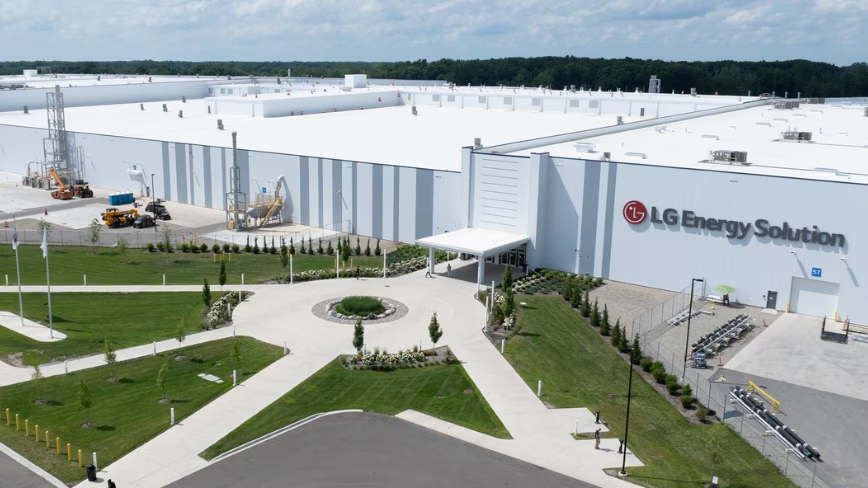
Image: courtesy of Thenextweb
Solid-State Battery Reality Check: Why a Decade-Long Wait May Still Be Optimistic for Mass EV Adoption
While automakers like Stellantis and Mercedes-Benz announce aggressive timelines for solid-state batteries, LG Energy Solution, a major battery producer that recently opened a new plant in the U.S., suggests that widespread adoption of solid-state electric vehicles is still a decade away. This creates a significant gap between industry aspirations and the complex realities of large-scale manufacturing, indicating that technical breakthroughs do not automatically translate into immediate market availability.
Outlook
Background
The promise of solid-state batteries has long captivated the electric vehicle industry. These next-generation power packs are expected to offer significantly longer range, faster charging times, and enhanced safety compared to current lithium-ion batteries. Automakers have been eager to claim leadership in this space, with Stellantis publicly stating its plan to release a solid-state battery in 2026, and Mercedes-Benz having already tested the technology in 2025. Toyota, a long-time researcher in the field, announced in 2022 that it had developed a solid-state battery capable of charging from 10% to 80% in just 10 minutes and delivering 620 miles of range, with expectations for 'these batteries' by the late 2020s. Volkswagen, through its partnership with Gotion, is also reportedly moving from a pilot phase to designing a 2-gigawatt-hour solid-state battery production line. General Motors, which opened a new battery plant in 2024, has partnered with SES to build a prototype assembly line for its Ultium system, aiming to address affordability and range barriers.
Yet, a more grounded perspective emerged this week from LG Energy Solution, a key player in battery manufacturing. The company, fresh off opening its own new U.S. plant, predicts that solid-state electric vehicles are still a decade away from broad market presence, with widespread adoption not expected until 2036. This assessment from a company deeply invested in the practicalities of battery production and scaling offers a stark counterpoint to the more optimistic pronouncements from some carmakers. The core of LG's caution lies in the formidable challenges associated with bringing solid-state technology from laboratory breakthroughs to reliable, cost-effective, and high-volume manufacturing.
See also
Precedents
The history of automotive innovation is replete with examples where groundbreaking technologies took far longer to reach mass market adoption than initial projections suggested. From anti-lock brakes to hybrid powertrains, the gap between proof-of-concept and widespread commercial viability is often measured in decades, not years. This pattern is particularly evident in battery technology. Early lithium-ion batteries, while revolutionary, faced years of refinement and cost reduction before becoming standard in consumer electronics, let alone electric vehicles. The transition from nickel-metal hydride to lithium-ion in hybrid cars, for instance, was a gradual evolution driven by manufacturing efficiencies and supply chain development, not just scientific discovery.
In the EV sector specifically, breakthroughs in energy density or charging speed often generate significant media attention, but the subsequent hurdles of scaling production, ensuring consistent quality, navigating complex supply chains for new materials, and meeting stringent automotive safety standards are frequently underestimated. Regulatory frameworks, recycling infrastructure, and consumer acceptance also play critical roles in determining a technology's true adoption timeline. The current situation with solid-state batteries appears to follow this historical arc: initial success in controlled environments, followed by the immense challenge of industrialization.
The conflicting timelines for solid-state batteries are not just a technical debate; they represent a fundamental tension in the future of electric mobility and carry significant implications for consumers, investors, and the broader automotive supply chain. If LG Energy Solution's decade-long forecast proves accurate, it means that the 'next big thing' in EV batteries is still far off for the average car buyer, tempering expectations that have been building for years.
For consumers, this suggests that the dramatic improvements in range and charging speed often associated with solid-state technology will not be available in mainstream vehicles for quite some time. Instead, buyers will continue to see incremental advancements in existing lithium-ion and potentially silicon anode chemistries. This delay could influence purchasing decisions, with some consumers perhaps holding off on an EV purchase in anticipation of future solid-state models, while others might prioritize the current generation of EVs knowing that a major leap is still distant.
For automakers, the discrepancy highlights the pressure to innovate versus the reality of production. Companies like Stellantis, Mercedes-Benz, and Toyota are investing heavily, but their ability to deliver on ambitious timelines will depend on overcoming engineering and manufacturing bottlenecks that LG, as a pure-play battery maker, understands intimately. The capital allocation decisions involved in building new plants and retooling existing ones for a different battery chemistry are enormous, and a miscalculation could be costly.
Furthermore, the focus on solid-state batteries might overshadow more immediate advancements. Sila's silicon anode technology, which is already in production for high-end applications like the McMurtry Spéirling hypercar, offers an evolutionary step that can improve range and charging today. This suggests that while solid-state remains the long-term goal, nearer-term innovations will continue to drive the EV market forward in the interim, potentially blurring the lines of 'breakthrough' in the eyes of the public.
Scenarios
AnalysisThe path forward for solid-state batteries, and the broader EV market, presents several possible outcomes, each with distinct implications for the industry and consumers.
One possible outcome is that LG Energy Solution's cautious forecast proves accurate, and solid-state batteries remain a niche technology for high-performance or specialized applications for the next five to seven years. In this scenario, significant breakthroughs in cost reduction and large-scale manufacturing techniques would be required before widespread adoption by 2036. This would mean that the market continues to rely heavily on improved lithium-ion chemistries and technologies like silicon anodes, which offer more immediate, albeit less dramatic, performance gains. Automakers would then face sustained pressure to differentiate their EVs through other means, such as software, charging infrastructure, or vehicle design, rather than relying on a 'silver bullet' battery technology.
Alternatively, some automakers or specialized battery developers could achieve limited commercial production of solid-state batteries for specific models much sooner than LG suggests, perhaps by the late 2020s. While this would not constitute 'widespread adoption,' it could create a premium segment for solid-state EVs, similar to how early electric cars were positioned. Companies like Stellantis, with its 2026 target, or Toyota, with its late 2020s expectations, might introduce select models featuring the technology, even if production volumes are initially low and costs are high. This would allow them to gain a first-mover advantage and refine their manufacturing processes, gradually increasing availability over time. However, it would still leave the mass market waiting for the broader cost and production efficiencies that LG projects will take a decade.
A third outcome could see a 'hybrid' approach, where solid-state components are integrated into existing battery architectures in stages, rather than a complete overhaul. This could involve solid-state electrolytes being combined with traditional electrodes, offering some benefits without demanding a full re-engineering of the entire battery cell and production line. This incremental integration might accelerate some of the benefits of solid-state technology without the decade-long wait for a fully solid-state pack, potentially bridging the gap between current lithium-ion and the ultimate vision of a pure solid-state battery. This approach could offer a more manageable transition for manufacturers and supply chains, leading to a more gradual, but earlier, introduction of some solid-state advantages into the market.
Timeline
late 2010s
Toyota's Solid-State Research Begins
Toyota begins extensive research into solid-state battery technology.
late 2019
Toyota Unveils LQ Concept
Toyota showcases the LQ concept car, featuring a solid-state battery.
2022
Toyota's Solid-State Progress Announcement
Toyota announces development of a solid-state battery capable of 10-80% charge in 10 minutes and 620 miles range, with expectations for 'these batteries' by the late 2020s.
2024
GM Opens New Battery Plant
General Motors opens America’s newest battery plant, with a focus that includes solid-state batteries.
2025
Mercedes-Benz Tests Solid-State
Mercedes-Benz conducts tests on solid-state batteries.
2026
Stellantis Solid-State Goal
Stellantis plans to release a solid-state battery.
August 22, 2026
LG Energy Solution's Decade Forecast
LG Energy Solution's new U.S. plant predicts solid-state cars are a decade away from broad adoption.
2036
LG's Broad Adoption Estimate
LG Energy Solution projects broader adoption of solid-state batteries by this year.
Frequently Asked Questions
Solid-state batteries are a type of battery technology that uses solid electrodes and a solid electrolyte, unlike traditional lithium-ion batteries which use liquid or gel electrolytes. This design promises increased energy density (more range), faster charging, and improved safety by reducing the risk of leaks or fires.
Discussion
Be the first to share your thoughts.