
The 'Mission Efficiency' concept, presented yesterday, is more than just a showcase of Volkswagen's engineering prowess; it represents a strategic pivot in how automakers could approach electric vehicle development. For consumers, this means future EVs might prioritize sleek, aerodynamic designs and lightweight materials over the brute force of massive battery packs. The immediate expectation is not that the Mission Efficiency itself will roll off assembly lines in its current form, but rather that its core principles — extreme aerodynamic optimization and a relentless focus on reducing energy consumption — will trickle down into Volkswagen's broader ID. lineup. This suggests that upcoming models built on the MEB+ platform, or its successors, will likely incorporate design elements and technical solutions proven in this concept. The question for many remains how much of this record-breaking efficiency can be realistically translated into vehicles that meet diverse consumer needs for space, styling, and cost, especially given the concept's length and potential limitations for urban driving or European incentive eligibility.
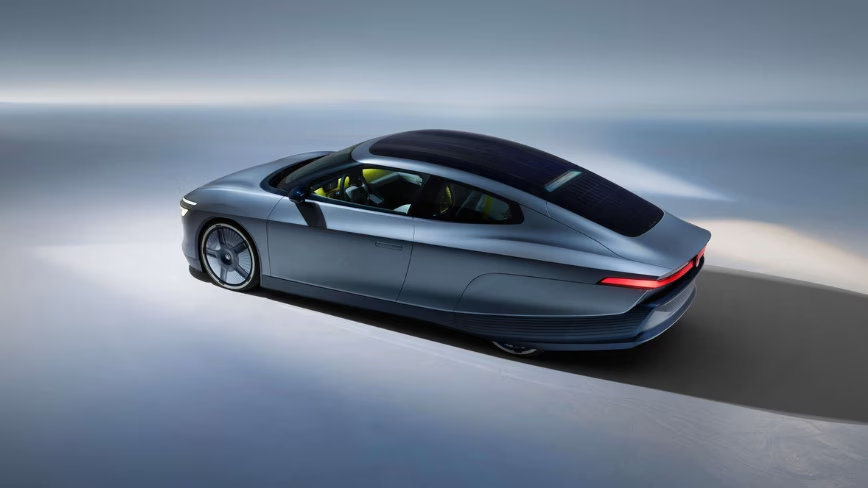
Image: courtesy of Thenextweb
Volkswagen's Record-Breaking EV Concept: What 'Near-Production' Actually Means for Your Next Car
Volkswagen unveiled its 'Mission Efficiency' concept car on September 14, setting new benchmarks for electric vehicle performance. The prototype achieved a record-low energy consumption of 6.48 kWh/100 km and a drag coefficient of 0.158, allowing it to travel over 870 miles on a single charge. Billed as a 'near-production' vehicle built on the existing MEB+ platform, the concept demonstrates how intelligent design focused on aerodynamics and weight reduction can significantly extend range without relying solely on larger, heavier batteries. While the technical achievement is clear, the path from this record-setter to a mass-market vehicle remains a complex question for Volkswagen and the broader automotive industry.
Outlook
Background
Volkswagen's Mission Efficiency concept secured three world records on September 14: for aerodynamics, energy consumption, and overall efficiency. The headline figure for energy consumption stands at an impressive 6.48 kWh per 100 kilometers. To put that into perspective, many current production EVs consume anywhere from 15 to 25 kWh/100 km, making Volkswagen's achievement a significant leap forward. This efficiency translates directly into a remarkable driving range, with the concept covering 1,278 kilometers (794 miles) on a single charge and still retaining 164 kilometers (102 miles) of range. That brings its total theoretical range to nearly 900 miles, far exceeding most production EVs today.
The second critical record is its drag coefficient (Cd) of just 0.158. The lower the Cd, the less air resistance a vehicle faces, directly impacting its efficiency at speed. For comparison, the most aerodynamic production cars currently hover around 0.20 to 0.23 Cd. Achieving 0.158 is an engineering marvel, typically seen only in purpose-built prototypes or land speed record attempts, not 'near-production' road vehicles.
Volkswagen states that the Mission Efficiency is built on standard MEB+ platform hardware. The MEB+ is an evolution of Volkswagen's modular electric drive matrix, a flexible architecture designed to underpin a wide range of electric vehicles. The fact that these record-breaking numbers were achieved using a production-ready platform, rather than exotic, bespoke components, is particularly noteworthy. It indicates that the gains come from intelligent design and optimization rather than entirely new, unproven technologies. The core strategy involved extreme aerodynamic shaping of the body and undercarriage, along with a focus on weight reduction, though specific weight figures were not immediately disclosed. This combination allows the car to slice through the air with minimal resistance and carry less mass, both critical factors in energy efficiency.
See also
Precedents
The automotive industry has a long history of using concept cars to push boundaries and signal future directions. From the sleek streamliners of the 1930s to the fuel-efficient prototypes of the oil crises, these vehicles often serve as laboratories for ideas that may or may not reach mass production. What often happens is that the radical design elements or extreme performance figures of a concept are toned down for commercial viability. Production cars need to balance aerodynamics with passenger comfort, cargo space, manufacturing costs, and regulatory requirements.
Historically, 'near-production' concepts can mean anything from a vehicle that is 80% ready for the assembly line to one that merely showcases a design language or a specific technology. Automakers often use such vehicles to gauge public and media reaction, refine engineering, and signal their strategic intent to competitors and investors. The journey from a record-setting prototype to a volume seller is fraught with trade-offs. Styling, for example, is often compromised for aerodynamic purity, which can be a tough sell in a diverse global market. Similarly, extreme weight reduction can come at the expense of premium materials or sound insulation, impacting the perceived quality and cost structure of a vehicle. The challenge for Volkswagen will be to distill the essence of Mission Efficiency's gains into vehicles that are both exceptionally efficient and broadly appealing.
The implications of Volkswagen's Mission Efficiency extend far beyond a single concept car; they challenge fundamental assumptions about electric vehicle design and the future of mobility. For years, the prevailing wisdom in the EV market has been that more range equals a bigger, heavier, and more expensive battery. This approach has led to a race for ever-larger battery packs, which in turn demands more raw materials, heavier vehicle structures, and longer charging times.
Volkswagen's achievement offers a compelling counter-narrative. By demonstrating that significant range can be achieved through superior efficiency — primarily via aerodynamics and weight reduction — it suggests a path to more sustainable, potentially more affordable EVs. If cars can achieve greater range with smaller batteries, it could alleviate pressure on critical raw material supply chains, reduce manufacturing costs, and lessen the strain on charging infrastructure, which is currently struggling to keep pace with EV adoption.
This shift in focus also has profound consequences for consumer adoption. Range anxiety, the fear of running out of charge, remains a significant barrier for many potential EV buyers. A vehicle capable of nearly 900 miles on a charge fundamentally alters that perception, making long-distance travel far more feasible and reducing the perceived need for ubiquitous fast-charging stations. Furthermore, higher efficiency translates to lower running costs for drivers, as less electricity is consumed per mile, making EVs even more economically attractive.
For the industry, this sets a new, aggressive benchmark. Competitors will now face increased pressure to innovate beyond battery size, forcing a deeper look into fundamental vehicle design. It could spark a new 'efficiency race,' where breakthroughs in aerodynamics, lightweighting, and powertrain optimization become as critical as battery chemistry.
Scenarios
AnalysisVolkswagen's 'Mission Efficiency' concept, while not a direct production model, suggests several potential shifts for the automaker and the wider industry.
One possible outcome is that Volkswagen will integrate key aerodynamic and lightweighting principles from the Mission Efficiency into its next generation of ID. vehicles, particularly those built on the MEB+ platform. This could mean a noticeable increase in the range and efficiency of future ID.3, ID.4, and other models without requiring significantly larger batteries. This approach would allow VW to offer more competitive range figures while potentially keeping costs down or even reducing the size and weight of battery packs, which has downstream benefits for handling and charging times.
Another scenario is that the concept could pave the way for a highly specialized, ultra-efficient production model. While the Mission Efficiency itself is reportedly not eligible for European incentives due to its length, a slightly modified version could be developed as a niche product aimed at consumers prioritizing maximum efficiency and range. This would serve as a halo car, showcasing Volkswagen's technical leadership and attracting a specific segment of eco-conscious buyers, much like early hybrid vehicles did for Toyota.
Beyond Volkswagen, the Mission Efficiency could intensify the competitive landscape among automakers. If VW can translate these efficiency gains into production, rival companies may be compelled to accelerate their own research and development into advanced aerodynamics and lightweight materials. This could lead to a broader industry trend where design and engineering become as crucial as battery technology in the race for EV dominance. The emphasis could shift from 'who has the biggest battery?' to 'who has the most efficient design?' ultimately benefiting consumers through more capable and sustainable electric vehicles across the market.
Timeline
Frequently Asked Questions
Discussion
Be the first to share your thoughts.