
Veridact
TechSportsFinanceGaming🎯 PredictionsAbout
Sign InSign Up
Veridact

AI-powered anticipation analysis. We cover tech, sports, finance, and gaming events before they happen — with historical context, scenario modeling, and evolving coverage.

Stay ahead of the story

Analysis delivered before events unfold.

Coverage

  • Tech
  • Sports
  • Finance
  • Gaming

Company

  • About Us
  • Privacy Policy

© 2026 Veridact. AI-assisted analysis platform.

Analysis is AI-generated and not professional financial, legal, or medical advice.

Tech
Why Apple built a third-party AI system for Siri and then refused to show it at WWDC

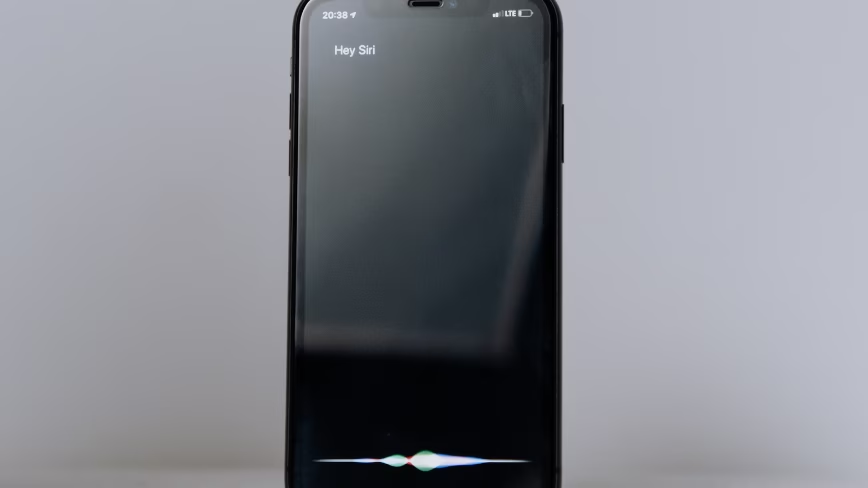
Image: courtesy of Thenextweb

techJune 15, 2026By Veridact EditorialUpdated Jun 15

The Invisible Gatekeeper: Inside Apple’s Decision to Hide Its Third-Party AI Engine

Apple's recent WWDC keynote conspicuously omitted a completed, internal architecture designed to route complex Siri queries to third-party AI models. This analysis explores the technical, commercial, and regulatory pressures driving Apple's decision to keep its multi-model gateway behind closed doors.

What to Expect

Apple spent months building a sophisticated digital switchboard designed to let Siri hand off complex tasks to external artificial intelligence models, only to lock it in a drawer when the lights went up at its annual developer conference.

At the Worldwide Developers Conference (WWDC) earlier this month, the tech giant showcased its customized in-house models and a highly controlled partnership with OpenAI. Yet behind the scenes, software engineers had already finalized a broader, model-agnostic infrastructure. This system was built to allow users to plug in almost any third-party model, from Google’s Gemini to Anthropic’s Claude, directly into the iOS core.

Why would a company under intense pressure to prove its AI capabilities build the exact tool Wall Street wanted—a seamless, open gateway to the world’s leading AI models—and then refuse to show it to the public?

The answer is not a story of technical failure. Instead, it is a calculated corporate retreat driven by platform economics, a looming regulatory checkmate in Europe, and a deep-seated fear of brand dilution. By holding back the multi-model gateway, Apple has chosen to prioritize platform control over immediate feature parity.

This decision reveals a profound tension at the heart of Apple's modern strategy. The company must balance the immediate demands of consumers who want state-of-the-art AI utilities with the long-term necessity of protecting the iOS ecosystem from being reduced to a mere distribution channel for other companies' intellectual property. For now, Apple is choosing to gatekeep.

Key Context

To understand why this third-party architecture remains hidden, one must look at how Apple has constructed its artificial intelligence stack. The system, known internally as the orchestration layer, acts as an intelligent traffic controller on the device. When a user asks Siri to perform a task, the orchestration layer must decide where that query is processed.

Simple tasks, such as scheduling a meeting or drafting a text message, are handled locally on the device using Apple’s lightweight, proprietary models. For more complex queries requiring broader contextual awareness, the system routes the request to Apple’s Private Cloud Compute, a custom server infrastructure built with Apple silicon designed to process data without compromising user privacy.

But there is a third tier. For open-ended creative tasks, complex coding help, or deep research, Apple’s own models lack the parameters and training depth of giant frontier models. This is where the third-party gateway comes in. The software architecture is designed to hand these queries off to external servers run by partners like OpenAI.

Confirmed details from developer sessions show that Apple has indeed built the APIs necessary to support this handoff. However, during the WWDC keynote, the company only announced a single, highly structured integration with OpenAI’s GPT-4o, presenting it as an opt-in, situational helper rather than a native, system-wide alternative to Siri.

This indicates that Apple is treating external AI models as temporary utilities rather than permanent platform partners. By refusing to show a system-wide model picker or an open API for third-party LLMs, Apple has kept the spotlight firmly on its own silicon and its own private cloud. This suggests a strategic hesitation: Apple wants the utility of external models, but it is not yet willing to grant them equal status on its premium hardware.

Related Coverage

Why Apple Might Put Cameras Into Its Next AirPods→Apple destroyed the mid-tier watch market. Now it’s coming for the $200 billion eyewear industry.→Apple is building a bill-splitting feature that photographs receipts and assigns items to friends→

Historical Patterns

This is not the first time Apple has faced the challenge of integrating a dominant external technology that it could not build fast enough itself. Two decades ago, Apple recognized that Google had built a superior search engine. Rather than spending billions to build a mediocre competitor, Apple made Google the default search engine on the iPhone.

That arrangement became one of the most lucrative partnerships in business history, with Google paying Apple an estimated $20 billion annually by 2022 to maintain its default status. However, that deal also created a massive vulnerability, leaving Apple open to federal antitrust lawsuits and tying its financial fortunes to a competitor's regulatory battles.

With generative AI, the dynamics are different and far more dangerous for Apple. Search is a destination; conversational AI is an interface. If an iPhone user begins using Gemini or ChatGPT as their primary conversational partner for everything from writing emails to planning trips, Siri becomes obsolete.

This historical precedent suggests that Apple is determined to avoid repeating the Google search model in the AI era. If Apple allows a third-party AI to become the default brain of the device, it risks losing its direct relationship with the user. The company’s historical playbook dictates that it must control the user interface, even if it has to rely on competitor technology under the hood. The hidden gateway was built to prevent any single AI provider from gaining the kind of leverage Google secured over search.

The decision to withhold the third-party AI gateway is not merely an aesthetic choice; it is a defensive maneuver in a battle over capital allocation and ecosystem sovereignty.

First, there is the matter of financial incentives. Under the current App Store model, Apple takes a 15% to 30% cut of digital subscriptions purchased through iOS. If a user signs up for ChatGPT Plus or Gemini Advanced, Apple wants its platform fee. However, the major AI developers are actively resisting these fees, arguing that the high compute costs of running LLMs make Apple’s traditional take-rate economically unfeasible. By keeping the third-party gateway hidden, Apple retains massive leverage in these negotiations. It can essentially tell OpenAI or Google that direct, system-level integration into iOS will only be unlocked once they agree to Apple’s revenue-sharing terms.

Second, the regulatory pressure is immense. In the European Union, the Digital Markets Act (DMA) strictly prohibits gatekeepers from self-preferencing their own services or locking out competitors. If Apple launches Siri with only OpenAI integrated, it faces immediate regulatory scrutiny and potential multi-billion-dollar fines for anti-competitive behavior.

By building a neutral, multi-model gateway behind the scenes, Apple has created a technical insurance policy. If regulators force the company's hand, Apple can quickly deploy the system-wide model picker, allowing European users to select their preferred AI provider upon device setup. This implies that the technology was built not for a grand consumer launch, but as a regulatory compliance tool to be deployed only under government duress.

Ultimately, a real person buying an iPhone 18 later this year will feel the weight of these corporate standoffs. They may find themselves with a device that is technically capable of running the world's best AI models seamlessly through Siri, but is artificially restricted to a basic, heavily guarded interface because two multi-trillion-dollar companies cannot agree on how to split a twenty-dollar subscription fee.

Potential Outcomes

Analysis

Analysis of Apple's current trajectory suggests three distinct paths for how this hidden architecture may eventually reach consumers.

One possible outcome is the 'Silent API Release' later this year. In this scenario, Apple could quietly release the third-party orchestration APIs to developers during the iOS 20 lifecycle, framing it as an advanced developer tool rather than a consumer feature. This would allow third-party apps to register as system-level AI assistants, satisfying regulatory demands in the EU while keeping the default Siri experience clean and Apple-branded in the rest of the world.

A second scenario is the 'Regulatory Choice Screen.' If European regulators reject Apple’s current single-partner approach with OpenAI, Apple may be forced to debut the third-party gateway as an explicit choice screen during the initial setup of new iPhones in Europe. Users would be prompted to select their primary AI model—similar to how European users are currently prompted to choose their default web browser. This would create a fragmented iOS experience, where iPhones in Paris offer a completely different AI core than iPhones in New York.

A third, more conservative outcome is a prolonged 'Negotiation Stand-Off.' If Apple cannot secure favorable revenue-share agreements with Google and Anthropic, it may choose to leave the gateway deactivated indefinitely. In this case, Apple would rely entirely on its own improving on-device models and its limited OpenAI partnership, betting that consumer loyalty to the Apple brand will outweigh any temporary performance gap between Siri and native third-party AI applications.

Timeline

June 2024
Apple Intelligence Announced
Apple introduces its initial AI strategy at WWDC 24, focusing on on-device processing and Private Cloud Compute.
Late 2025
The Orchestration Layer Secretly Finalized
Apple engineering teams complete the internal architecture for multi-model third-party routing.
June 2026
The WWDC Omission
Apple holds its keynote without demonstrating the multi-model gateway, opting to showcase only a controlled OpenAI integration.
September 2026 (Projected)
iPhone 18 Launch
Apple may introduce updated AI features, potentially forcing a decision on whether to unlock the hidden gateway.

Frequently Asked Questions

No. Internal engineering reports indicate the architecture is complete and fully functional. The decision to withhold it was strategic, driven by business negotiations and regulatory concerns rather than technical limitations.

Discussion

0/100
0/1000

Be the first to share your thoughts.

Related Coverage

tech

Why the Electric Vehicle Industry Is Quietly Settling for Gel Batteries

Jun 15
tech

Škoda’s Premium Push: Why the Brand’s Upcoming Flagship EV Is Set to Test the Limits of Value Pricing

Jun 15
tech

The Cheat Code: How Chinese AI Models Learned to Spot Their Evaluators

Jun 15
tech

The PeopleSoft Zero-Day Breach Exposes the Deep Vulnerability of Enterprise Legacy Software

Jun 14

Stay ahead of the story

AI analysis delivered before events unfold. No spam.

ⓘ

Disclosure: This article contains AI-assisted analysis based on publicly available information.