
The immediate consequence of this funding is the expansion of Qureight's AI imaging lab and the continued development of its general-purpose chest foundation model. This investment is expected to solidify Qureight's position in the niche but critical area of AI-driven medical imaging for pharmaceutical research. Over the next year, we can anticipate Qureight deepening its partnerships with major pharmaceutical companies, potentially expanding the scope of diseases it addresses beyond lung and heart conditions, and working to demonstrate concrete reductions in drug trial durations. The focus will be on proving the model's adaptability and efficacy across a broader range of clinical trial scenarios.
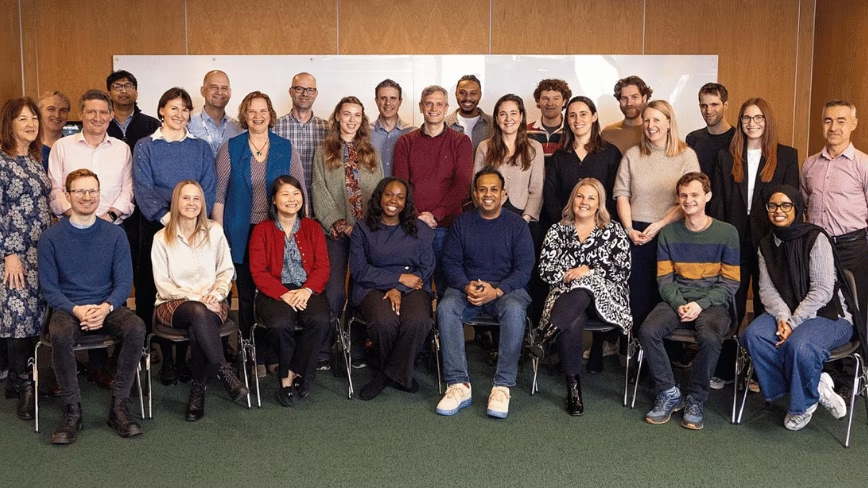
Image: courtesy of Thenextweb
Qureight's Chest AI Foundation Model: How $20 Million Could Remake Drug Trials for Lung and Heart Disease
Cambridge-based startup Qureight has secured $20 million in Series B funding to advance its artificial intelligence (AI) platform, which aims to drastically shorten drug development timelines. The core of their strategy is a 'foundation model' for chest imaging, designed to accelerate clinical trials for lung and heart conditions by generating disease-specific AI models in a fraction of the time traditionally required. This approach could streamline the costly and often slow process of bringing new medicines to patients.
Outlook
Background
At the heart of Qureight's offering is an AI 'foundation model' specifically trained on extensive chest imaging data. Unlike traditional AI models, which are often built from scratch for each specific disease or task, a foundation model is designed to be highly versatile. It learns a broad understanding of the chest's anatomy and common pathologies, allowing it to be 'retuned' or adapted rapidly for new, specific diseases. This process, according to Qureight, reduces the development time for a new disease-specific model from approximately a year to just one or two months.
Qureight currently offers two main products to its pharmaceutical clients, both underpinned by this foundation model. The first, 'Workflow,' significantly cuts the time required for imaging-based decisions in clinical trials, shrinking a process that typically takes about two weeks down to just 48 hours. The second, 'AI Lung,' provides detailed insights into how a drug affects disease progression by modeling airways and blood vessels. This level of granular data helps researchers understand treatment efficacy more precisely.
The company, founded by two medical doctors, has already established itself in the pharmaceutical sector. It is actively running global clinical trials in partnership with major players like AstraZeneca and Bristol Myers Squibb, alongside several biotech firms. This demonstrates early validation of its technology and its integration into real-world drug development pipelines.
Precedents
Drug development has long been a notoriously slow and expensive endeavor, with clinical trials representing a significant bottleneck. Historically, identifying and quantifying disease progression, especially in complex areas like lung and heart conditions, has relied on extensive manual analysis of medical images by human experts. This process is not only time-consuming but can also be subjective, leading to variability in data interpretation.
Previous attempts to accelerate this process have included advanced statistical modeling and earlier generations of AI, but these often required substantial, bespoke development for each new trial or disease. The concept of a 'foundation model' for medical imaging marks a departure from this, mirroring a trend seen in large language models in other AI fields. The idea is to create a robust, generalized base that can then be efficiently specialized. This architectural shift aims to overcome the historical hurdle of needing to reinvent the wheel for every new therapeutic area or clinical question, potentially offering a more scalable solution than prior technological interventions.
The implications of Qureight's technology extend far beyond the technical details of AI. For pharmaceutical companies, the ability to shorten drug trial timelines from years to months represents a massive potential reduction in R&D costs, which can run into billions of dollars for a single drug. Faster trials also mean quicker market entry for successful treatments, providing a significant competitive advantage and increasing revenue potential.
For patients, this acceleration holds the promise of earlier access to life-saving and life-improving medications for conditions like idiopathic pulmonary fibrosis, chronic obstructive pulmonary disease, and various cardiovascular diseases. The current protracted trial process often leaves patients with limited options, waiting years for new therapies. Furthermore, the detailed insights provided by Qureight's AI models could lead to more precise drug development, allowing researchers to better understand how treatments affect specific disease pathways and potentially leading to more effective, personalized medicines.
Beyond individual drugs, this model could reshape the entire R&D pipeline, making it more agile and responsive. It could allow for the exploration of more drug candidates, the repurposing of existing drugs, and a more efficient allocation of research capital, ultimately benefiting public health on a broader scale.
Scenarios
Analysis1. Accelerated Drug Approvals and Market Access: If Qureight's foundation model proves consistently effective in reducing the time for imaging-based endpoints in clinical trials, it could lead to a tangible acceleration in regulatory approvals for new lung and heart disease drugs. This would translate to faster patient access to novel therapies, potentially improving public health outcomes and reducing the economic burden of these chronic conditions.
2. Increased Competition and Broader AI Adoption: Should Qureight successfully validate its approach with more major pharma partners and demonstrate clear ROI, it is INFERRED that other AI companies and internal pharma R&D divisions will intensify their efforts to develop similar foundation models for various organ systems or disease areas. This could spark an 'AI arms race' in medical imaging, driving innovation and potentially making AI a standard tool in drug discovery, rather than a niche application.
3. Regulatory Scrutiny and Data Integration Challenges: As AI models become more central to drug approval processes, regulatory bodies like the FDA and EMA will likely increase their scrutiny of these technologies. Qureight, and others, could face significant hurdles in demonstrating the transparency, robustness, and generalizability of their AI models across diverse patient populations and imaging modalities. Additionally, the seamless integration of these advanced AI tools into existing, often siloed, pharmaceutical data infrastructure and clinical workflows may present operational challenges that slow broader adoption, despite the technological promise.
4. Refined Drug Development Strategies: The detailed insights offered by AI Lung models could lead to a shift in how pharmaceutical companies design their clinical trials. Instead of broad patient populations, trials might become more targeted, focusing on specific biomarkers or patient subgroups identified by AI. This INFERRED outcome could result in more efficient trials with higher success rates, but it would also require a re-evaluation of current trial methodologies and patient recruitment strategies.
Timeline
2026-07-29
Qureight Secures $20 Million Series B Funding
Cambridge startup Qureight announced it had raised $20 million in Series B funding. The capital is earmarked for building an AI 'foundation model' of the chest and expanding its AI imaging lab to speed up drug trials for lung and heart diseases.
Ongoing (2026)
Active Clinical Trial Partnerships
Qureight is currently running global clinical trials with major pharmaceutical companies including AstraZeneca, Bristol Myers Squibb, and various biotech partners, leveraging its existing AI tools for imaging analysis.
Next 12-24 Months (Speculative)
Expansion of Disease-Specific Models and Partnerships
With the new funding, Qureight is expected to accelerate the development of new disease-specific AI models, expanding its capabilities for a wider array of lung and heart conditions. It may also pursue additional partnerships with pharmaceutical companies looking to streamline their R&D pipelines, aiming to demonstrate tangible reductions in trial timelines.
Frequently Asked Questions
An AI 'foundation model' for the chest is a large, general-purpose AI model trained on a vast amount of chest imaging data. Unlike traditional AI models built for one specific task, this foundation model learns broad patterns and features, allowing it to be quickly adapted or 'retuned' to perform various disease-specific analyses, such as identifying early signs of lung fibrosis or tracking heart disease progression, without starting from scratch each time.
Discussion
Be the first to share your thoughts.