
BMW's workforce reduction will proceed through a voluntary redundancy program and natural staff turnover, targeting administrative and development roles across its German operations, as confirmed by the company. The partnership with Qualcomm is expected to accelerate BMW's development of advanced in-car technology, from infotainment to driver-assistance systems, over the next ten years. This strategic pivot suggests a future where BMW's core value increasingly lies in software integration and user experience, rather than solely its traditional mechanical engineering prowess. The coming months will likely see more details emerge about the specific roles affected by the job cuts and the initial phases of Qualcomm's technology integration into new BMW models.
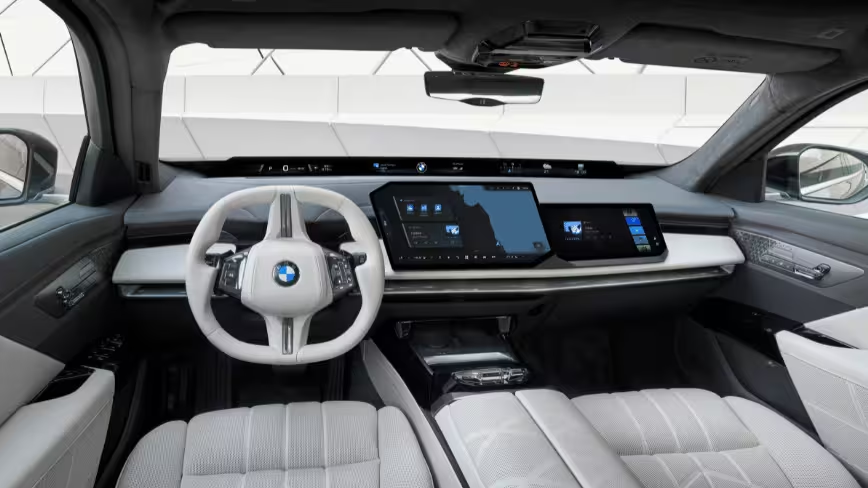
Image: courtesy of Thenextweb
BMW's 8,000 Job Cuts and Qualcomm Deal: The Luxury Automaker's Reckoning with Software and Chinese Rivals
BMW is undertaking one of its most significant restructurings in years, announcing plans to cut approximately 8,000 jobs, primarily in Germany, by the end of 2027. The company also confirmed a decade-long partnership with Qualcomm, positioning the U.S. chipmaker as the sole provider of the compute technology that will power BMW's future vehicles. These moves signal a fundamental shift in how the German luxury automaker intends to design and build its cars, driven by intense market pressures, particularly declining sales in China, and the broader industry transition towards software-defined vehicles.
Outlook
Background
On July 29, 2026, BMW announced a dual strategy to address what its CEO, Milan Nedeljkovic, described as a 'substantial change to the rules of the game' in the automotive sector. The luxury carmaker confirmed plans to reduce its German workforce by up to 8,000 employees through voluntary redundancies and attrition by the end of 2027. These cuts specifically target roles not directly involved in production, focusing instead on administrative and development functions. The decision was made in agreement with employee representatives, offering severance packages to eligible staff from October 2026.
In parallel, BMW named Qualcomm as its exclusive lead compute silicon provider for its next generation of vehicles, a partnership slated to run for the next decade. This means the core 'brains' of future BMW cars, responsible for everything from digital cockpits to advanced driver-assistance systems, will be powered by Qualcomm's technology. The move reflects growing market pressures, including a challenging sales environment in China and the industry-wide shift towards software-defined vehicles, where a car's capabilities are increasingly determined by its onboard computing and software rather than purely its hardware. BMW currently employs around 84,000 people in Germany and 154,000 globally.
Precedents
The automotive industry has a long history of adapting to technological shifts, from the internal combustion engine to electrification. However, the current transition to software-defined vehicles represents a more profound challenge for legacy automakers. Historically, car manufacturers like BMW built their reputation on in-house engineering, particularly in mechanical components and engine design. The shift towards software and advanced computing demands different skill sets and operational structures, often leading to significant workforce restructuring.
Previous periods of major technological change, such as the initial push into electric vehicles or the adoption of advanced manufacturing automation, have seen similar reallocations of resources and job profiles. German automakers, in particular, have often faced pressure to maintain a strong domestic manufacturing base while also embracing global supply chains for specialized components. The outsourcing of core technology, like compute silicon, mirrors patterns seen in other industries where specialized tech companies become critical partners, allowing traditional manufacturers to focus on integration, branding, and final assembly. This move by BMW echoes similar collaborations or internal reorganizations at rivals like Mercedes-Benz and Volkswagen, all grappling with the same pressures to compete with tech-forward newcomers and a rapidly evolving Chinese market.
This dual announcement from BMW is more than a cost-cutting exercise; it signals a fundamental redefinition of what a luxury car company needs to be in the 21st century. By shedding thousands of jobs in traditional development roles and outsourcing the critical 'brains' of its cars to Qualcomm, BMW is openly acknowledging that the future of automotive value creation is shifting away from purely mechanical engineering towards software and digital experience. This is a profound moment for a brand built on 'sheer driving pleasure,' a phrase historically tied to engine performance and chassis dynamics.
For BMW, the immediate consequence is a leaner, potentially more agile organization that can respond faster to technological trends. The partnership with Qualcomm allows BMW to tap into cutting-edge chip technology without the immense investment and time required to develop it entirely in-house. This indicates a strategic choice to prioritize software excellence and user experience, which are increasingly critical for attracting buyers, especially in tech-savvy markets like China.
For the broader automotive industry, BMW's move sets a precedent. It suggests that even the most established luxury brands may need to surrender control over certain core components to specialized tech partners to remain competitive. This could accelerate the trend of cars becoming 'smartphones on wheels,' where the driving experience is heavily influenced by the digital interface and connectivity. It also raises questions about brand identity: if the core intelligence of a BMW is shared with a tech company, what then truly distinguishes its engineering?
For German workers and the national economy, the job cuts represent a challenging transition. While voluntary, 8,000 fewer jobs in development and administration will impact a highly skilled workforce, pushing for retraining and adaptation to new industry demands. The decision also highlights the intense competitive pressures from Chinese automakers, who are often faster to market with advanced software and electric vehicle technology, forcing traditional players to make difficult strategic choices.
Scenarios
Analysis1. Accelerated Software-Defined Vehicle Development: The Qualcomm partnership could significantly speed up BMW's ability to integrate advanced digital features, improve infotainment systems, and deploy sophisticated driver-assistance technologies. This might lead to BMW vehicles offering a more seamless and personalized digital experience, helping the brand compete more effectively with tech-focused rivals and new entrants from China. However, this also carries execution risk, as integrating complex external technology into a proprietary vehicle architecture is challenging.
2. Shift in Brand Perception and Competitive Landscape: As the 'brains' of BMW cars become more standardized through external suppliers, the brand's unique selling proposition may shift further towards design, interior luxury, and overall user experience, rather than solely its traditional engineering prowess. This could intensify competition in the premium segment, forcing all luxury automakers to innovate rapidly in software and services to differentiate themselves. It also raises the long-term question of how much control BMW retains over its vehicle's core identity and performance characteristics if a key element is outsourced.
3. Further Workforce Restructuring and Skill Re-evaluation: The initial 8,000 job cuts may be part of a larger, ongoing process of workforce adaptation. As BMW becomes more reliant on software and external partnerships, the demand for traditional automotive engineering skills may continue to decline, while skills in software development, data analytics, and systems integration become more critical. This could lead to further voluntary or involuntary redundancies in the future, alongside significant investment in upskilling and reskilling programs for the remaining workforce.
Timeline
Frequently Asked Questions
Discussion
Be the first to share your thoughts.