
In the immediate term, expect Lionel Scaloni and the Argentine coaching staff to treat the upcoming friendly matches against Ecuador and Guatemala with extreme caution. Messi will likely feature, but his involvement will be limited to short, low-intensity cameos designed to test his cardiovascular fitness rather than push his muscular limits. The training sessions at Inter Miami’s facilities in Fort Lauderdale have been structured around recovery and individualized load management, reflecting a deep collaboration between club and country medical staffs. Scaloni is expected to use a highly rotated starting lineup in these warmups, giving younger players like Alejandro Garnacho and Valentin Carboni extended minutes to minimize the physical burden on the veteran core. Observers should look for tactical adjustments in these friendlies, specifically how Argentina structures its midfield to cover defensive ground when Messi is walking. The coaching staff is prioritizing tactical cohesion over individual brilliance in these final tune-ups, knowing that a single muscle tear in June could derail their entire title defense before the tournament even begins.
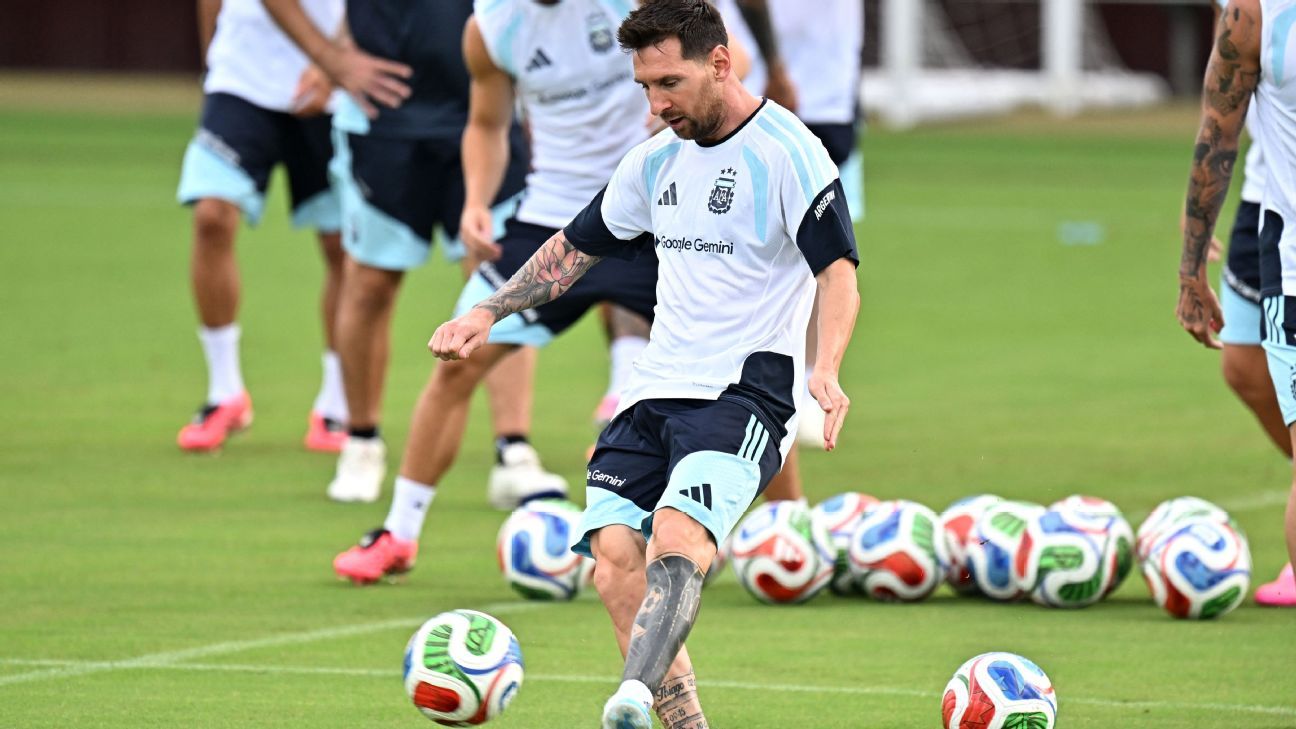
Image: courtesy of ESPN
The 38-Year-Old Engine: Inside Argentina's High-Stakes Plan to Preserve Lionel Messi for One Final World Cup
As Argentina prepares for its final World Cup warmups in the United States, Lionel Messi's physical readiness has become the central anxiety of the tournament. National team staff report he is 'doing well' following recent muscle fatigue, but his minutes will be strictly rationed. The defending champions face a delicate balancing act: satisfying massive commercial demands in North America while ensuring their aging captain survives a grueling summer campaign.
Outlook
Background
The anxiety surrounding Messi's fitness is not born out of paranoia, but of a sobering 12-month medical record in Major League Soccer. Since his high-profile move to Inter Miami, the Argentine playmaker has missed 12 league matches due to recurring hamstring strains and general muscle fatigue, a stark departure from the remarkably durable physical profile he maintained during his peak European years. At 38, the physiological recovery time between high-intensity sprints has lengthened significantly, a reality that the North American climate and extensive travel demands will only exacerbate. The 2026 tournament is spread across three massive countries, featuring distinct microclimates, altitude changes, and time zone shifts that present a logistical and physical challenge unlike the compact footprint of Qatar in 2022. Argentina’s technical staff is acutely aware that they cannot replicate the strategy of four years ago, where Messi played every single minute of the tournament. Instead, the current preparation is about building physical resilience through targeted, short-duration training blocks, recognizing that his impact must be concentrated in decisive moments rather than sustained over 90-minute stretches of continuous running.
See also
Precedents
Historical precedents for defending champions managing aging icons show that the transition from talisman to passenger can happen abruptly. In 1994, an aging Diego Maradona entered the World Cup in peak physical condition after a crash diet and intense training, only for his campaign to end in disgrace and physical exhaustion. More recently, Portugal's management of Cristiano Ronaldo during the 2024 European Championship demonstrated the tactical friction that arises when a team refuses to limit the minutes of an iconic but physically declining superstar, resulting in a stagnant attack and early exit. Argentina, however, has spent the last four years developing a tactical system specifically engineered to mitigate Messi's physical limitations. The tireless running of Rodrigo De Paul, Alexis Mac Allister, and Enzo Fernandez in the midfield engine room serves as a protective shield, allowing Messi to conserve his energy for the final third. When Messi was injured during the Copa America preparation cycles, Scaloni experimented with a more fluid, high-pressing 4-3-3 system that relied on collective movement rather than individual gravity, proving that the squad has developed a functional plan B, even if they hope never to use it on the grandest stage.
The economic and sporting stakes of Messi's physical availability extend far beyond the Argentine dressing room. For FIFA and the local organizing committees in the United States, Mexico, and Canada, Messi is the primary commercial engine of a tournament projected to generate record-breaking revenues. Secondary market ticket prices for Argentina’s group stage matches have surged past $1,200, but historical data from Inter Miami matches shows that these valuations can plummet by up to 70% within hours if Messi is ruled out. Broadcasters, sponsors, and local hospitality industries have capitalized heavily on his presence, making his physical condition a matter of corporate urgency. Tactically, his fitness dictates the entire structural integrity of the defending champions. Without Messi, Argentina remains a formidable, highly organized side capable of deep tournament runs, but they lose the unique psychological advantage and creative unpredictability that transformed them into world champions. The tournament's competitive balance hinges on whether his body can withstand the physical demands of seven high-intensity matches in thirty days, or if the modern, athletic press of elite international football will finally catch up with the game's greatest player.
Scenarios
AnalysisUnder the first scenario, Argentina successfully manages Messi's workload by using him as a highly efficient 'closer' during the group stages, limiting his starts to 60-minute appearances before withdrawing him once matches are secured. This preserves his hamstrings for the high-stakes knockout rounds, allowing him to peak physically in July when the intensity reaches its maximum.
In an alternative, more volatile scenario, the competitive pressure of the tournament forces Scaloni to abandon caution, playing Messi for full matches in the group stage to secure top seeding. This overexertion leads to a recurrence of his hamstring injury in the round of 16, forcing Argentina to navigate the remainder of the bracket without their captain and shifting the tactical burden onto Lautaro Martinez and Julian Alvarez.
A third possibility involves a tactical pivot where Messi accepts a highly specialized role as a substitute, entering matches in the final 30 minutes to exploit tired defensive lines. While this would optimize his physical output and minimize injury risk, it would require a massive ego concession from Messi and create immense media pressure on Scaloni from fans and sponsors demanding to see the superstar start.
Timeline
Frequently Asked Questions
Discussion
Be the first to share your thoughts.