
Eligible YouTube Premium subscribers in the United States can expect a direct enhancement to their existing membership without any price increase. From early 2027, their subscription will automatically include access to Peacock's extensive content library. This means a seamless pathway to live sports, including NFL and NBA games, a catalog of blockbuster films, and a wide array of popular shows from NBCUniversal, all within their current ad-free YouTube experience for user-generated content. For NBCUniversal, the deal is designed to funnel a large, established audience directly into Peacock, potentially boosting its viewership and engagement metrics without the high marketing costs typically associated with direct-to-consumer subscriber growth. The broader streaming industry may observe this partnership closely as a template for future content distribution and bundling strategies, particularly as competition for viewer attention intensifies.
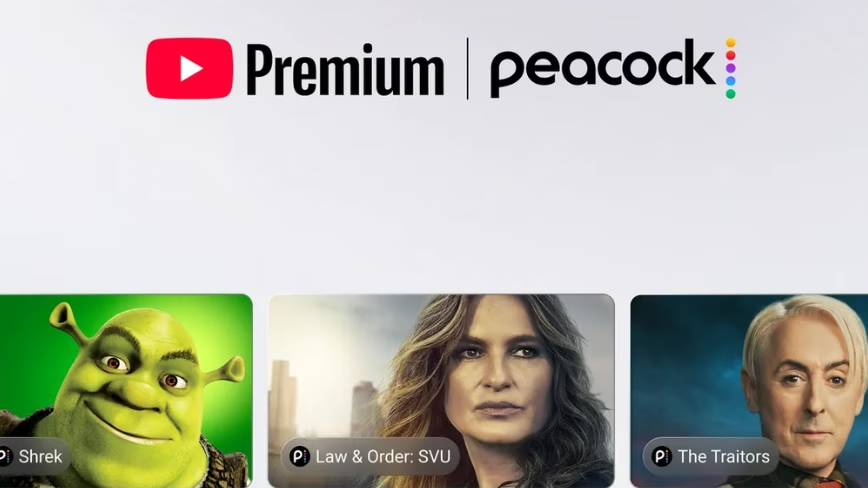
Image: courtesy of Thenextweb
YouTube Premium's Peacock Play: A New Front in the Streaming Wars
YouTube Premium will incorporate Peacock's ad-supported Premium tier at no additional cost for its U.S. subscribers starting in early 2027. This arrangement, confirmed on July 27, 2026, represents Peacock's most substantial distribution partnership to date, aiming to significantly expand its reach to millions of new viewers. The strategic move by NBCUniversal and Google comes as the streaming market continues to evolve, with platforms increasingly exploring bundling as a mechanism for subscriber acquisition and retention.
Outlook
Background
The streaming industry has spent the last few years in a phase of rapid expansion, but that growth has come with increasing costs and a growing challenge: subscriber churn. Consumers, faced with a multitude of services and rising prices, are becoming more selective, often canceling subscriptions after catching up on a specific show or sporting event. This environment has pushed platforms to seek new strategies beyond individual subscriber acquisition. For Peacock, a service that has aggressively pursued various distribution channels, this deal represents a significant acceleration of its reach. The platform has previously experimented with bundling, notably with Instacart in November 2023, signaling a clear intent to broaden its audience through partnerships rather than relying solely on organic sign-ups. For YouTube Premium, the addition of a robust content library like Peacock's strengthens its value proposition beyond its core offering of ad-free viewing, YouTube Music, and exclusive content, positioning it as a more comprehensive entertainment hub in a crowded market.
Precedents
The bundling of content is not a novel concept; it is a strategy deeply rooted in the history of media distribution, from newspaper subscriptions that included multiple sections to the foundational model of cable television. In the early days of streaming, the goal was largely to 'unbundle' from cable, offering consumers more choice and lower costs. However, as the number of streaming services proliferated, a new form of 're-bundling' has emerged. Companies like Disney have successfully integrated Disney+ and Hulu, while Paramount Global has combined Paramount+ and Showtime. These moves reflect a recognition that consumers value convenience and perceived savings when faced with fragmented content. Peacock, in particular, has been proactive in this space, having inked deals that saw its service included with other subscriptions, such as Instacart+. This pattern suggests a deliberate strategy by NBCUniversal to leverage existing subscriber bases from other platforms to drive growth for Peacock, rather than competing head-on for every individual subscriber through direct marketing efforts. The YouTube Premium deal, given its scale and reach, marks the largest iteration of this strategy to date, indicating a mature market where distribution partnerships are becoming as critical as original content production.
This deal matters because it addresses several critical pressures facing both YouTube Premium and Peacock in the highly competitive streaming landscape. For NBCUniversal and Peacock, gaining access to YouTube Premium's millions of U.S. subscribers is a direct solution to the persistent challenge of customer acquisition costs. Instead of spending heavily on marketing to attract individual subscribers, Peacock can instantly tap into a vast, engaged audience already paying for a premium service. This could significantly boost Peacock's viewership for its key offerings, especially live sports and its growing library of original series and films, ultimately strengthening its position in the 'streaming wars.'
For Google and YouTube Premium, the inclusion of Peacock at no extra cost is a powerful lever for subscriber retention. In a market where users frequently cancel and resubscribe, adding substantial, high-value content like NFL games or popular NBC shows without raising the price makes the YouTube Premium subscription stickier. It transforms YouTube Premium from primarily an ad-free music and video service into a more comprehensive entertainment bundle, increasing its perceived value against competitors like Netflix or Max.
EARNED QUESTION: But does simply adding more content guarantee success in a market already saturated with options? The answer lies not just in quantity, but in the integration and convenience. By folding Peacock directly into an existing subscription, the deal removes a significant barrier to adoption: the need for a separate sign-up, billing, and app. This frictionless access could lead to higher engagement rates for Peacock content among YouTube Premium users who might not have otherwise sought out the service. The deal also signals a potential shift in how major tech platforms and traditional media companies collaborate, prioritizing broad distribution and shared subscriber value over siloed competition. It’s a move that could redefine what a 'premium' subscription looks like in the digital age, emphasizing curated bundles over standalone services.
Scenarios
AnalysisOne possible outcome is a substantial, immediate boost to Peacock's active user base and viewing hours. By removing the friction of a separate subscription and integrating directly into an established premium service like YouTube Premium, a significant portion of the existing YouTube Premium subscriber base may begin engaging with Peacock's content. This could translate into more robust advertising revenue for NBCUniversal, even for the ad-supported tier, by offering advertisers access to a larger, more diverse audience. For YouTube Premium, this increased value could lead to higher subscriber retention rates and potentially attract new users who find the combined offering compelling, solidifying its place as a comprehensive entertainment package.
Another scenario suggests this deal could accelerate a broader trend of cross-platform bundling and strategic partnerships across the streaming industry. Should the YouTube-Peacock collaboration prove successful in terms of subscriber stickiness and increased content consumption, other streaming services and tech platforms may feel compelled to form similar alliances. This could lead to further consolidation or complex bundling arrangements, where consumers access a wider range of content through fewer, more comprehensive subscriptions. Such a shift could reshape the competitive landscape, making it harder for smaller, standalone services to thrive and potentially creating new dominant bundles that resemble a more modern version of cable television, albeit with greater consumer choice and flexibility.
Timeline
Frequently Asked Questions
Discussion
Be the first to share your thoughts.