
The impending delivery of the US State Department's letter is expected to trigger a period of intense diplomatic maneuvering. Countries that have signed the US "AI Opportunity Statement" will face direct pressure to formalize their allegiance to Pax Silica, which emphasizes securing AI supply chains, including critical minerals and semiconductors. Nations, particularly those with strong economic ties to both the US and China, will need to carefully assess the long-term implications of their choice. This could lead to public declarations of alignment, quiet internal policy shifts, or, in some cases, attempts to delay a definitive decision. The situation with Kazakhstan, which has already joined both initiatives, will serve as an early test case for how the US intends to enforce its new policy. The communication from Washington, while not explicitly naming China, is clear in its intent: dual membership will not be tolerated, signaling a hardening stance in the global technology rivalry.
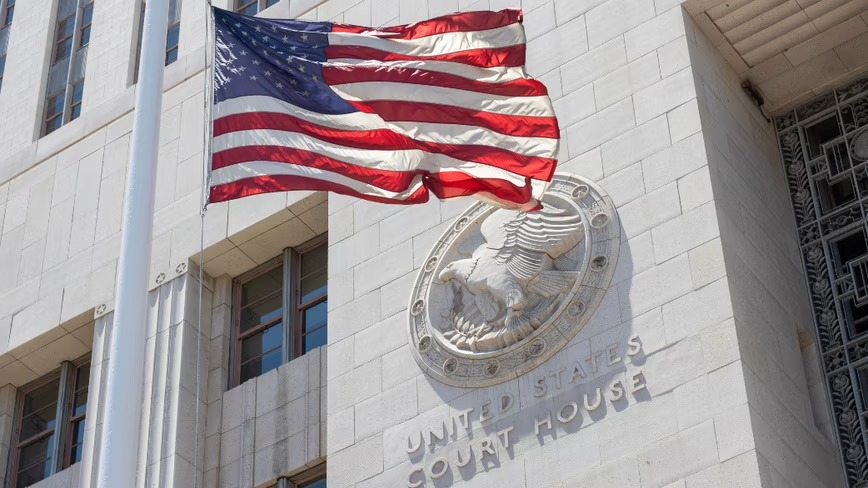
Image: courtesy of Thenextweb
The Real Cost of Picking a Side in the US-China AI Race
The United States is preparing to issue a stark ultimatum to 35 countries, demanding they choose between aligning with its AI coalition, Pax Silica, or China's competing artificial intelligence framework. This move, communicated through a draft State Department letter, aims to consolidate Washington's technological alliances and, by extension, limit Beijing's access to critical resources and partnerships necessary for advanced AI development. The implicit demand forces nations to weigh the benefits of American technological cooperation against potential economic and diplomatic repercussions from either side, setting the stage for a significant realignment in global tech policy.
Outlook
Background
The global competition for dominance in artificial intelligence has intensified dramatically in recent years, evolving beyond pure technological innovation into a geopolitical contest over standards, supply chains, and talent. The US, through initiatives like Pax Silica, seeks to establish a coalition of like-minded nations committed to developing AI in line with Western democratic values and securing crucial elements of the AI ecosystem. This includes everything from the rare earth minerals vital for advanced chips to the high-end semiconductors themselves, and the foundational AI models that drive next-generation applications.
China, for its part, has been aggressively pursuing its own national AI strategy, aiming for global leadership by 2030. Beijing's approach often involves state-backed enterprises, extensive data collection, and a focus on integrating AI into its domestic economy and military capabilities. Its competing AI framework offers an alternative vision for technological development, often appealing to countries seeking to avoid perceived Western hegemony or those with different governance models.
Washington's "AI Opportunity Statement," signed in June, laid the groundwork for this current push, bringing together 35 countries interested in aligning their AI cooperation with the US. However, this non-binding declaration is now being followed by a more direct demand for exclusivity. The explicit goal, according to sources familiar with the draft letter, is to "starve China of resources" in the race to develop advanced AI. This institutional move reflects a broader US foreign policy objective to contain China's technological rise, viewing AI as a critical domain that will shape future economic and military power.
See also
Precedents
The current US demand for countries to choose sides in the AI race echoes historical patterns of geopolitical competition, particularly during the Cold War. During that era, nations were often pressured to align with either the US-led Western bloc or the Soviet-led Eastern bloc, with economic aid, military alliances, and technological access serving as incentives or deterrents. While the current situation lacks the direct ideological and military confrontation of the Cold War, the underlying mechanism of alliance building through technological exclusivity is strikingly similar.
In more recent history, the US has employed similar tactics in areas like telecommunications, notably with its campaign against Huawei and 5G infrastructure. Washington urged allies to exclude Huawei equipment from their networks, citing national security concerns, and offered incentives for adopting alternatives. This strategy saw mixed results, with some allies fully complying, others adopting a more cautious approach, and a few resisting outright due to economic dependencies or differing assessments of risk.
This current move is also reminiscent of efforts to control access to sensitive technologies, such as nuclear proliferation controls or export restrictions on advanced weaponry. The critical difference here is the pervasive nature of AI, which is not merely a military technology but also a foundational element of future economic growth, scientific discovery, and societal organization. The US approach suggests a belief that controlling the flow of AI resources and partnerships is as strategically vital as controlling nuclear materials was in the 20th century. The outcome of this new technological alignment push will likely be shaped by the economic clout the US can wield, the perceived benefits of Pax Silica, and the willingness of smaller nations to resist pressure from either global power.
This diplomatic offensive marks a critical escalation in the US-China technology rivalry, transforming the abstract concept of an "AI race" into a concrete, binary choice for dozens of nations. The consequences extend far beyond mere diplomatic allegiances.
For the 35 targeted countries, the decision carries significant economic and technological weight. Choosing the US-led Pax Silica could mean privileged access to cutting-edge American AI research, advanced semiconductors, and secure supply chains. It could also open doors to investment, joint ventures, and participation in shaping global AI standards. Conversely, it might risk retaliatory measures from China, impacting trade, investment, or access to the vast Chinese market.
Opting for China's framework, or attempting to maintain neutrality, could offer different benefits, potentially including access to China's rapidly developing domestic AI ecosystem and its significant investment capital. However, it risks exclusion from the US-led coalition, potentially limiting access to crucial Western technologies and intellectual property, which remain dominant in many high-end AI components.
For the global AI industry, this forced alignment could lead to a further fragmentation of technology ecosystems. Instead of a single, interconnected global standard for AI development, the world may see the emergence of two distinct, potentially incompatible, technological spheres. This could create inefficiencies, duplicate research efforts, and complicate cross-border collaboration, ultimately slowing overall AI progress. It also raises questions about data sovereignty, ethical AI guidelines, and the future of open-source development in a bifurcated world. The long-term impact on innovation, market structures, and the geopolitical balance of power will be profound, shaping which nations lead the next wave of technological advancement.
Scenarios
Analysis1. Consolidated US-led AI Bloc: Many of the 35 countries, especially close US allies like Japan, Australia, and South Korea, may formally align with Pax Silica. This would strengthen the US position by securing critical supply chains for semiconductors and minerals, and by pooling research and development efforts. It would also enhance Washington's ability to set global standards for AI governance and ethics, effectively limiting China's influence in these areas. The direct consequence for China would be a more restricted access to international partnerships and resources, potentially slowing its AI advancement.
2. Strategic Hedging by Key Nations: Countries with significant economic ties to both the US and China, such as some in Southeast Asia or resource-rich nations like Kazakhstan, may attempt to navigate a middle path. While the US letter explicitly warns against dual membership, these countries might seek to maintain a degree of cooperation with both powers where possible, perhaps by aligning with Pax Silica on certain aspects (e.g., ethical guidelines) while continuing trade and investment with China in others. This could lead to a less clear-cut geopolitical split, forcing the US to calibrate its enforcement mechanisms and potentially accepting a nuanced form of alignment rather than outright exclusivity.
3. Emergence of a Non-Aligned Digital Sphere: A smaller subset of countries, particularly those wary of being drawn into a great power competition, could actively resist the pressure to choose. They might seek to develop their own independent AI frameworks or pursue multilateral initiatives that are not explicitly aligned with either the US or China. This outcome could be driven by a desire for technological sovereignty, a rejection of binary choices, or a focus on regional cooperation. While challenging to achieve given the dominance of the two major powers, it could represent an attempt to create a third path in the global AI landscape, albeit one that may face significant challenges in scaling and resource acquisition.
Timeline
Frequently Asked Questions
Discussion
Be the first to share your thoughts.