
The immediate aftermath of Elon Musk's denial will likely see continued speculation across tech and financial markets regarding SpaceX's long-term ambitions beyond space exploration and satellite internet. Investors and industry observers will be closely watching for any further leaks, official statements, or product reveals that could either corroborate or definitively refute the Wall Street Journal's initial reporting. The competitive landscape in consumer AI hardware, already intensifying with players like Apple and Rabbit, will also be under scrutiny for how it reacts to the mere idea of a new entrant from a company like SpaceX.
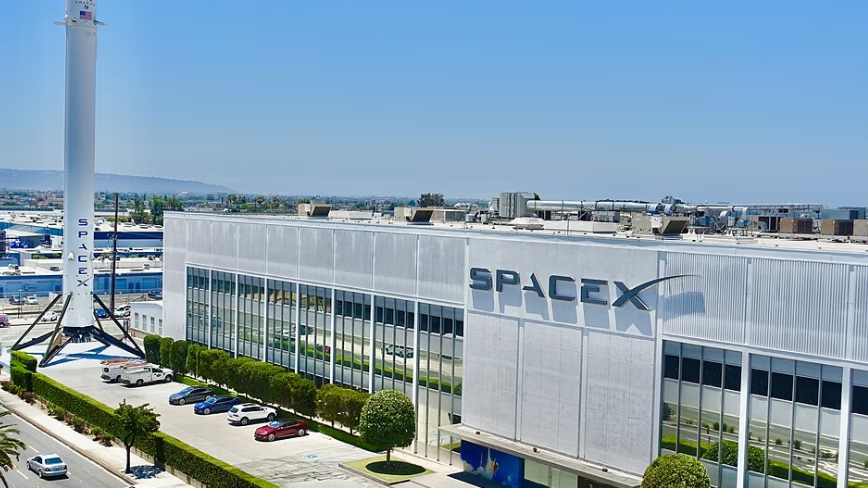
Image: courtesy of Thenextweb
Elon Musk Denies SpaceX AI Device Report, But The Questions Remain For Consumer Tech
Elon Musk has publicly dismissed a Wall Street Journal report claiming SpaceX showed investors a prototype consumer AI device ahead of its initial public offering. Musk labeled the report 'utterly false,' despite the detailed description of a 'handset-like' gadget said to be slimmer than an iPhone, running a proprietary operating system, and integrating technology from SpaceX's xAI division. The categorical denial creates a clear conflict, leaving the market to weigh the report's specifics against Musk's reputation for controlling narratives and, at times, denying developments that later materialize.
Outlook
Background
On July 1, The Wall Street Journal reported that SpaceX had presented a prototype AI hardware device to investors and key stakeholders. This alleged showing occurred in advance of the company's recent initial public offering. The device was described in detail: a 'handset-like' form factor, notably slimmer than an iPhone, operating on a proprietary system, and leveraging technology from xAI, the artificial intelligence firm acquired by SpaceX earlier in 2026. The report also mentioned the device was planned to use a Qualcomm Snapdragon chipset.
Shortly after the report surfaced, Elon Musk, CEO of SpaceX, issued a direct denial on social media, stating the report was 'utterly false.' This denial did not offer further specifics but was absolute. Musk has previously denied claims about SpaceX developing a phone or similar consumer hardware, maintaining a consistent public stance against such ventures.
This situation unfolds against a backdrop of increasing competition in the consumer AI hardware space. Companies like Apple are integrating advanced AI features directly into their devices, while startups like Rabbit have introduced dedicated AI companions, such as the Rabbit R1, attempting to redefine how users interact with artificial intelligence outside traditional smartphones.
See also
Precedents
Elon Musk has a notable history of public denials regarding various company initiatives or reports that later proved to be at least partially true. This pattern creates a degree of skepticism around his categorical dismissals, especially when they contradict detailed reports from established publications. For instance, there have been instances where Musk initially downplayed certain product timelines or strategic shifts, only for those developments to emerge publicly at a later stage. This behavior can be interpreted in several ways: a desire to manage expectations, protect competitive information, or simply to control the narrative until a product or strategy is fully ready for public disclosure.
Conversely, Musk is also known for ambitious, sometimes speculative, pronouncements that do not always materialize as initially described. This duality makes it difficult for observers to discern the absolute truth behind his statements, particularly concerning early-stage prototypes or unconfirmed projects. The market has learned to interpret Musk's denials not always as definitive refutations, but sometimes as signals that a project might be nascent, highly confidential, or subject to significant changes before any official unveiling.
The reported existence of a SpaceX AI device, even if denied, holds significant weight for several reasons. For investors, it suggests a potential expansion of SpaceX's business model beyond its core aerospace and satellite communications activities, hinting at new revenue streams and market opportunities that were not explicitly factored into its pre-IPO valuations. A move into consumer hardware would diversify SpaceX, but also introduce it to a fiercely competitive and capital-intensive sector.
For the broader technology industry, particularly in consumer electronics and artificial intelligence, this report signals a potential new formidable entrant. SpaceX's brand recognition, combined with xAI's technological capabilities (especially if leveraging Grok), could challenge established players like Apple, Google, and Samsung, as well as emerging AI hardware companies. The description of a device 'slimmer than an iPhone' suggests a focus on sleek design and potentially novel interaction methods, aiming to carve out a distinct niche.
Musk's denial, while firm, also highlights the intense secrecy and strategic maneuvering often involved in developing cutting-edge technology. The public tug-of-war between a detailed media report and a CEO's outright rejection creates uncertainty, which can influence investor sentiment and competitive strategies. It forces the market to consider not just what might be true, but why a particular narrative is being pushed or denied, adding a layer of strategic complexity to SpaceX's public image and future direction.
Scenarios
AnalysisOne possible outcome is that the Wall Street Journal's report, despite its specific details, was based on incomplete or misinterpreted information, and SpaceX genuinely has no plans to develop a consumer AI device. In this scenario, Musk's denial would be entirely accurate, and any 'prototype' shown was either a conceptual mock-up, an internal tool, or simply did not exist in the capacity described. If this holds true, SpaceX would likely continue to focus its xAI efforts on enterprise applications or integrations with its existing space and Starlink services, avoiding the high-stakes consumer hardware market.
Another outcome is that the report captures an early-stage, highly confidential project that SpaceX is indeed exploring, and Musk's denial serves to protect this secrecy. Given Musk's history, a categorical denial does not always equate to an absence of development. The 'handset-like' description, proprietary OS, and xAI integration suggest a serious, if nascent, effort. If this is the case, SpaceX could be deliberately managing expectations or delaying public disclosure until the product is more mature or closer to market readiness. This approach would allow them to iterate on the design and technology without immediate public scrutiny, potentially leading to a surprise market entry at a later date, which could significantly disrupt the consumer AI device segment.
Finally, there is a scenario where the project exists, but its scope or target market shifts dramatically. Perhaps the 'handset-like' device is not intended as a mass-market consumer product in the vein of a smartphone replacement, but rather a specialized interface for Starlink users, or a unique enterprise tool for specific industries. Such a device could still leverage consumer-grade hardware components and AI capabilities without directly competing in the broad consumer electronics space, thus allowing Musk's denial of a 'phone' to technically stand, even if a 'device' exists.
Timeline
2026-01-01
xAI Acquired by SpaceX (Approximate)
SpaceX reportedly acquired xAI, the artificial intelligence company behind Grok, earlier in 2026. This acquisition would integrate significant AI capabilities directly into the SpaceX ecosystem, providing the technological foundation for potential AI-powered devices.
2026-07-01
WSJ Reports AI Device Prototype
The Wall Street Journal published a report stating that SpaceX showed investors and stakeholders a prototype consumer AI hardware device, described as slimmer than an iPhone and running a proprietary OS with xAI technology, ahead of its IPO.
2026-07-01
Elon Musk Denies Report
Shortly after the WSJ report was published, Elon Musk publicly denied its claims on social media, calling the report 'utterly false' without providing further details or context.
Frequently Asked Questions
The Wall Street Journal reported the device was 'handset-like,' slimmer than an iPhone, ran on a proprietary operating system, and used technology from SpaceX's xAI division, specifically integrating Grok capabilities. It was also said to feature a Qualcomm Snapdragon chipset.
Discussion
Be the first to share your thoughts.