
Together AI's immediate priority, following this substantial capital infusion, is to scale its physical infrastructure. This means a significant increase in the availability of high-demand Nvidia GPU clusters and other specialized AI hardware for its customers. The company has also stated plans to broaden its product offerings. This could include new services designed for model fine-tuning, efficient data management, or advanced tooling specifically tailored for the open-source AI development community. The commitment to secure over 500 megawatts of compute capacity suggests a massive build-out, likely involving new data center partnerships or expansions to meet surging demand. Ultimately, Together AI intends to use these resources to further reduce the cost and improve the speed of running open-source AI models, thereby attempting to democratize access to advanced AI capabilities.
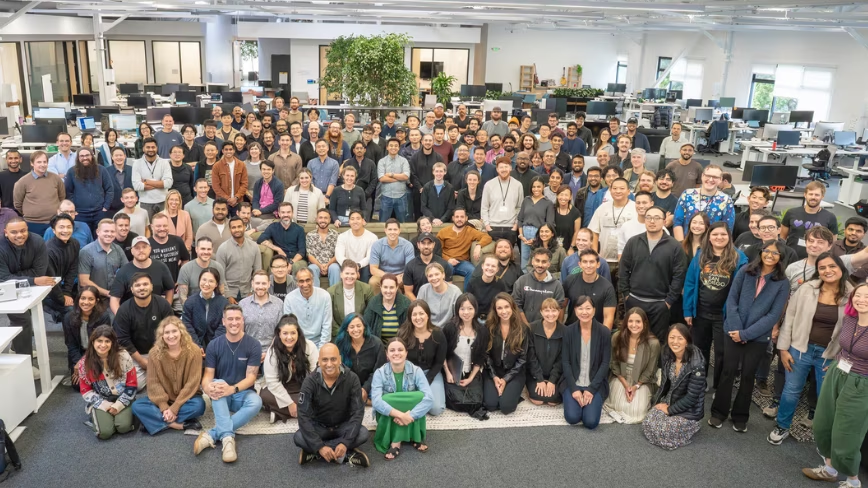
Image: courtesy of Thenextweb
The $8.3 Billion Bet: Why Together AI's Funding Changes the Rules for Open-Source AI
Together AI, a startup focused on providing specialized AI infrastructure, secured $800 million in Series C funding yesterday, July 1, 2026. This latest round pushes the company's valuation to $8.3 billion. Aramco Ventures led the investment, with significant participation from Nvidia and Vista Equity Partners. The capital injection is earmarked for a substantial expansion of Together AI's infrastructure and product offerings, including commitments for over 500 megawatts of compute capacity. The company aims to further its mission of making advanced, open-source AI models more accessible and cost-effective, positioning itself as a critical player in the intense competition for AI compute resources.
Outlook
Background
The artificial intelligence industry is currently in a fierce competition for raw compute power. Training and deploying large-scale AI models, often referred to as 'frontier AI,' demands immense graphical processing unit (GPU) resources. These specialized GPUs, predominantly supplied by Nvidia, are both expensive and frequently scarce, creating a significant bottleneck for many companies and research institutions. While established cloud providers offer these resources, their services often come at a premium and are typically designed for a more generalized cloud infrastructure. Together AI, founded in 2022, emerged to specifically address this need for AI-optimized cloud infrastructure, with a particular focus on open-source models. Open-source AI, where the underlying code is freely available for inspection, modification, and distribution, is gaining considerable traction as a transparent and flexible alternative to proprietary, closed-source models from major tech players. The demand for scalable, cost-effective infrastructure to deploy and experiment with these open models has surged, creating the market opportunity Together AI is actively pursuing. The lead investment by Aramco Ventures is particularly notable, indicating a strategic move by the Saudi Arabian oil giant to diversify its portfolio and secure access to critical AI capabilities, reflecting a broader trend of national strategic investments in advanced technology. Nvidia's continued participation reinforces its strategic interest in ensuring its hardware is widely adopted across various AI cloud platforms, extending beyond just the largest providers.
See also
Precedents
The current landscape of AI infrastructure bears a striking resemblance to the early days of cloud computing. In the initial phase of the internet boom, many companies were forced to build and maintain their own server farms, a process that was both capital-intensive and often inefficient. The subsequent rise of hyperscale providers like Amazon Web Services (AWS), Microsoft Azure, and Google Cloud democratized access to powerful IT infrastructure by offering on-demand compute, storage, and networking services. The AI industry is now experiencing a similar evolution, albeit with an even greater concentration of power due to the highly specialized nature and scarcity of GPUs. The open-source movement itself has a long track record of disrupting established industries, from foundational operating systems like Linux to web servers and databases. By promoting accessibility and fostering community-driven innovation, open-source projects frequently accelerate adoption and create entirely new markets. However, a persistent challenge for open-source AI has been the sheer computational cost required to run these sophisticated models at scale. Companies like Together AI are attempting to bridge this gap, effectively providing the crucial 'picks and shovels' for the open-source AI gold rush. Furthermore, the investment by a major energy firm such as Aramco Ventures echoes historical patterns where traditional industries diversify into emerging technologies. This often occurs to secure future relevance and leverage new strategic assets, much like how oil companies diversified into petrochemicals or renewable energy sources in previous decades.
This $800 million capital injection for Together AI is more than just another large tech funding round; it's a strategic maneuver with the potential to significantly reshape the competitive dynamics within the broader AI industry. First, it equips Together AI with substantial financial power to rapidly expand its compute capacity, directly addressing the core bottleneck in AI development: reliable access to GPUs. This means that a wider array of developers, researchers, and smaller companies will gain a viable alternative to the dominant hyperscalers for running complex AI models. Second, the investment, particularly from Aramco Ventures, signals a growing global recognition of AI infrastructure as a national and economic imperative, extending beyond traditional tech investment hubs. Aramco's involvement implies a long-term strategic view on securing access to foundational AI capabilities, potentially influencing future technology development and adoption in the region. Third, Nvidia's continued backing serves as a powerful validation of Together AI's 'AI neocloud' model and, by extension, the increasing importance of specialized, optimized infrastructure for demanding AI workloads. Nvidia benefits from ensuring its GPUs are widely adopted across diverse AI cloud platforms, and Together AI offers a direct conduit to a rapidly expanding segment of the market focused on open-source AI. Finally, and perhaps most consequentially, this funding directly empowers the open-source AI movement. By making it cheaper and faster to run these models, Together AI is fostering an ecosystem that can innovate at an accelerated pace, potentially offering more transparent, customizable, and auditable AI solutions compared to purely proprietary alternatives. This could lead to a more diversified and resilient AI landscape, reducing the concentration of power among a handful of large technology companies.
Scenarios
AnalysisThe substantial funding secured by Together AI opens several distinct pathways for the company and the broader AI ecosystem.
One possible outcome is a significant acceleration in the adoption and development of open-source AI models. With considerably expanded and more affordable infrastructure, Together AI could become an indispensable resource for developers and researchers. This might lead to a surge in the creation of new applications, advanced research, and specialized models built upon open foundations, potentially challenging the market dominance currently held by proprietary AI systems. Startups and individual developers, often constrained by the prohibitive costs of compute, could find it much easier to bring their open-source AI projects to a wider audience.
A second outcome could be a notable increase in competition within the AI cloud infrastructure market. This massive investment provides Together AI with the financial muscle to directly contend with established cloud giants like Amazon, Microsoft, and Google, as well as other specialized AI cloud providers. This intensified competition could lead to downward pressure on prices for GPU access across the industry, benefiting the entire AI development community. It could also compel larger players to innovate more rapidly in their own AI-specific offerings and pricing models to retain market share.
A third, more speculative outcome involves the strategic geopolitical implications of Aramco Ventures' leadership in this funding round. This investment suggests a broader strategic interest from Saudi Arabia in establishing a significant foothold in critical AI infrastructure. Such a move could be part of a larger national strategy to diversify its economy and position the kingdom as a key player in the global AI landscape, potentially leading to further investments in AI research and development and talent acquisition within the region.
Finally, as the AI infrastructure race continues to intensify, Together AI's strengthened position could make it an attractive partner or even an acquisition target for larger technology companies seeking to bolster their open-source AI capabilities or secure access to substantial compute resources. Conversely, Together AI itself might leverage its newfound capital to acquire smaller, specialized AI infrastructure or tooling companies to further expand its ecosystem and competitive edge.
Timeline
Frequently Asked Questions
Discussion
Be the first to share your thoughts.