
The introduction of Plasma Care UVC by Hyundai and Kia, if it clears all safety and regulatory hurdles, could set a new benchmark for in-cabin air quality and hygiene. This technology suggests a future where vehicle interiors are actively disinfected throughout a journey, rather than just periodically cleaned. Consumers may come to expect such features as standard, particularly in shared mobility services. However, the path to widespread adoption will depend heavily on the final safety certifications, public perception, and the practicality of integrating the system into various vehicle designs and pricing points.
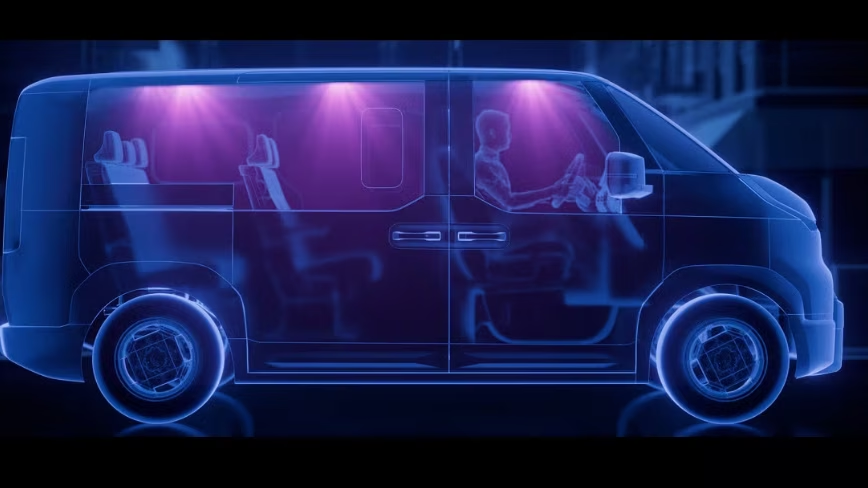
Image: courtesy of Thenextweb
Hyundai and Kia's In-Car UV System: Can 'Safe for Humans' Far-UVC Reshape Cabin Health?
Hyundai Motor Company and Kia Corporation recently unveiled 'Plasma Care UVC,' an in-vehicle sanitization system designed to kill bacteria and viruses, and eliminate odors, even while passengers are present. The technology employs far-ultraviolet C (far-UVC) light, which the automakers claim is lethal to pathogens but safe for human skin and eyes. While lab tests show high efficacy against airborne viruses and E. coli, the system is still undergoing further safety standard testing.
Outlook
Background
On June 24, 2026, Hyundai Motor Company and Kia Corporation announced the development of 'Plasma Care UVC,' which they describe as the world's first in-vehicle sanitization technology capable of operating safely with passengers inside. The system utilizes far-ultraviolet C (far-UVC) light, specifically within the 200-230 nanometer wavelength range. This particular spectrum is crucial, as the companies claim it provides enough energy to destroy bacteria and viruses without penetrating the protective outer keratin layer of human skin or damaging eyes.
Lab tests conducted in collaboration with the Korea Automotive Technology Institute (KATECH) demonstrated significant efficacy. The Plasma Care UVC system eliminated nearly 97% of airborne viruses within 30 minutes. Further tests applying the technology to a Kia PV5 confirmed a 99.9% eradication of Escherichia coli (E. coli) after 40 minutes of irradiation under specific tested conditions. Beyond pathogen destruction, the system also aims to reduce odors by targeting the microorganisms that cause them.
Despite these promising results, Hyundai and Kia confirmed that the technology is still undergoing rigorous testing to meet safety standards. This ongoing validation is a critical step before the system can be integrated into production vehicles and offered to the public.
See also
Precedents
The automotive industry has a long history of responding to consumer demands for comfort, safety, and increasingly, health. Air filtration systems, such as cabin air filters, have been standard for decades, evolving from basic dust filters to advanced particulate filters and even activated carbon filters designed to trap pollutants and allergens. More recently, high-efficiency particulate air (HEPA) filters have become a premium feature in some vehicles, especially after concerns about air quality heightened.
Beyond filtration, the concept of actively sanitizing vehicle interiors has gained traction, particularly following the global pandemic. Many aftermarket solutions, typically using conventional UV-C lamps or chemical sprays, emerged for disinfecting unoccupied vehicle cabins. However, these methods often require the vehicle to be empty due to the harmful nature of direct exposure to traditional UV-C light.
Hyundai and Kia's Plasma Care UVC represents a significant departure from these precedents by attempting to bring active, continuous disinfection into a occupied space. The use of far-UVC light in a consumer product, particularly one with such broad public exposure as an automobile, mirrors the industry's broader trend towards integrating advanced health and wellness technologies directly into the vehicle's core functionality, moving beyond passive protection to active intervention.
The potential for continuous, active sanitization in a vehicle cabin fundamentally changes the conversation around in-car health. For individual car owners, it could offer enhanced peace of mind, especially for families with young children, allergy sufferers, or those with compromised immune systems. The ability to disinfect while driving means a constantly refreshed environment, potentially reducing the spread of common illnesses.
For the booming shared mobility sector — ride-sharing, car rentals, and public transport — this technology holds even greater significance. Maintaining hygiene in vehicles used by multiple people throughout the day is a major operational challenge and a key concern for passengers. A system like Plasma Care UVC could dramatically improve public confidence in shared transport options, potentially reducing cleaning costs and turnaround times for operators.
This also positions Hyundai and Kia as innovators in automotive health technology, potentially giving them a competitive edge in a market increasingly focused on holistic well-being. If the safety claims of far-UVC light are fully validated and accepted by regulators, it could prompt other automakers to invest heavily in similar solutions, driving a new wave of in-cabin health features across the industry. The impact on vehicle design, material choices, and even air conditioning systems could be profound as manufacturers adapt to integrate such active sanitization capabilities.
Scenarios
Analysis1. Successful Regulatory Approval and Widespread Adoption: If Hyundai and Kia successfully navigate the remaining safety standard tests and secure regulatory approvals, Plasma Care UVC could become a significant selling point. This might lead to its integration into a wide range of their future models, starting with premium vehicles and eventually becoming a standard or optional feature across their lineup. Other automakers might then accelerate their own research and development into similar far-UVC or alternative in-cabin sanitization technologies, making active disinfection a new expected feature in vehicles.
2. Limited Rollout or Niche Application: There is a possibility that while the technology is proven safe, its cost, complexity of integration, or perceived necessity by the average consumer could limit its initial rollout. It might be primarily offered in specific markets where health concerns are paramount, or restricted to commercial fleets, ride-sharing vehicles, and luxury models. This outcome would still validate the technology's potential but slow its broader market penetration, allowing competitors more time to develop their own solutions.
3. Regulatory Hurdles or Public Hesitation: Despite Hyundai and Kia's claims, if ongoing safety tests reveal any unexpected long-term risks, or if regulatory bodies adopt an overly cautious stance on far-UVC exposure in occupied spaces, the technology's introduction could be delayed or significantly altered. Public perception, particularly regarding any form of UV light exposure, could also lead to hesitation, even with scientific assurances. This scenario would force Hyundai and Kia to either re-engineer the system, restrict its use, or abandon it entirely, at least for passenger-present applications.
Timeline
2026-06-24
Plasma Care UVC Unveiled
Hyundai Motor Company and Kia Corporation officially announce 'Plasma Care UVC,' describing it as the world’s first in-vehicle sanitization technology capable of operating while passengers are present. They highlight its use of far-UVC light and initial lab test results.
2026-07-01
Ongoing Safety Testing Confirmed
Reports confirm that the Plasma Care UVC system is still undergoing further testing to meet safety standards, a crucial step before commercial deployment.
Frequently Asked Questions
Far-UVC light refers to a specific band of ultraviolet-C radiation, typically in the 200-230 nanometer wavelength range. Unlike conventional UV-C light (which is commonly used for sterilization but can harm human skin and eyes), far-UVC is claimed by Hyundai and Kia to be safe for humans. This is because its photons have enough energy to destroy bacteria and viruses, but not enough to penetrate beyond the protective outer layer of human skin (the stratum corneum) or the tear layer of the eye, preventing cellular damage.
Discussion
Be the first to share your thoughts.