
Engineering teams at Starbase will spend the coming weeks analyzing telemetry data from Flight 15, specifically focusing on the divergent fates of the successfully caught upper stage and the lost booster. Regulatory reviews with the Federal Aviation Administration will likely center on the booster anomaly before any subsequent flight authorizations are granted.
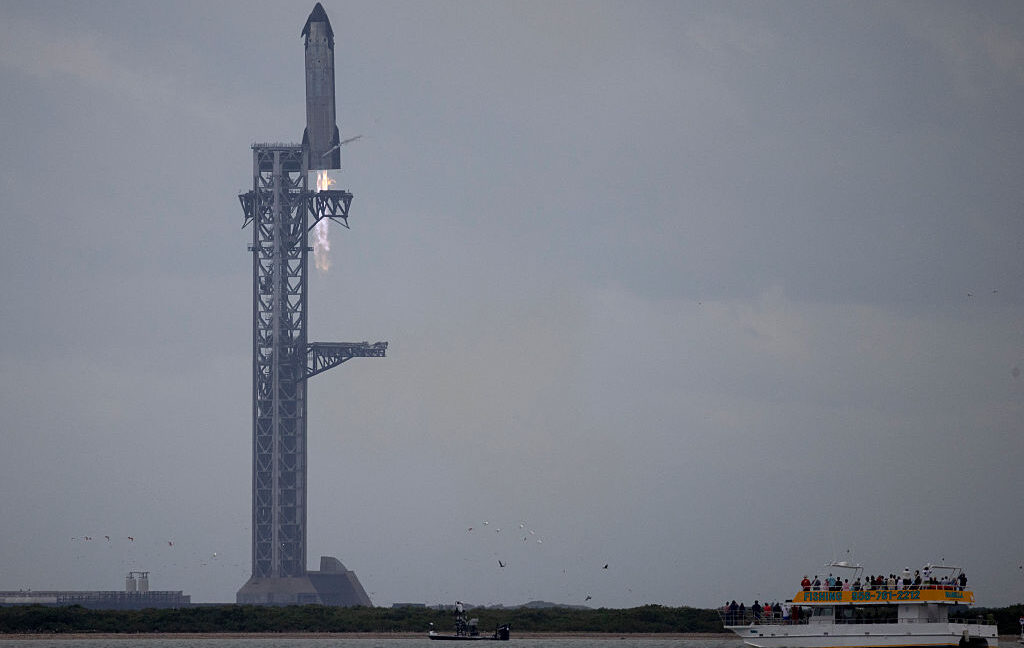
Image: courtesy of Ars Technica
SpaceX Caught Starship From Orbit, But the Booster Failure Reveals the Hard Math of Full Reusability
SpaceX successfully captured its orbital Starship upper stage using launch tower mechanical arms on Saturday, November 14, 2026, marking a major milestone for reusability. However, the Super Heavy booster missed its catch and splashed down in the Gulf of Mexico, highlighting the complex engineering hurdles still facing the program.
Outlook
Background
The test flight involved an ambitious 22-hour orbital mission for the Starship upper stage, designated Ship 42, before executing a controlled deorbit burn and a precision midair mechanical capture in South Texas. While capturing an upper stage returning from orbital velocity represents an unprecedented technical feat, the simultaneous loss of the Super Heavy booster indicates that achieving simultaneous, dual-stage tower catches remains an elusive operational goal.
See also
Precedents
SpaceX has historically treated hardware loss during test flights as iterative data collection rather than catastrophic failure, following a philosophy of rapid prototyping and frequent flight testing. Similar booster anomalies during early Falcon 9 development eventually gave way to routine recoveries, though scaling that reliability to a vehicle the size of Starship involves entirely new thermal and mechanical constraints.
The economic viability of future commercial payloads, lunar landings, and deep-space missions depends entirely on eliminating refurbishment bottlenecks and reducing turnaround times between flights. When half of a multi-million-dollar launch system ends up in the ocean rather than being reset on the pad, the cost-per-launch math changes significantly, putting pressure on engineering teams to close the reliability gap between the upper and lower stages.
Scenarios
AnalysisSpaceX may adjust its guidance software and grid-fin controls on upcoming flights to stabilize booster trajectories before attempting another tower catch. Alternatively, recurring booster aborts could force the company to rely on ocean splashdowns for the lower stage longer than originally planned while focusing primarily on upper-stage reusability metrics.
Timeline
November 13, 2026
Flight 15 Liftoff
SpaceX launched the Starship system on an ambitious test profile from its Starbase facility in South Texas.
November 14, 2026
Booster Abort and Upper Stage Orbit
The Super Heavy booster aborted its planned launch tower catch and fell into the Gulf of Mexico, while the upper stage successfully reached orbit for a 22-hour duration test.
November 14, 2026
Midair Tower Capture
Ship 42 executed a controlled deorbit burn, restarted its Raptor engines, and was successfully secured by the launch tower mechanical arms.
Frequently Asked Questions
The Super Heavy booster aborted its planned mechanical arm catch shortly after separation and fell into the Gulf of Mexico.
Discussion
Be the first to share your thoughts.