
Veridact
TechSportsFinanceGaming🎯 PredictionsAbout
Sign InSign Up
Veridact

AI-powered anticipation analysis. We cover tech, sports, finance, and gaming events before they happen — with historical context, scenario modeling, and evolving coverage.

Stay ahead of the story

Analysis delivered before events unfold.

Coverage

  • Tech
  • Sports
  • Finance
  • Gaming

Company

  • About Us
  • Privacy Policy

© 2026 Veridact. AI-assisted analysis platform.

Analysis is AI-generated and not professional financial, legal, or medical advice.

Tech
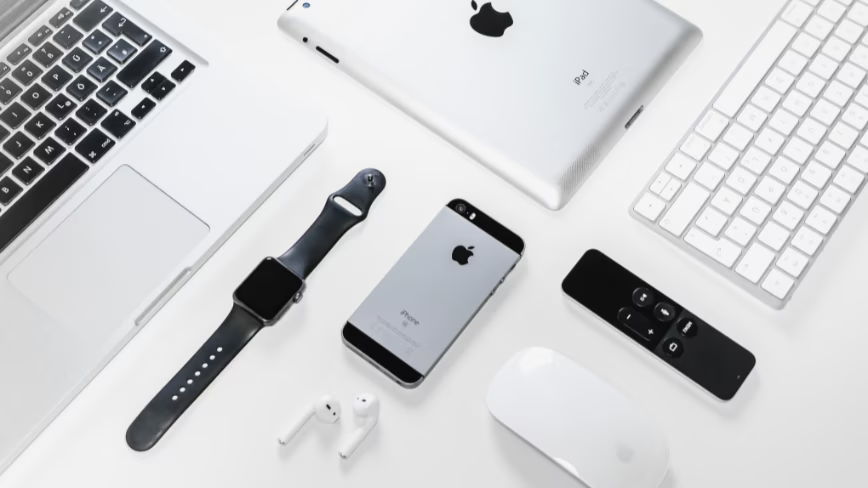
For the second time, Apple Intelligence is delayed in Europe, and this time there is no timeline

Image: courtesy of Thenextweb

techJune 9, 2026By Veridact EditorialUpdated Jun 9

Apple Pulls the Plug on European AI Timeline as Regulatory Standoff Deepens

Apple has indefinitely suspended its rollout timeline for Apple Intelligence features in the European Union, marking a dramatic escalation in its standoff with Brussels regulators. The decision exposes a fundamental incompatibility between the EU's Digital Markets Act (DMA) interoperability mandates and Apple's closed, security-first on-device and private cloud AI architecture.

What to Expect

The decision announced on June 8, 2026, marks the second major delay for Apple Intelligence in Europe, but this time, the company has removed all target dates and milestones from its regional roadmap. European iPhone, iPad, and Mac users are now facing an indefinite exclusion from the company's core generative AI features, including system-wide writing tools, image generation, and the deeply integrated Siri upgrade.

At the heart of the suspension is a profound technical and philosophical conflict over the European Union's Digital Markets Act. Under Article 6(7) of the DMA, 'gatekeepers' like Apple are legally required to provide third-party developers and service providers with effective, equivalent interoperability with the same operating system and hardware features used by the gatekeeper's own services. Apple's engineering team has designed Apple Intelligence as a deeply woven system component, running on-device models that share memory directly with the silicon and utilizing Private Cloud Compute (PCC) for off-device processing.

Apple asserts that opening up these deeply integrated APIs to third parties, as demanded by the European Commission, would create severe vulnerabilities in its security architecture. The company argues that allowing external developers equivalent access to the system-level contexts required by a proactive AI assistant could expose sensitive user data to malicious exploitation. Rather than attempting to patch or modify its global AI architecture for a single market, Apple has chosen to halt the deployment entirely. This decision leaves millions of European consumers with premium hardware that lacks the flagship software features sold elsewhere in the world, creating a stark regional division in the iOS ecosystem.

Key Context

The regulatory friction between Cupertino and Brussels has been building since the DMA came into full effect in early 2024. The European Commission, led by antitrust regulators, has consistently targeted Apple's control over its ecosystem, forcing the introduction of alternative app marketplaces, third-party browser engines, and alternative payment systems within the EU. While Apple complied with those rules through the release of iOS 17.4, it did so with visible reluctance, implementing complex fee structures and notarization processes that critics argue undermine the spirit of the law.

AI has transformed the nature of this conflict. Unlike app distribution or browser engines, which can be sandboxed and isolated, Apple Intelligence relies on continuous, system-wide observation of user behavior to deliver contextual value. It reads emails, scans calendars, monitors messages, and tracks on-screen activity to anticipate user needs. To do this safely, Apple engineered a cryptographic chain of trust extending from the local device to its custom silicon servers.

Why would Apple choose to alienate its second-largest regional market rather than simply comply with the DMA's interoperability rules?

The answer lies in the global integrity of Apple's brand. If Apple opens these deep-level system APIs to comply with the EU, it establishes a precedent that other jurisdictions—such as China, India, or the United States—might demand. Furthermore, a single high-profile security breach resulting from a third-party AI integration in Europe could permanently damage Apple's carefully cultivated reputation for privacy. From a capital allocation perspective, Apple has determined that protecting its global security model is far more valuable than maintaining immediate software parity in the European market.

Meanwhile, the European Commission remains unyielding. Regulators view Apple's security arguments with deep skepticism, often interpreting them as anti-competitive pretexts designed to lock users into proprietary services and freeze out European tech startups. This mutual distrust has turned what could have been a technical negotiation into an ideological stalemate.

Related Coverage

We tried Google’s AI glasses and they’re almost there→Apple destroyed the mid-tier watch market. Now it’s coming for the $200 billion eyewear industry.→Apple is building a bill-splitting feature that photographs receipts and assigns items to friends→Why Apple Might Put Cameras Into Its Next AirPods→

Historical Patterns

This is not the first time a major technology company has withheld advanced services from the European market due to regulatory uncertainty. In 2023, Meta delayed the European launch of its Threads platform for several months to assess compliance with the DMA's rules on data sharing between platforms. More recently, Google and Meta have both paused or restricted the deployment of specific multimodal AI capabilities and training initiatives within the EU, citing the unpredictable enforcement of both the DMA and the General Data Protection Regulation (GDPR).

Historically, Apple has eventually complied with European mandates, but only after exhausting every legal and technical delay tactic. The transition from the proprietary Lightning connector to the universal USB-C standard on the iPhone 15 is a prime example of Apple resisting regulatory pressure until compliance became unavoidable. Similarly, the company fought the integration of alternative app stores for years before executing a highly controlled, localized capitulation in iOS 17.4.

However, the Apple Intelligence delay represents a different strategic approach. Unlike hardware ports or app distribution channels, which can be modified without altering the core experience of users in the rest of the world, AI integration is the defining feature of Apple's long-term software roadmap. By withholding its most advanced software, Apple is employing a form of soft leverage, shifting the burden of consumer frustration directly onto European regulators. The company is testing whether European voters and business leaders will tolerate falling behind the global curve in AI productivity, or if they will pressure Brussels to soften its enforcement of the DMA.

The Geopolitical Split of Consumer Technology

Potential Outcomes

Analysis

Analysis: The standoff over Apple Intelligence is likely to resolve through one of three distinct scenarios over the next eighteen months:

In the first scenario, a prolonged regulatory stalemate leads to a permanent software divide. Apple refuses to compromise its security architecture, and the European Commission refuses to grant an exemption. As a result, Apple continues to sell hardware in Europe with a stripped-down, localized operating system that relies on legacy search tools and basic cloud integrations. Over time, this causes a gradual erosion of Apple's premium market share in Europe, as consumers migrate to competitor devices running Android systems that have negotiated compliant, localized AI partnerships.

In the second scenario, Apple and the European Commission reach a highly technical compromise. Under this agreement, Apple develops a specialized 'EU Sandbox' for Apple Intelligence. This framework allows third-party AI models to access system APIs, but only under extremely rigid, cryptographically verified conditions that satisfy Apple's security requirements while technically meeting the DMA's interoperability mandates. This localized version of Apple Intelligence would likely launch with significant delays and reduced performance compared to the global version, but it would prevent a total product lockout.

In the third scenario, consumer and business backlash forces a political reassessment in Brussels. As European enterprises realize their workforces are operating at a competitive disadvantage without integrated AI tools, business lobbies put pressure on the European Commission to issue a clarified guidance document. This guidance would classify deeply integrated, on-device operating system security measures as exempt from standard interoperability mandates, allowing Apple to deploy its global AI architecture without modification.

Timeline

2024-06-10
Apple Intelligence Unveiled
Apple introduces its generative AI system at WWDC 2024, promising deep integration across iOS, iPadOS, and macOS.
2024-06-21
First European Delay Announced
Apple announces that Apple Intelligence, iPhone Mirroring, and SharePlay Screen Sharing will be withheld from the EU due to DMA regulatory uncertainties.
2025-03-15
Global Rollout Expands
Apple Intelligence features roll out in multiple languages and regions globally, while European devices remain restricted to basic system functions.
2026-06-08
Timeline Suspended Indefinitely
Apple officially removes all target dates for the European release of Apple Intelligence, citing unresolved compliance discussions with the European Commission.
2026-11-15
Expected: EC Compliance Review
The European Commission is scheduled to release its comprehensive review of gatekeeper compliance under the Digital Markets Act.

Frequently Asked Questions

The delay is caused by a conflict between Apple's security architecture and the EU's Digital Markets Act (DMA). The DMA requires Apple to make its core operating system features interoperable with third-party developers. Apple argues that opening up the deep system access required by its AI tools would compromise user privacy and data security.

Discussion

0/100
0/1000

Be the first to share your thoughts.

Related Coverage

tech

The Neural Cold War Begins: Inside China's Approval of the First Commercial Brain Implant

Jun 9
tech

The Automated Ring: Inside the Tri-National AI and Robotics Network Securing the 2026 World Cup

Jun 8
tech

Lauf’s eElja is an $8,500 Play to Prove Boutique Gravel Design Can Survive the Brutal e-MTB Market

Jun 8
tech

The NUMMI Solution: Why Detroit's Survival Now Depends on Partnering with Its Chinese Rivals

Jun 7

Stay ahead of the story

AI analysis delivered before events unfold. No spam.

ⓘ

Disclosure: This article contains AI-assisted analysis based on publicly available information.