
The immediate focus will be on the next launch attempt for SpaceX's Starship, which has been reset after its most recent delay. Industry observers will be watching closely to see if the engine swap resolves previous issues and if the 13th test flight can finally proceed. For Relativity Space, the announcement of a second factory suggests an accelerated timeline for production and a push towards increasing launch cadence, with more details on its construction and operational targets likely to emerge. The successful Chinese launch, despite the lightning, confirms their operational robustness, suggesting continued activity in their satellite deployment programs.
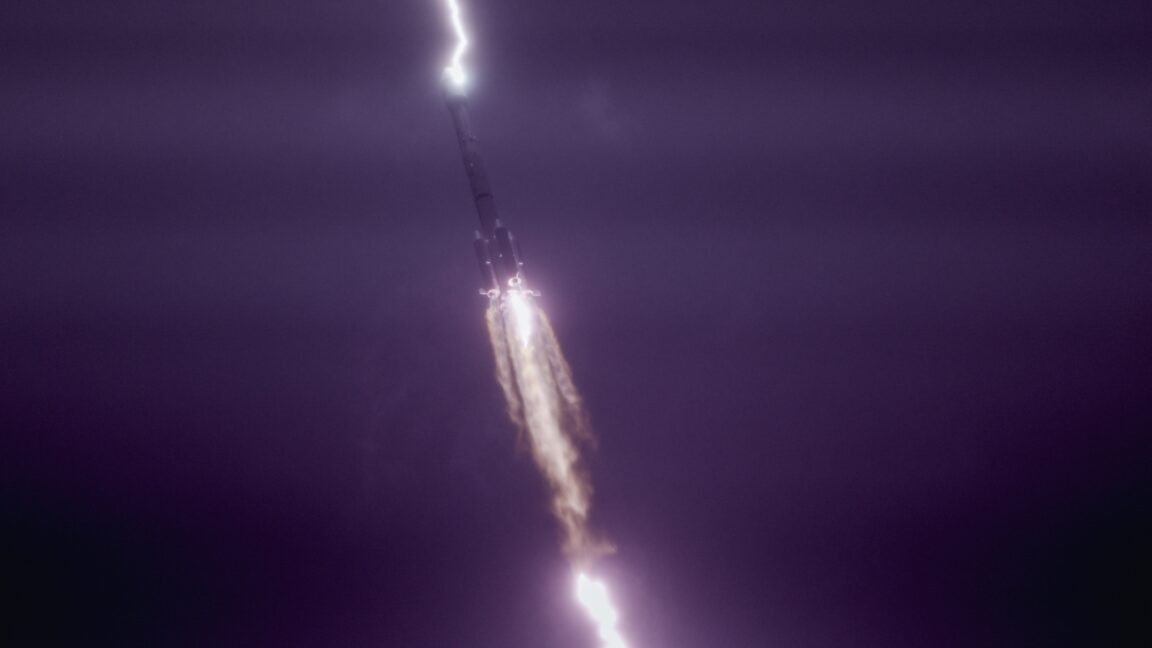
Image: courtesy of Ars Technica
China's Rocket Resilience, SpaceX's Starship Delays, and the Shifting Space Race
Recent developments in the global space industry paint a complex picture of innovation, resilience, and persistent challenge. A Chinese Long March 3B rocket successfully shrugged off a direct lightning strike immediately after liftoff on July 23, 2026, delivering its satellite to orbit without issue. Meanwhile, SpaceX's much-anticipated 13th Starship test flight faces further delays, with the vehicle now back on the launch pad after a last-minute engine swap on July 16. Adding another dimension to the competitive landscape, Relativity Space confirmed plans to construct a second rocket manufacturing facility near Cape Canaveral, Florida, signalling an expansion of its 3D-printed rocket capabilities.
Outlook
Background
The survival of the Long March 3B rocket after a lightning strike is a testament to modern rocket engineering and the robust electrical grounding and shielding systems built into these vehicles. Rockets are designed to withstand such events, particularly when launching through stormy weather, but a direct hit remains a dramatic and concerning incident. This success reinforces China's growing technical prowess and reliability in space operations, especially as it expands its independent satellite communication networks with missions like the Tianlian II-06 relay satellite.
SpaceX's Starship program, by contrast, represents the bleeding edge of reusable rocketry, aiming for unprecedented scale and cost efficiency. The 13th test flight's delay, following a last-second abort and subsequent engine swap, highlights the inherent difficulties in developing and refining such a complex, next-generation system. Each delay, while frustrating for enthusiasts and potentially impacting internal timelines for projects like Starlink deployment or lunar missions, is a critical part of the iterative testing process necessary for a vehicle of this ambition. The ability to roll back the booster for repairs and return it to the pad quickly also demonstrates SpaceX's operational flexibility.
Relativity Space's decision to build a second factory near Cape Canaveral indicates a significant scaling of its operations. The company is known for its innovative approach to rocket manufacturing, primarily using 3D printing to produce entire rocket structures. Expanding its manufacturing footprint in Florida, a prime launch location, suggests a strategic move to increase production capacity for its Terran 1 and future Terran R rockets, positioning it as a more substantial competitor in the commercial launch market against established players and new entrants alike. This move implies a confident outlook on future demand for its unique, rapidly manufacturable launch services.
See also
Precedents
Rocket launches have always been fraught with risk, and weather, particularly lightning, has historically posed a significant threat. One of the most famous incidents involved Apollo 12 in 1969, which was struck by lightning twice shortly after liftoff, causing temporary power losses but ultimately a successful mission thanks to quick-thinking ground control and resilient systems. Modern rockets incorporate advanced lightning protection, including conductive paths to guide electrical charges safely away from sensitive electronics and fuel tanks. The Chinese Long March 3B's survival echoes these historical precedents, demonstrating that while dramatic, such events are often accounted for in design.
Delays in ambitious space programs are also a well-established pattern. From the early days of NASA's Mercury and Apollo programs to the Space Shuttle's development and more recent large-scale projects, pushing the boundaries of technology almost always involves unforeseen engineering challenges, extensive testing, and schedule adjustments. SpaceX itself has a history of iterative development and delays with its Falcon 9 and Starship programs, often prioritizing testing and safety over strict adherence to initial timelines. This approach, while sometimes frustrating, is often necessary to achieve long-term reliability for complex systems.
The expansion of manufacturing capabilities by new space companies, particularly in areas like Cape Canaveral, mirrors growth trends seen in other high-tech industries. As companies mature from R&D to commercial operations, scaling production becomes paramount. The move by Relativity Space to build a second factory is a classic sign of a company moving beyond initial proof-of-concept to industrialize its unique manufacturing process, aiming for higher launch frequencies and greater market share. This pattern has been observed with other launch providers who have invested heavily in dedicated production facilities to meet growing demand.
These developments collectively highlight the intense global competition and rapid evolution within the space industry. The Long March 3B's successful mission, despite the lightning strike, solidifies China's position as a robust and reliable space power, capable of maintaining its critical satellite infrastructure even under challenging conditions. This reliability is strategically important for its national security and economic interests, particularly as global powers increasingly rely on space assets.
For SpaceX, the Starship program is not just another rocket; it is central to the company's long-term vision of making humanity multi-planetary and drastically reducing the cost of space access. The persistent delays, while expected in such an ambitious undertaking, underscore the significant engineering hurdles that still need to be overcome. The success or failure of Starship's rapid development will dictate the pace of future missions to the Moon and Mars, and significantly influence the economic viability of large-scale satellite constellations like Starlink.
Relativity Space's expansion, meanwhile, signals the maturation of a new manufacturing paradigm in aerospace. Its 3D printing technology promises faster, more flexible, and potentially cheaper rocket production. A second factory could accelerate the availability of its launch services, introducing more competition and potentially driving down costs across the industry. This could enable a wider range of companies and nations to access space, democratizing launch capabilities and fostering further innovation in satellite technology and in-orbit services. The interplay between established reliability, cutting-edge but challenging innovation, and scalable new manufacturing defines the current stakes of the space race.
Scenarios
AnalysisOne immediate outcome centres on SpaceX's Starship program. If the upcoming 13th test flight proceeds successfully, demonstrating key flight objectives, it could accelerate the development timeline, potentially leading to more frequent test flights and a clearer path toward operational readiness. This could allow SpaceX to begin deploying the next generation of Starlink satellites or move forward with crewed lunar missions as planned.
Conversely, another abort or a partial failure of the 13th test flight could necessitate further redesigns and extensive re-testing. This would likely push back Starship's operational debut, potentially delaying Starlink V2 deployments and the ambitious timelines for lunar and Martian missions. Such delays could also increase development costs, placing additional financial pressure on the company's long-term goals.
For Relativity Space, the successful construction and operationalization of its second factory could significantly boost its production capacity and launch cadence. This might allow the company to capture a larger share of the small and medium-lift launch market, proving the viability and scalability of its 3D-printing approach. Increased competition from Relativity could also put pressure on other launch providers to innovate on cost and manufacturing speed.
However, the expansion could also face unforeseen construction or operational challenges, including supply chain issues for materials or difficulties in scaling up its unique manufacturing processes. Market demand might not grow as quickly as anticipated, or established competitors could introduce more cost-effective solutions, potentially leading to underutilized capacity at the new facility and financial strain.
Timeline
2024-09-18
SpaceX Static Fires Ship 31
SpaceX conducted a static fire test of Ship 31, the upper stage for a future Starship flight, as documented by NASASpaceflight.
2024-11-16
Starship Stakeout
SpaceX continued its Starship test preparations, with ongoing activities at its launch site documented by NASASpaceflight.
2026-07-16
Starship 13th Test Flight Abort
SpaceX aborted the 13th test flight of its Starship vehicle at the last second, necessitating a rollback to the hangar for an engine swap.
2026-07-23
Chinese Long March 3B Lightning Strike and Launch
A Long March 3B carrier rocket, carrying the Tianlian II-06 satellite, was struck by lightning about 30 seconds after liftoff from the Xichang Satellite Launch Center. The rocket successfully delivered its payload into geostationary transfer orbit.
2026-07-24
Relativity Space Factory Announcement
Relativity Space announced its plans to build a second rocket factory near Cape Canaveral, Florida, to expand its manufacturing capabilities.
Frequently Asked Questions
Modern rockets are designed with robust electrical grounding and shielding systems. These systems typically include conductive paths on the rocket's exterior that can safely channel the massive electrical charge of a lightning strike away from sensitive internal electronics and fuel tanks, dissipating it into the atmosphere or through the rocket structure without causing critical damage. Engineers also consider launch weather conditions carefully, though unexpected strikes can still occur.
Discussion
Be the first to share your thoughts.