
As the moon passes directly between the Sun and Earth today, August 12, 2026, creating a total solar eclipse across parts of Europe, the Circular Slit Spectrometer (CISS) will be activated. Researchers at the Javalambre Astrophysical Observatory in Spain will be attempting to use the brief moments of totality to gather comprehensive data. The CISS is designed to overcome a long-standing challenge in solar observation: capturing the full, faint extent of the corona's light at once. Scientists hope the instrument will successfully break down the corona's light into its component wavelengths, providing a detailed spectral map across its entire visible expanse. This would allow them to analyze the elements present, their temperatures, and their velocities with a level of detail previously unattainable during an eclipse. Success would mean a flood of new data, offering immediate insights into the physical processes driving the corona, while any unexpected results could still open new avenues of inquiry.
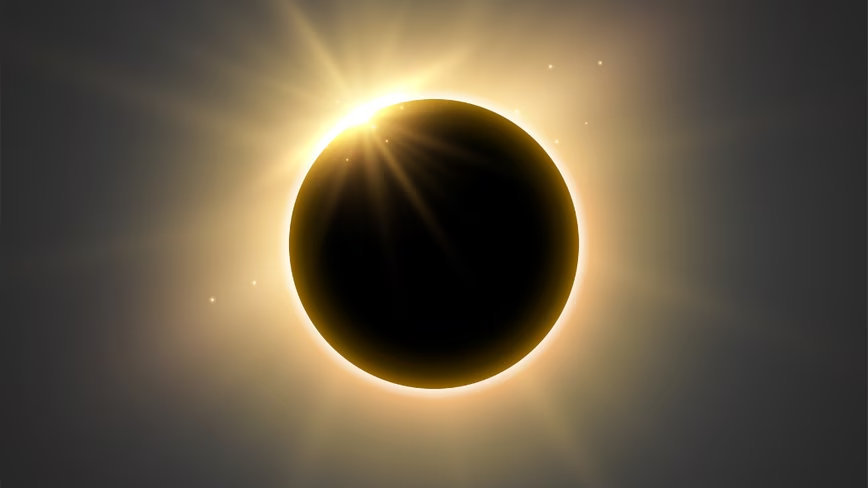
Image: courtesy of Thenextweb
Today's Eclipse Test: Italy's New Spectrometer Aims to Unlock the Sun's Corona Secrets
Italian scientists are putting a new solar instrument, the Circular Slit Spectrometer (CISS), to its most critical test today during a total solar eclipse. Positioned at Spain's Javalambre Astrophysical Observatory, the CISS aims to capture the entire spectrum of the Sun's mysterious outer atmosphere, the corona, in a single photograph. This high-stakes experiment could provide an unprecedented view of the corona's composition and dynamics, potentially advancing solar research significantly.
Outlook
Background
The solar corona, the outermost layer of the Sun's atmosphere, is a region of extreme temperatures — millions of degrees Celsius — far hotter than the Sun's surface. Yet, it remains one of the most enigmatic areas of solar physics. Its extreme brightness is usually outshone by the Sun's photosphere, making it visible only during a total solar eclipse or with specialized instruments called coronagraphs, which artificially block the Sun's disk. Current methods of studying the corona's spectrum often involve scanning instruments that capture data from small sections at a time, or using instruments with limited fields of view. This piecemeal approach makes it difficult to understand the corona's overall structure and how different regions interact.
The Circular Slit Spectrometer (CISS), developed by Italian scientists in Padua, addresses this by employing a circular slit that, in theory, allows it to image the entire corona simultaneously. A spectrometer is an instrument that separates light into its constituent colors, or wavelengths, much like a prism. By analyzing these individual wavelengths, scientists can deduce crucial information about the light source, including its chemical composition, temperature, density, and motion. The CISS's novel design aims to provide a complete spectral snapshot, offering a holistic view rather than fragmented data points. If it performs as intended today, it could provide the most comprehensive spectral data of the solar corona ever collected during an eclipse, potentially revealing mechanisms behind phenomena like solar flares and coronal mass ejections.
Precedents
Humanity's fascination with solar eclipses dates back millennia, with early observations often tied to myth and prophecy. Scientifically, eclipses have long served as rare windows into the Sun's outer layers. It was during an 1868 eclipse that helium, an element previously unknown on Earth, was first detected in the Sun's spectrum. Over the centuries, astronomers have used eclipses to observe the corona's structure, measure its temperature, and study its dynamic plumes and streamers.
The development of the coronagraph in the 1930s allowed for continuous, artificial eclipses, enabling daily monitoring of the corona from ground-based observatories and eventually from space. However, even advanced coronagraphs have limitations, particularly in observing the innermost regions of the corona and capturing its full spectral detail across a wide field. Each total solar eclipse, therefore, remains a unique opportunity to deploy new instruments and gather data that might be impossible to obtain otherwise. The CISS experiment today follows a long tradition of leveraging these fleeting moments for significant scientific advancement, building upon centuries of incremental progress in solar observation and spectroscopic analysis. Historically, breakthroughs often come from new instruments that can see more, or see differently, than their predecessors.
Understanding the Sun's corona is not merely an academic exercise; it has tangible consequences for life and technology on Earth. The corona is the source of the solar wind, a stream of charged particles that constantly flows from the Sun and interacts with our planet's magnetic field. More dramatically, it is where powerful events like solar flares and coronal mass ejections (CMEs) originate. These 'space weather' phenomena can cause geomagnetic storms, disrupting satellite communications, GPS systems, power grids, and even posing risks to astronauts.
By providing a comprehensive spectral map of the corona, the CISS could help scientists better understand the fundamental physics driving these events. This improved understanding could lead to more accurate predictions of space weather, giving critical infrastructure operators more time to prepare and mitigate potential damage. Beyond practical applications, the data could also shed light on fundamental astrophysical questions, such as how stellar atmospheres are heated to such extreme temperatures, a puzzle that has challenged physicists for decades. The CISS experiment represents a crucial step in unraveling these solar mysteries, with implications ranging from basic physics to safeguarding our technological society.
Scenarios
AnalysisThe success or failure of the CISS instrument today carries several distinct possibilities for solar science:
* Outcome 1: Comprehensive Success and New Discoveries. If the Circular Slit Spectrometer operates flawlessly and captures high-resolution, full-corona spectral data, it would be a significant validation of its innovative design. This would immediately provide scientists with an unprecedented dataset, likely revealing new details about the corona's composition, temperature gradients, and plasma flows. This could lead to a rapid re-evaluation of existing models for coronal heating and solar wind acceleration, potentially unlocking long-standing puzzles. The instrument would then be seen as a viable tool for future eclipse expeditions and potentially inspire new designs for space-based coronagraphs, offering a 'proof of concept' for a new generation of solar observation.
* Outcome 2: Partial Success or Unforeseen Data. The CISS might function, but perhaps not to its full design specifications, or it could capture data that is unexpected or difficult to interpret. This could be due to minor technical glitches, atmospheric interference during the eclipse, or the corona itself behaving in ways not fully anticipated. Even partial success, however, would still yield valuable information, perhaps highlighting areas for instrument refinement or pointing towards new, previously unconsidered aspects of coronal physics. This outcome would still be considered scientifically fruitful, though it might delay the 'transformative' impact, leading to further development and testing rather than immediate breakthroughs.
* Outcome 3: Technical Failure or Data Loss. In any complex scientific experiment, particularly one relying on a brief, natural event, there is a risk of failure. This could involve an instrument malfunction, severe weather conditions at the observatory hindering observations, or issues with data recording or transmission. A complete failure to collect meaningful data would represent a setback for the Italian team and a missed opportunity for solar science during this eclipse. It would necessitate a thorough review of the instrument's design and operation, potentially leading to significant redesigns and a wait for the next suitable eclipse opportunity to re-test the concept.
Timeline
Frequently Asked Questions
Discussion
Be the first to share your thoughts.