
Expect a period of intense internal focus on Apple's industrial design group under John Ternus's leadership. This will likely involve strategic new hires, a re-evaluation of current design processes, and a clearer articulation of Apple's future design philosophy. Consumers may see the early results of this renewed emphasis in product lines launched from late 2027 onwards, potentially featuring design choices that prioritize functionality and user experience in new ways, or revisit popular features from earlier generations. For investors, the success of this design overhaul will be a key indicator of Apple's long-term innovation capacity and brand strength.
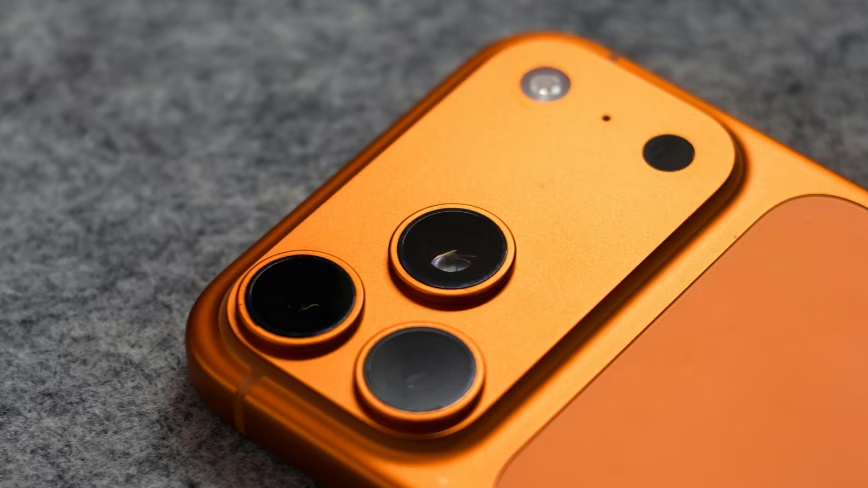
Image: courtesy of Thenextweb
Apple's New CEO John Ternus Faces the Challenge of Rebuilding a Faded Design Studio
Apple is undergoing a significant leadership transition, with Tim Cook moving to Executive Chairman and John Ternus stepping in as CEO. Ternus inherits a design studio that has seen an exodus of key talent from the Jony Ive era. He has publicly committed to refocusing on design, a move that signals a potential shift in Apple's product philosophy and an attempt to re-energize a core part of its identity. This comes amidst a broader debate about whether Apple's design had lost its way or was simply evolving.
Outlook
Background
For decades, Apple's identity has been inextricably linked to its design. Sir Jony Ive, who served as Apple's chief design officer, was the architect of many of its most iconic products, from the original iMac to the iPhone. His departure in June 2019 to form his own independent design company, LoveFrom, marked the end of an era. While Apple remained a client, his direct influence waned. In the years following, a quiet but steady exodus of designers who had worked closely with Ive has occurred, leaving the studio significantly changed. This 'brain drain' has raised questions about the direction and vitality of Apple's design ethos.
Incoming CEO John Ternus, officially announced on April 20, 2026, to succeed Tim Cook, steps into this environment with a clear mandate. Ternus comes from Apple’s product engineering and design ranks, having overseen the industrial design group since late 2025. He has directly addressed employees, stating that the company will 'keep focusing on design, because design is core to what we do at Apple.' This public declaration signals a conscious effort to rebuild and re-center design at the heart of Apple's operations, a critical task for a company whose market value is built as much on aesthetic appeal and user experience as it is on technology.
See also
Precedents
Apple's history is punctuated by periods of significant design evolution and leadership changes. The return of Steve Jobs in the late 1990s, alongside Jony Ive, ushered in an era of minimalist, user-centric design that rescued the company from near bankruptcy. This period established a precedent: design, when executed with clear vision and authority, can be a primary differentiator and growth engine.
Conversely, periods of perceived design stagnation or missteps have historically drawn criticism. After Jobs’ initial departure in the 1980s, Apple products sometimes struggled with cohesive design language. More recently, some critics and users argued that Ive's later obsession with 'thinness' and 'minimalism' sometimes came at the expense of practicality, leading to issues like the controversial butterfly keyboard or the removal of popular ports. The reintroduction of features like MagSafe charging and HDMI ports in more recent MacBook models, which came after Ive's departure, is often cited by some users as evidence of a course correction, suggesting that a shift away from Ive's singular vision could be beneficial. This historical tension between aesthetic purity and functional pragmatism provides a backdrop for Ternus's current challenge.
The future of Apple's design studio is not just an internal corporate matter; it is central to the company's long-term strategy and its perceived value in the global market. Apple's premium pricing and fiercely loyal customer base are heavily influenced by the distinct look, feel, and user experience of its products. A strong design team ensures that Apple can continue to innovate not just technologically, but also aesthetically and functionally.
If Ternus succeeds in revitalizing the design studio, it could lead to a new wave of iconic products that reinforce Apple's brand leadership and command market attention. This would maintain its competitive edge against rivals who consistently try to emulate its success. Conversely, if the rebuilding efforts falter, or if Apple's design language becomes diluted or less distinctive, it could erode customer loyalty and make it harder to justify premium prices, potentially impacting revenue and market share. For investors, this translates directly into questions about Apple's ability to sustain its growth trajectory and maintain its high valuation.
Scenarios
AnalysisThere are several possible directions for Apple's design studio under John Ternus.
One outcome is a renaissance of pragmatic design, where Ternus, leveraging his product engineering background, steers the team towards a design philosophy that balances aesthetics with enhanced functionality and user convenience. This could involve a continued willingness to reintroduce or refine beloved features, while still pushing boundaries on new product categories. Such an approach might resonate strongly with a user base that has sometimes expressed frustration with design choices prioritizing form over function.
Alternatively, Ternus could pursue a more evolutionary path, focusing on a gradual infusion of new talent and ideas while maintaining a core Apple aesthetic. This would be a less radical shift, aiming to rebuild institutional knowledge and collaborative spirit within the design team without fundamentally altering the company's overall design direction. This approach might prioritize stability and incremental improvements over dramatic departures.
A third possibility, though less likely given Ternus's stated intent, is that the design studio struggles to regain its former influence or cohesion. Rebuilding a creative team after a significant talent exodus is challenging, and cultural shifts can be slow. If new leadership fails to attract top-tier talent or establish a clear, compelling design vision, the studio's output could become less distinctive, potentially leading to a more iterative product roadmap and a perceived lack of innovation in future Apple devices.
Timeline
2017-12-08
Jony Ive Resumes Direct Design Oversight
Apple announced that Jony Ive would resume direct responsibility for the company's product design, after a period where he had stepped back from day-to-day management.
2019-06-27
Jony Ive Departs Apple
Apple announced that Jony Ive would depart after 27 years to form his own independent design company, LoveFrom, with Apple as his first client.
2025-10-01
John Ternus Takes Oversight of Industrial Design (Inferred)
John Ternus began overseeing Apple's industrial design group in late 2025, a move that positioned him closer to the company's core product aesthetics ahead of his CEO appointment.
2026-04-20
Tim Cook to Executive Chairman, John Ternus to CEO
Apple officially announced that Tim Cook would transition to Executive Chairman, and John Ternus would become the new Chief Executive Officer.
2026-06-21
Ternus Reaffirms Design Focus
Reports emerged that John Ternus addressed employees, emphasizing that Apple would 'keep focusing on design, because design is core to what we do at Apple,' in response to the exodus of Jony Ive-era designers.
Frequently Asked Questions
John Ternus is the incoming CEO of Apple, announced on April 20, 2026, to succeed Tim Cook. He previously held leadership roles in product engineering and design, and began overseeing Apple's industrial design group in late 2025.
Discussion
Be the first to share your thoughts.