
The immediate consequence of the proposed ban on Chinese data center components will be a substantial shift in procurement strategies for companies operating large AI infrastructure, notably Amazon and Microsoft. These firms are likely to accelerate investments in non-Chinese suppliers and domestic manufacturing capabilities, as evidenced by Amazon's multi-billion dollar agreement with Corning for optical fiber. This transition will likely increase initial costs for building and expanding AI data centers in the U.S., as domestic or allied-nation suppliers may not yet offer the same economies of scale or production capacity as their Chinese counterparts. We can expect intensified lobbying efforts from tech companies regarding the specifics of the ban, particularly concerning timelines for compliance and potential subsidies or incentives for domestic production. The move also signals a hardening stance in the broader US-China tech competition, setting a precedent for future restrictions on critical technology components.
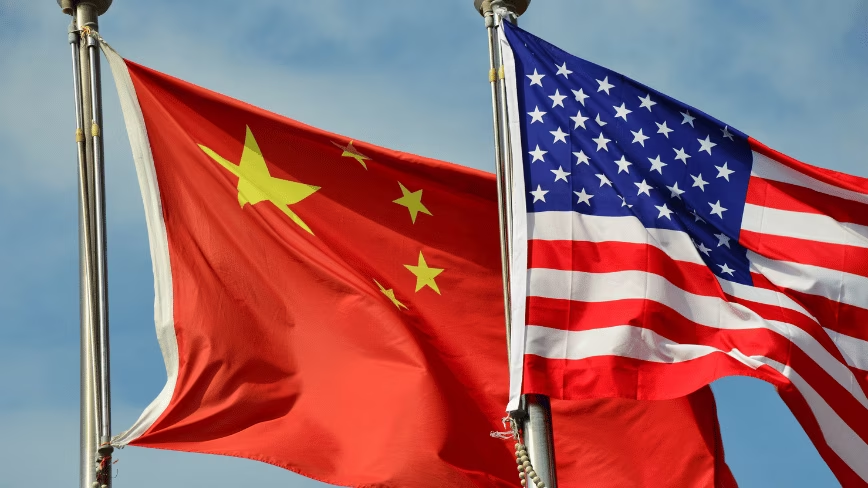
Image: courtesy of Thenextweb
The AI Supply Chain Split: Billions at Stake as Amazon and Microsoft Rewire Data Centers Away From China
The United States is pushing to remove Chinese-made optical components from its critical artificial intelligence data centers, citing national security concerns. Major tech companies like Amazon and Microsoft are publicly backing this initiative, which is set to incur significant costs and reshape the global tech supply chain. The Trump administration is reportedly drafting a ban on new Chinese data center parts, aiming to secure the infrastructure that underpins the booming AI industry.
Outlook
Background
At the heart of modern AI data centers are optical transceivers — tiny, high-speed components that convert electrical signals into light and vice versa, enabling vast amounts of data to travel across fiber optic networks within and between facilities. These components are crucial for the rapid communication required by AI models, which process immense datasets at unprecedented speeds. China has emerged as a dominant global supplier of these optics, offering competitive pricing and extensive manufacturing capabilities. The U.S. government's concern, particularly from the Trump administration, centers on the potential for these Chinese-made components to be exploited for espionage or to disrupt critical U.S. infrastructure in a geopolitical conflict. The fear is that embedded vulnerabilities or backdoors could compromise data integrity or even allow for remote sabotage of AI systems. This national security imperative now directly confronts the economic realities of a deeply integrated global supply chain. Companies like Amazon, Microsoft, Meta, Alphabet, and OpenAI are collectively spending hundreds of billions of dollars on AI capacity, much of it reliant on these very components. The proposed 'America-First Right of Refusal' within the Guaranteeing Access and Innovation for National Artificial Intelligence (GAIN AI) Act, which would prioritize domestic orders for advanced AI chips, further illustrates the broader governmental push to de-risk the AI supply chain from foreign dependencies.
Precedents
The current push to restrict Chinese components in AI data centers is not an isolated policy, but rather an escalation in a long-running pattern of U.S.-China tech competition. Over the past decade, Washington has increasingly viewed China's technological advancements, particularly in areas like 5G networks and advanced semiconductors, as national security threats. The most prominent example is the series of restrictions placed on Huawei, the Chinese telecommunications giant, which effectively cut off its access to crucial U.S.-made chips and software. Similarly, the U.S. has imposed export controls on advanced semiconductor manufacturing equipment, aiming to slow China's progress in developing cutting-edge chips. These actions reflect a strategy of 'decoupling' or 'de-risking' critical supply chains, attempting to reduce U.S. reliance on Chinese manufacturing for sensitive technologies. However, history also shows the complexity and cost of such efforts. Shifting supply chains is a monumental task, often leading to higher prices and potential delays as new manufacturing capabilities are built out. While the U.S. has successfully spurred some domestic investment in semiconductors, fully replacing Chinese dominance in areas like optical components, where they hold a significant market share, presents a formidable challenge. The Amazon-Corning deal mirrors previous attempts by companies to preempt or react to government pressure by investing in domestic alternatives, but the scale of the AI build-out means this is a far larger undertaking.
This move to purge Chinese optics from U.S. AI data centers carries profound implications across national security, economic competitiveness, and the future trajectory of artificial intelligence. From a national security standpoint, securing the foundational infrastructure of AI is seen as paramount. As AI systems become more integrated into defense, critical infrastructure, and economic functions, any potential vulnerability introduced through compromised hardware could have catastrophic consequences. The policy aims to eliminate this perceived risk, ensuring the integrity and resilience of America's AI backbone. Economically, the ban forces a costly realignment for hyperscale cloud providers and other companies investing heavily in AI. While supporting domestic manufacturing, as seen with the Corning deal creating 1,000 jobs, it also means higher procurement costs in the short to medium term. These increased costs could eventually trickle down to consumers and businesses relying on AI services, potentially slowing the pace of innovation or making AI less accessible. Furthermore, this policy deepens the technological divide between the U.S. and China, creating parallel ecosystems. This could lead to fragmentation in global tech standards and supply chains, increasing complexity and potentially hindering international collaboration on AI development. The real stakes lie in defining who controls the foundational layers of future AI, and whether the U.S. can build a secure, self-sufficient, and competitive supply chain without stifling its own technological progress.
Scenarios
AnalysisThe push to remove Chinese optical components from U.S. AI data centers could lead to several distinct outcomes, each with its own set of challenges and opportunities.
One possible outcome is a successful, albeit costly, domestication or diversification of the AI optics supply chain. Companies like Amazon and Microsoft, with their vast capital and strategic importance, could significantly accelerate investments in U.S. and allied-nation manufacturing. The Amazon-Corning deal is an early indicator of this. This would create new jobs, strengthen domestic industrial capacity, and fulfill the national security objective. However, this path would likely involve higher initial costs for AI infrastructure, potentially slowing the expansion of AI capabilities as companies absorb these expenses. It would also require a sustained commitment from both government and industry to overcome technical bottlenecks and achieve competitive scale.
Another scenario involves partial success with persistent reliance on non-Chinese foreign suppliers. If U.S. domestic manufacturing cannot ramp up quickly enough or achieve cost parity, companies might pivot heavily towards suppliers in countries like South Korea, Japan, or European nations. This would still diversify away from China and address some security concerns, but it would not achieve full domestic self-sufficiency. This path might be less expensive than full domestication but still introduces dependencies on other foreign nations, albeit ones considered more aligned with U.S. interests. It would also mean that the U.S. would not fully capture the economic benefits of manufacturing these components domestically.
A third outcome could see significant market fragmentation and a bifurcated global AI ecosystem. If the U.S. aggressively pursues this ban, China could respond by accelerating its own efforts to develop indigenous, self-sufficient AI hardware. This could lead to two distinct, incompatible AI infrastructure standards and supply chains globally, complicating international trade and technological collaboration. For companies like Amazon and Microsoft that also operate in China, this could force difficult decisions about their operations and technology stacks in different regions, potentially increasing operational complexity and costs.
Finally, there is a speculative possibility of unintended consequences, such as a slowdown in U.S. AI innovation. If the cost of building secure AI data centers becomes too high, or if supply chain disruptions lead to delays in acquiring critical components, it could hinder the rapid development and deployment of new AI applications in the U.S. This would create a tension between national security and technological advancement, forcing policymakers to balance these priorities carefully. The sheer scale of investment required, coupled with potential manufacturing challenges, means that achieving the desired level of security without impacting innovation will be a delicate balancing act.
Timeline
Frequently Asked Questions
Discussion
Be the first to share your thoughts.