
The immediate aftermath of Apple's lawsuit will likely see OpenAI's legal team preparing a robust defense, potentially denying the allegations or seeking to dismiss parts of the complaint. The U.S. District Court for the Northern District of California will oversee the initial proceedings, which typically involve discovery—a process where both sides exchange evidence and testimony. This phase could be lengthy and contentious, as Apple would aim to uncover internal communications and practices at OpenAI, while OpenAI would scrutinize Apple's claims and the specific nature of the alleged 'stolen' information. The tech industry, particularly companies vying for leadership in AI hardware, will be closely watching for any precedent-setting developments.
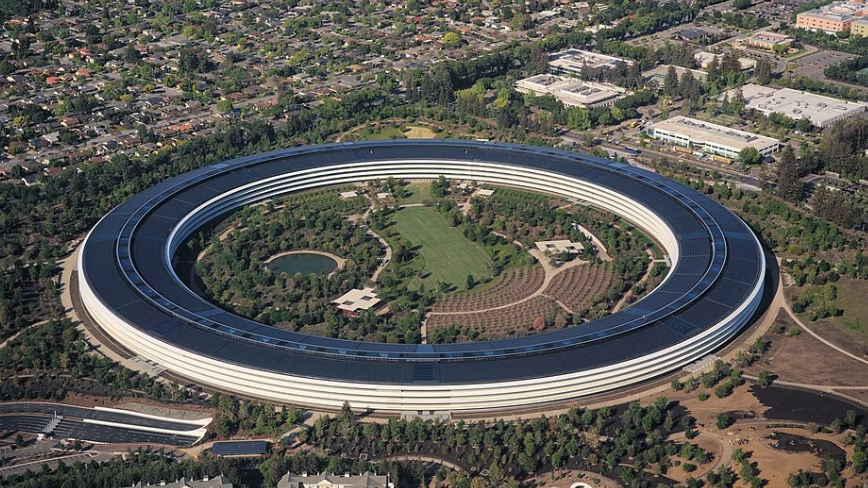
Image: courtesy of Thenextweb
Apple's Trade Secret Lawsuit Against OpenAI: A Battle for AI Hardware Supremacy
Apple has filed a lawsuit against OpenAI, alleging the artificial intelligence company stole hardware designs and prototypes. The complaint, lodged yesterday, specifically names former Apple employees, including Tang Tan, now OpenAI's chief hardware officer, and engineer Chang Liu. Apple claims OpenAI encouraged these individuals to bring confidential information, presentations, and details about component and vendor selection processes to 'show and tell' interviews, asserting that this misconduct was 'normalized and exemplified by leadership' at OpenAI. This legal action marks a significant escalation in the competitive landscape of the tech industry, particularly as OpenAI reportedly prepares to launch its own AI-focused devices.
Outlook
Background
Apple's lawsuit centers on the alleged misappropriation of specific trade secrets related to hardware designs and prototypes. The complaint explicitly states that OpenAI and its partners utilized former Apple employees to extract this confidential information. Among the named individuals are Tang Tan, who spent 24 years at Apple, rising to Vice President of Design for iPhone and Apple Watch before joining OpenAI as its chief hardware officer. Also named is Chang Liu, a senior electrical engineer who worked at Apple for eight years. Apple alleges that these former employees, through their access to 'sensitive projects, trusted partner relationships, proprietary manufacturing techniques, and unreleased product information,' were instrumental in this alleged theft. The core of Apple's accusation is that OpenAI's strategy involved actively soliciting these employees to bring in confidential materials during interviews and to answer detailed questions about Apple's internal processes, such as component and vendor selection. This suggests Apple views the alleged actions not as isolated incidents by rogue employees, but as a coordinated effort sanctioned, if not encouraged, by OpenAI's senior management, particularly as the AI firm appears to be gearing up for a significant push into consumer hardware.
See also
Precedents
The tech industry has a long history of intense competition over intellectual property and talent, often leading to high-stakes legal battles. Cases like Waymo's lawsuit against Uber, where a former Google engineer was accused of stealing self-driving car technology, offer a relevant parallel. In that instance, the core issue revolved around an employee moving to a competitor and allegedly bringing trade secrets with them. Similarly, Apple itself has been involved in numerous intellectual property disputes, from its protracted legal clashes with Samsung over smartphone design patents to its efforts to protect its chip designs. These cases often highlight the challenges of defining and proving trade secret theft, especially when employees move between highly competitive firms. The difficulty lies in distinguishing between general professional knowledge and specific, proprietary information. Historically, such lawsuits can result in significant financial penalties, injunctions preventing the use of alleged stolen technology, or out-of-court settlements designed to avoid prolonged legal exposure and public scrutiny. The outcome often depends on the specificity of the evidence presented and the ability to demonstrate clear intent and direct harm.
This lawsuit is more than just a dispute between two tech giants; it represents a critical juncture for the burgeoning AI hardware market and the broader norms of talent acquisition in a hyper-competitive industry. For Apple, the action sends a clear message: it will aggressively protect its intellectual property, especially in areas like hardware design where it has invested decades and billions. This is particularly relevant as AI capabilities become increasingly integrated into physical devices, blurring the lines between software and hardware innovation. For OpenAI, a company primarily known for its software advancements like ChatGPT, the allegations could cast a shadow over its anticipated foray into consumer hardware, potentially delaying product launches or increasing scrutiny from partners and investors. The case also forces a re-evaluation of ethical boundaries in talent poaching. If Apple's claims hold, it could set a precedent that makes it significantly riskier for companies to hire directly from competitors, especially for roles involving sensitive product development. This could lead to a chilling effect on employee mobility or force companies to implement stricter onboarding and offboarding protocols to prevent future disputes. Ultimately, the outcome could redefine how innovation is protected and pursued in the rapidly evolving AI ecosystem, impacting everything from startup funding to major corporate strategies.
Scenarios
AnalysisThis high-profile lawsuit could unfold in several ways, each carrying significant implications for both Apple and OpenAI.
One likely outcome is a settlement outside of court. Many major intellectual property disputes in the tech sector are resolved through confidential settlements to avoid lengthy, costly trials and the public disclosure of sensitive company information. Such a settlement could involve a monetary payment from OpenAI to Apple, an agreement on what specific technologies or designs OpenAI can or cannot use, or even a non-poaching agreement for certain employees.
Alternatively, if the case proceeds to trial and Apple successfully proves its claims, a court could issue an injunction against OpenAI. This could legally prevent OpenAI from developing or launching specific hardware products that are found to incorporate Apple's stolen designs. An injunction could severely disrupt OpenAI's hardware ambitions and force a significant re-think of its product roadmap.
Another possibility, if Apple wins, is a substantial award of damages. Apple would seek financial compensation for the harm caused by the alleged theft, covering lost profits, development costs, and the value of the intellectual property. The amount could be considerable, given the scale of Apple's hardware operations and the potential market value of AI-integrated devices.
However, it is also possible that OpenAI could successfully defend against the claims, leading to the dismissal of the lawsuit or a ruling in its favor. OpenAI might argue that the information was not a protected trade secret, that the employees brought general knowledge rather than specific designs, or that Apple failed to adequately protect its own information. A victory for OpenAI could embolden other companies in their talent acquisition strategies and potentially weaken the perceived strength of trade secret protections in the tech industry.
Regardless of the direct legal outcome, the case is almost certain to lead to increased scrutiny from regulators and investors on how tech companies manage intellectual property and talent. It may prompt a wider industry discussion on best practices for hiring from competitors and the ethical lines in competitive intelligence gathering.
Timeline
Frequently Asked Questions
Discussion
Be the first to share your thoughts.