
The detection of an atmosphere around WD 1856 b by the Webb Telescope is a crucial step in understanding how planets can endure extreme stellar events. Future observations with Webb and other advanced instruments are expected to provide more detailed atmospheric compositions, which could offer clues about the planet's formation and its journey to its current, surprisingly close orbit. Researchers will continue to refine theoretical models to explain the planet's survival, particularly its proximity to the white dwarf, which remains a puzzle. This ongoing research will shape our understanding of planetary system resilience and the prospects for life in post-stellar-death environments.
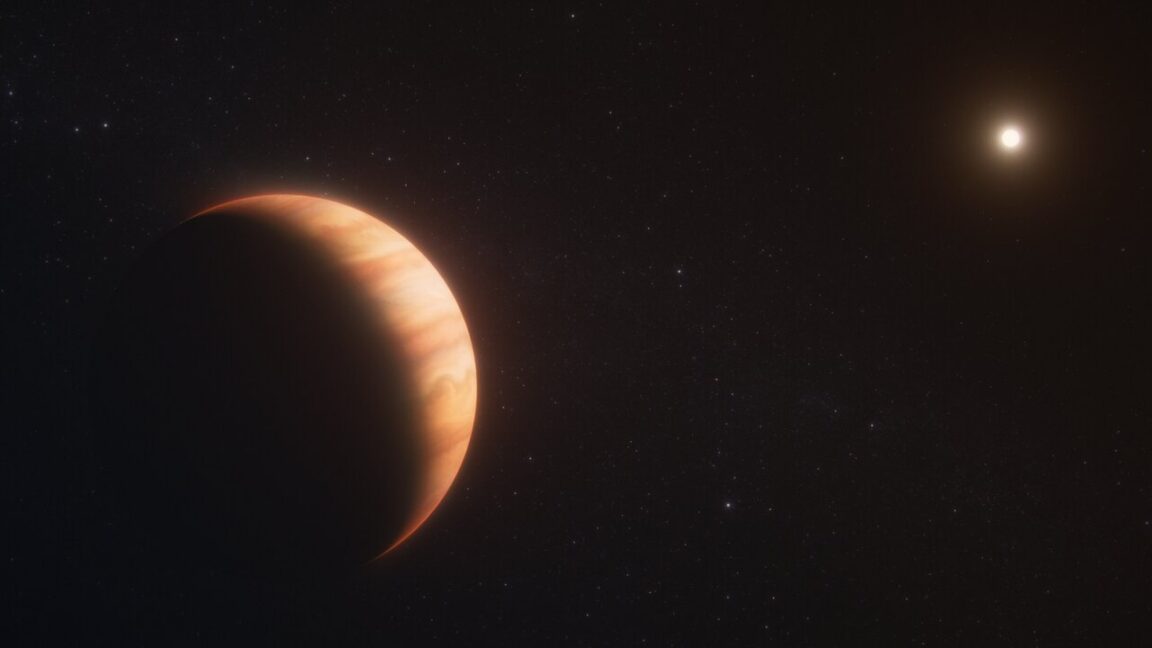
Image: courtesy of Ars Technica
The Jupiter-Sized 'Oddball' That Defied Stellar Death — And What It Tells Us About Our Own Sun's End
Astronomers have confirmed that WD 1856 b, a Jupiter-sized planet, survived its host star's violent death and now orbits a white dwarf. Using NASA's Webb Telescope, scientists detected the planet's atmosphere, marking the first time such an observation has been made on a planet orbiting a white dwarf. This discovery challenges existing models of planetary evolution and offers a rare glimpse into the potential fate of gas giants like Jupiter and Saturn when our own Sun eventually dies.
Outlook
Background
When a star like our Sun nears the end of its life, it expands into a 'red giant,' swelling to hundreds of times its original size. This phase typically engulfs and destroys any planets in close orbit. After expelling its outer layers, the star collapses into a dense, Earth-sized remnant known as a 'white dwarf.' For WD 1856 b, a gas giant roughly the size of Jupiter, to have survived this red giant phase and continue orbiting its white dwarf host, WD 1856+534, is highly unusual. The planet orbits its white dwarf every 1.5 days, a remarkably tight trajectory that should have placed it well within the destructive reach of its star's red giant expansion. The white dwarf itself is located about 80 light-years from Earth.
Precedents
The search for exoplanets has yielded thousands of discoveries, primarily through methods like the transit method (detecting dips in starlight as a planet passes in front of its star) and radial velocity (measuring wobbles in a star caused by a planet's gravity). The TESS (Transiting Exoplanet Survey Satellite) and the retired Spitzer Space Telescope initially detected WD 1856 b in 2020. However, observing the atmospheres of exoplanets, especially those around white dwarfs, is far more challenging. NASA's Webb Telescope, with its advanced infrared capabilities, has changed that. Webb uses 'transmission spectroscopy' – splitting starlight that filters through a planet's atmosphere into its component colors to identify chemical fingerprints. This technique allowed researchers to confirm the presence of an atmosphere around WD 1856 b on April 27, 2023, a first for a planet orbiting a white dwarf. This marks a significant advance over previous observations, which could only confirm the planet's existence and size. While other planets have been found orbiting white dwarfs, WD 1856 b is the first confirmed case of a Jupiter-sized world that survived its star's death, rather than forming later.
The survival of WD 1856 b carries profound implications for exoplanet science and our understanding of planetary resilience. For decades, the conventional wisdom held that planets orbiting too closely to their stars would be consumed when those stars entered their red giant phase. WD 1856 b directly challenges this, raising questions about the conditions under which planets can escape such fates. If planets can survive these cataclysmic events, it expands the potential zones for habitability, even in the late stages of stellar evolution. This discovery also offers a crucial preview of our own solar system's distant future. In about 5 billion years, our Sun will become a red giant, potentially engulfing Mercury, Venus, and Earth before shrinking into a white dwarf. The existence of WD 1856 b suggests that our gas giants, Jupiter and Saturn, could endure, possibly migrating to new orbits around the Sun's remnant. This deepens our understanding of planetary system longevity and opens new avenues for exploring the universe's most extreme environments.
Scenarios
AnalysisThe scientific community is currently considering several scenarios for how WD 1856 b could have survived its star's death and ended up in such a tight orbit. One possibility is that the planet formed much further away from its star and then migrated inward after the star had already become a white dwarf. This migration could have been triggered by gravitational interactions with other, unseen planets in the system. Another theory suggests the planet might have been part of a wider orbit before the star's red giant phase, and then a gravitational encounter, perhaps with another star in a binary system, flung it into its current close orbit. A less likely, but still considered, scenario is that the planet somehow resisted the star's expansion, though its current proximity makes this difficult to reconcile with current stellar models. Further observations and refined simulations of planetary dynamics around dying stars will be crucial to distinguish between these possibilities. The answer will not only explain WD 1856 b's unusual existence but will also inform the broader understanding of planetary survival mechanisms across the cosmos.
Timeline
2020
Initial Discovery
The Jupiter-sized planet WD 1856 b is discovered orbiting a white dwarf using data from NASA's TESS (Transiting Exoplanet Survey Satellite) and the Spitzer Space Telescope.
2023-04-27
Webb Telescope Observation
NASA's Webb Telescope observes WD 1856 b as it transits in front of its white dwarf star, collecting data on starlight filtered through the planet's atmosphere.
2026-07-09
Research Published in Nature
Results of the Webb observations, confirming the detection of WD 1856 b's atmosphere—the first on a planet orbiting a white dwarf—are published in the scientific journal *Nature*.
Frequently Asked Questions
A white dwarf is the dense, Earth-sized remnant of a star that has exhausted its nuclear fuel, like our Sun. After shedding its outer layers as a red giant, the star's core collapses into a white dwarf, which slowly cools over billions of years.
Discussion
Be the first to share your thoughts.