
The coming months will see AMD's Helios system move from engineering samples to broader deployment, with its MI455X GPU hardware shipping in the latter half of 2026. The full rack-scale system is projected for mass production and cloud availability by the second quarter of 2027. This timeline sets up a direct confrontation with Nvidia's established NVL72 offerings and its upcoming Vera Rubin NVL144 systems. The market will be watching closely to see how quickly hyperscale cloud providers, beyond Microsoft, adopt AMD's open platform and if it translates into tangible market share gains. The success of Helios hinges not just on its raw performance, but on the appeal of its open ecosystem in a market increasingly wary of vendor lock-in.
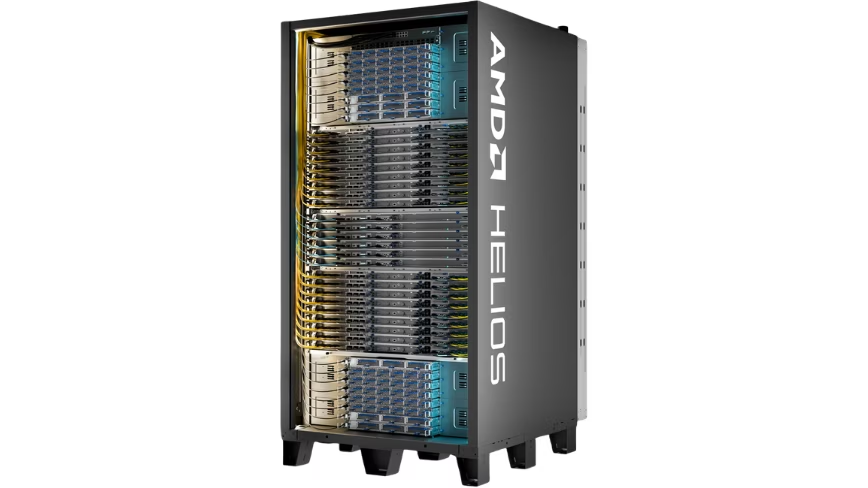
Image: courtesy of Thenextweb
AMD's Helios: The Open Standard Play to Break Nvidia's AI Dominance
AMD has unveiled Helios, a rack-scale AI system designed to directly challenge Nvidia's market-leading NVL72. Helios packs 72 MI455X GPUs and 31 terabytes of HBM4 memory into a single rack, delivering substantial compute power for AI inference and training. Crucially, AMD is building Helios on open interconnect standards like UALink, a direct contrast to Nvidia's proprietary NVLink. Engineering samples for the MI455X hardware are expected to ship in the second half of 2026, with mass production and broader cloud availability of the full Helios system slated for the second quarter of 2027. Microsoft has already confirmed it will deploy Helios in its Azure data centers, signaling a major endorsement for AMD's strategy.
Outlook
Background
The race to build and deploy artificial intelligence has become a defining characteristic of the technology sector, driving unprecedented demand for specialized computing hardware. At the heart of this demand are Graphics Processing Units (GPUs), which excel at the parallel processing required for training and running complex AI models. For years, Nvidia has held a near-monopoly in this critical segment, largely due to its advanced GPU architectures and its proprietary NVLink interconnect technology, which creates a tightly integrated, high-performance ecosystem.
AMD's Helios system represents a direct and formidable response to this dominance. It is not merely a collection of powerful GPUs, but a 'rack-scale' system – a fully integrated unit designed for massive AI workloads. This means 72 MI455X accelerators, each contributing to a collective 31 terabytes of high-bandwidth memory (HBM4) and an aggregate memory bandwidth of 1.4 petabytes per second. Such a configuration is engineered to deliver 2.9 exaFLOPS of FP4 inference performance and 1.4 exaFLOPS of FP8 training performance, numbers that place it squarely in contention with Nvidia’s top-tier offerings.
However, the technical specifications tell only part of the story. The more significant strategic differentiator for Helios is its embrace of open standards. Where Nvidia employs its proprietary NVLink to connect GPUs within its systems, AMD's Helios leverages UALink, an open interconnect standard developed under the Open Compute Project (OCP) with initial contributions from Meta. This choice is a calculated move to offer data center operators greater flexibility, potentially lower costs, and freedom from vendor lock-in.
Microsoft's commitment to integrate Helios into its Azure data centers is a critical early victory for AMD. This endorsement from one of the world's largest cloud providers not only validates AMD's technical approach but also provides a significant channel for market penetration. It signals that at least one major player sees substantial value in an alternative, open-standard AI infrastructure, potentially paving the way for other hyperscalers and enterprises to consider Helios as a viable option.
Precedents
The technology industry has a long history of battles between proprietary ecosystems and open standards, with outcomes often shaping entire market segments. From the early days of personal computing, where IBM's open architecture for PCs eventually outpaced Apple's closed system in terms of market share, to the operating system wars between Microsoft Windows and open-source Linux, the tension between control and collaboration is a recurring theme.
In the server and data center world, this dynamic has played out repeatedly. Intel, for decades, dominated the CPU market with its x86 architecture, but eventually faced challenges from AMD, which offered compatible, often more cost-effective, alternatives. In networking, proprietary hardware often gave way to solutions built on open protocols, driven by the desire for interoperability and reduced vendor dependence. The Open Compute Project itself, where AMD's UALink originates, was founded by Meta to push for more open and efficient hardware designs in data centers, precisely to avoid the limitations and costs associated with closed systems.
Nvidia's current stronghold in AI hardware, built on its CUDA software platform and NVLink interconnect, echoes historical patterns of proprietary dominance. CUDA, in particular, has created a powerful developer ecosystem that is difficult to dislodge, acting as a significant barrier to entry for competitors. However, history also shows that even the most entrenched proprietary systems can be challenged when an open alternative offers compelling advantages in cost, flexibility, or performance – especially when backed by major industry players like Microsoft and Meta. The success of Linux in enterprise servers, despite Windows' desktop dominance, serves as a powerful precedent for how open alternatives can thrive in specific, high-stakes environments.
The emergence of AMD's Helios system is more than just another product launch; it represents a pivotal moment in the battle for control over the foundational infrastructure of artificial intelligence. Nvidia's near-monopoly in high-performance AI GPUs has given it immense pricing power and significant influence over the direction of AI hardware development. This has led to concerns among data center operators and cloud providers about vendor lock-in, limited choices, and potentially higher costs.
Helios, with its open standards approach, offers a credible alternative. For hyperscale cloud companies like Microsoft, the ability to integrate hardware that uses open interconnects means greater flexibility in designing their data centers, potentially optimizing for cost and energy efficiency without being tied to a single vendor's roadmap. This could translate into lower operational expenses for cloud providers, which could, in turn, influence the pricing of AI services for developers and enterprises.
For the broader AI ecosystem, increased competition is almost always a catalyst for innovation. If AMD can successfully carve out a significant portion of the AI hardware market, it could spur both companies to accelerate their development cycles, pushing the boundaries of what's possible in AI performance and efficiency. It might also encourage further investment in open-source AI software and hardware initiatives, fostering a more collaborative and diverse development environment.
Ultimately, the success or failure of Helios will have long-term implications for who controls the future of AI. Will the market continue to consolidate around proprietary ecosystems, or will open standards gain enough traction to democratize access to high-performance AI compute? The answer will shape not just the balance sheets of semiconductor giants, but the cost, accessibility, and pace of AI innovation for years to come.
Scenarios
AnalysisThe introduction of AMD's Helios system, particularly with Microsoft's backing and its open standards approach, sets the stage for several distinct market outcomes:
1. Increased Competition and Open Standard Adoption: One possible outcome is that Helios gains significant traction among major cloud providers and enterprises. Microsoft's endorsement could serve as a powerful signal, encouraging other hyperscalers to evaluate and deploy Helios, drawn by the promise of reduced vendor lock-in and potentially more competitive pricing. This scenario would lead to a more diversified AI hardware market, with open standards like UALink becoming a viable alternative to Nvidia's proprietary NVLink. Increased competition could drive down costs for AI compute and accelerate innovation across the industry as both AMD and Nvidia vie for market share.
2. Nvidia's Entrenched Dominance Persists: Conversely, despite its strong specifications and open approach, Helios might struggle to fundamentally disrupt Nvidia's deeply entrenched ecosystem. Nvidia's CUDA software platform and its long-standing relationships with AI developers and researchers create a powerful network effect that is difficult to overcome. In this scenario, Helios could find success in specific niches or within certain cloud environments (like Azure), but it may not achieve widespread adoption that significantly alters Nvidia's market leadership. Data centers might continue to prioritize the perceived performance and ecosystem benefits of NVLink, even with the trade-offs of a proprietary system.
3. A Hybrid Ecosystem Emerges: A third outcome could see the market evolve into a hybrid model. Open standard solutions like Helios might gain substantial ground for specific types of AI workloads, particularly inference, where cost and flexibility are paramount. Meanwhile, Nvidia's proprietary systems could maintain their advantage in highly specialized, performance-critical training workloads where maximum optimization within a closed ecosystem is still seen as beneficial. This would create a more fragmented market where data centers deploy a mix of hardware solutions, optimizing for different needs and strategic priorities, rather than a single dominant architecture.
Timeline
2026-07-20
AMD Unveils Helios Rack-Scale AI System
AMD officially announced its Helios rack-scale AI system, positioning it as a direct competitor to Nvidia's NVL72. The system features 72 MI455X GPUs and 31 terabytes of HBM4 memory, built on open interconnect standards. Microsoft confirmed plans to use Helios in its Azure data centers.
H2 2026
MI455X Engineering Samples Ship
AMD is scheduled to begin shipping engineering samples of its MI455X GPU hardware, which forms the core of the Helios system, to partners and customers for evaluation and development.
Q2 2027
Helios Mass Production and Cloud Availability
The full AMD Helios rack-scale AI system is expected to enter mass production, with broader availability for cloud providers and data centers, including deployment in Microsoft Azure.
Frequently Asked Questions
AMD Helios is a rack-scale AI system designed by AMD to provide high-performance computing for artificial intelligence workloads. It integrates 72 MI455X GPUs, 31 terabytes of HBM4 memory, and uses open interconnect standards, making it a direct competitor to Nvidia's NVL72.
Discussion
Be the first to share your thoughts.