
The cessation of the Phoenix partnership between Waymo and Uber indicates a significant shift in their respective autonomous vehicle strategies. For Waymo, the focus appears to be on consolidating its direct-to-consumer operations and maintaining tighter control over its integrated fleet experience. Uber's stated intention to find a new partner suggests a continued commitment to its platform model, aiming to offer diverse autonomous options from multiple providers. We can expect Uber to announce a new Phoenix AV partner in the coming months, potentially signaling which other autonomous driving companies are ready for real-world deployment on a major ride-hailing platform. The future of the previously announced Austin and Atlanta expansions for the Waymo-Uber partnership remains uncertain following this development.
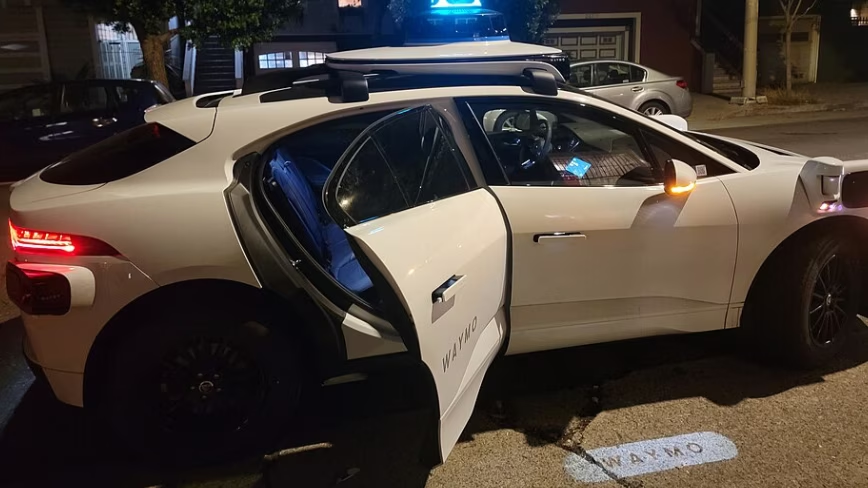
Image: courtesy of Thenextweb
The Quiet Unraveling of the Uber-Waymo Alliance: What the Phoenix Split Reveals About Robotaxi Strategy
After nearly three years, Waymo and Uber have quietly ended their robotaxi collaboration in Phoenix, Arizona. The partnership, which saw Waymo's self-driving cars available through the Uber app, ceased with Waymo integrating its vehicles back into its dedicated fleet. Uber, meanwhile, has stated plans to pursue a new autonomous vehicle partnership in Phoenix, without naming its prospective partner. This quiet divergence, coming months after the companies announced an expansion of their collaboration to Austin and Atlanta, suggests a strategic re-evaluation by both mobility giants regarding how best to scale autonomous ride-hailing services.
Outlook
Background
The Waymo-Uber partnership in Phoenix began in May 2023, marking a notable collaboration between two companies that were once fierce rivals in the autonomous vehicle space, even engaging in a high-profile lawsuit. The agreement allowed Uber riders in parts of Phoenix to hail a Waymo robotaxi directly through the Uber app. This deployment was described by Uber as an 'intentionally limited' program, involving just over a dozen vehicles. Despite this modest scale, the companies announced an expansion of their partnership in October 2025, intending to bring Waymo's autonomous ride-hailing to Austin, Texas, and Atlanta, Georgia. Uber CEO Dara Khosrowshahi expressed enthusiasm for this expansion at the time, citing tens of thousands of successful trips in Phoenix. However, the partnership in Phoenix quietly concluded on Monday, June 29, 2026, with both companies confirming the split to TechCrunch. Waymo's vehicles have since been reabsorbed into its existing Phoenix fleet, while Uber is actively seeking a different autonomous vehicle company to integrate into its Phoenix operations.
See also
Precedents
The autonomous vehicle industry has been characterized by both ambitious partnerships and abrupt strategic shifts. Many early collaborations between automakers and tech companies have either dissolved or been restructured as the technology matured and business models evolved. Uber itself has a history of navigating complex AV strategies, from its initial pursuit of in-house development with its Advanced Technologies Group (ATG) to its subsequent sale of ATG to Aurora and its current pivot towards integrating third-party AV providers onto its platform. Waymo, a pioneer in self-driving technology, has consistently maintained a more vertically integrated approach, developing both the hardware and software for its autonomous vehicles and operating its own ride-hailing service. This quiet split in Phoenix, despite previous expansion announcements, aligns with a broader pattern in the AV sector where companies continuously re-evaluate alliances based on operational performance, strategic fit, and the high capital demands of scaling driverless technology.
This quiet separation in Phoenix matters because it offers a rare glimpse into the complex and often difficult realities of scaling autonomous vehicle services. For Waymo, it suggests a preference for greater control over its operational footprint and user experience, potentially seeing direct integration with its own app as more efficient for data collection and service refinement. This approach could imply that Waymo is prioritizing profitability and brand consistency as it expands. For Uber, the move highlights its strategic commitment to a 'network-as-a-service' model, where it aims to be the central platform for multiple autonomous vehicle providers. By seeking a new partner in Phoenix, Uber signals that it is not tethered to any single AV developer and values redundancy and choice in its offerings. The split also raises questions about the commercial viability and terms of these large-scale partnerships. If a collaboration between two industry leaders like Waymo and Uber, initially framed as a success, can quietly end, it underscores the ongoing challenges in finding sustainable business models for autonomous ride-hailing and could influence how future partnerships are structured across the industry.
Scenarios
AnalysisOne potential outcome is that Waymo will double down on its integrated strategy, focusing on expanding its Waymo One service in existing and new markets directly, rather than through extensive third-party platform integrations. This could allow Waymo to capture more direct revenue and maintain full control over the rider experience and vehicle data, which are crucial for continuous improvement of its Waymo Driver technology.
A second outcome is that Uber will quickly announce a new autonomous vehicle partner for its Phoenix operations, potentially one that offers more flexible terms or a different technological approach. This would reinforce Uber's strategy of diversifying its AV suppliers, ensuring it can offer autonomous rides even if one partner faces operational challenges or strategic shifts. Aurora, given its acquisition of Uber's ATG, could be a strong candidate for this new partnership, or perhaps another player like Zoox or Mobileye's AV division.
A third possibility is that the previously announced expansion of the Waymo-Uber partnership to Austin and Atlanta may be re-evaluated or proceed under different terms. The quiet end to the Phoenix pilot, which was the foundation for the broader expansion, suggests that the economics or operational synergies might not have met expectations. It is possible that the Austin and Atlanta plans could be delayed, scaled back, or even canceled if both companies decide against deeper integration.
Timeline
Frequently Asked Questions
Discussion
Be the first to share your thoughts.