
The expansion into Denver, San Diego, and Tampa signifies Waymo's accelerated strategy to capture market share and prove the scalability of its autonomous technology across diverse urban and environmental settings. Expect Waymo to closely monitor operational performance, especially in Denver's varying weather, to refine its driving models and sensor capabilities. The phased public rollout suggests a cautious approach to ensure service quality and build customer trust, a common pattern in previous Waymo launches. Competitors, including Amazon's Zoox, will likely observe Waymo's performance in these new markets closely, particularly its ability to handle adverse conditions.
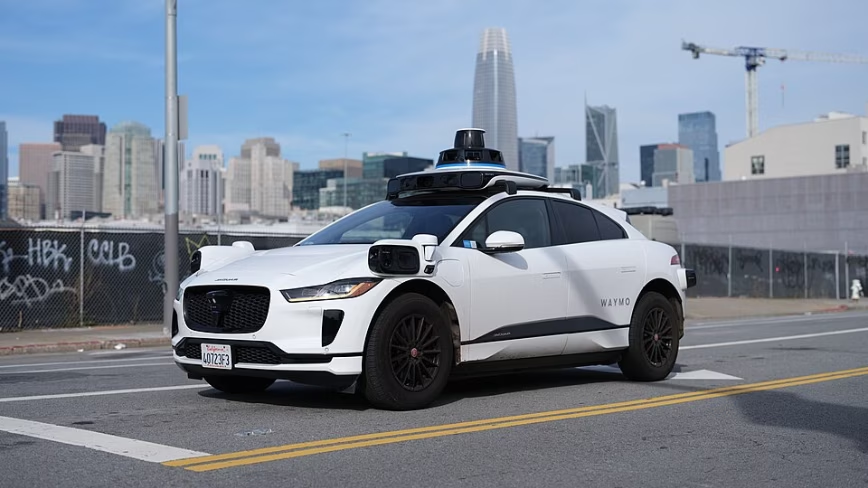
Image: courtesy of Thenextweb
Waymo's Snow Gambit: Why Denver Is The Real Test For The Robotaxi Race
Waymo has launched its driverless ride-hailing service in Denver, San Diego, and Tampa, expanding its operations to 14 U.S. cities. The move marks a significant push for the Alphabet-owned company, particularly with Denver representing its first commercial deployment in a climate known for snow and more complex weather conditions. The service is opening gradually, initially to select riders, before becoming widely available to the general public.
Outlook
Background
Waymo, a subsidiary of Alphabet Inc., has been a frontrunner in autonomous vehicle technology for over a decade. Its initial commercial services primarily focused on cities with predictable, sunny weather, such as Phoenix and parts of California. The expansion into San Diego and Tampa aligns with this strategy, offering dense urban environments with relatively mild climates. However, Denver presents a distinct challenge. The city experiences significant snowfall, ice, and fluctuating temperatures, conditions that severely test the perception systems, navigation algorithms, and overall safety protocols of self-driving cars. This move is not merely about adding more cities; it is about demonstrating the robustness of Waymo's technology beyond ideal conditions, a critical step toward widespread adoption and regulatory approval across the country. The company's ability to operate reliably and safely in Denver's winter weather will serve as a crucial benchmark for the entire autonomous vehicle industry, indicating a readiness to tackle more complex operational environments. Waymo's relentless expansion push has been evident over the past 18 months, solidifying its position as a U.S. robotaxi market leader, a position it aims to maintain and extend through these new deployments.
Precedents
The rollout of autonomous vehicle technology has historically followed a pattern of cautious, incremental expansion. Companies like Waymo typically begin with extensive testing in controlled environments, moving to limited public trials with safety drivers, and then gradually transitioning to fully driverless operations in pre-mapped, geofenced areas. Initial commercial deployments, such as Waymo's long-standing service in Phoenix, have often been restricted to specific zones and times of day to mitigate risk and gather data. This phased approach allows companies to refine their software, hardware, and operational logistics while building public confidence. The strategy of expanding into new cities, initially with a subset of riders before a full public launch, mirrors Waymo's previous market entries. For instance, its operations in San Francisco began with an employee program before opening more broadly. The industry has also seen competitors like Cruise face operational challenges and regulatory scrutiny when attempting rapid expansion, highlighting the inherent difficulties in scaling this technology. Waymo's current move, while ambitious, reflects a learned caution from its own decade-plus of development and the broader industry's experiences, balancing aggressive growth targets with the imperative of safety and reliability. The choice of Denver, specifically, draws a parallel to the early days of automotive engineering, where vehicles had to prove their mettle in all conditions, not just fair weather. Early electric vehicle companies, for example, had to overcome range anxiety in cold weather, a technical hurdle that required significant engineering to resolve.
The stakes of Waymo's latest expansion extend far beyond simply adding more cities to its operational map. This move is a direct challenge to the fundamental technical and operational limitations that have long constrained the autonomous vehicle industry. Success in Denver, with its unpredictable snowy conditions, would validate Waymo's technological maturity in a way that its sunny city deployments cannot. It would signal to regulators, investors, and the public that driverless technology is capable of handling real-world complexities, not just ideal scenarios. This could accelerate regulatory approvals in other challenging geographies and attract further investment into the sector. For consumers, a reliable robotaxi service in diverse climates would transform urban mobility, offering a new alternative to traditional ride-hailing and personal car ownership. It could particularly impact those in areas with less robust public transportation or for whom driving is a challenge due to age or disability. For Waymo, maintaining its market leadership is critical. As competition from companies like Zoox intensifies, demonstrating superior operational versatility across varied environments reinforces its competitive edge and justifies the immense investment made by Alphabet. A misstep in a high-profile, challenging market like Denver, however, could set back public trust and regulatory progress for years. The long-term vision of autonomous vehicles relies on their ability to operate anywhere, anytime, and Denver represents a crucial proving ground for that ambition.
Scenarios
AnalysisWaymo's expansion into Denver, San Diego, and Tampa presents several distinct paths forward, each with significant implications for the company and the broader autonomous vehicle industry.
Outcome 1: Validated Versatility and Accelerated Growth
One possible outcome is that Waymo successfully navigates the technical challenges posed by Denver's snowy and varied weather conditions. This would involve its autonomous driving system consistently performing safely and reliably, with minimal human intervention, throughout the winter months. If Waymo can demonstrate this level of operational resilience, it would significantly bolster its credibility as the market leader. This success could lead to an accelerated pace of expansion into other northern U.S. cities and potentially international markets with similar climates. Regulatory bodies, observing Waymo's proven capability, may become more inclined to grant operating permits more quickly and with fewer restrictions. For consumers, this would mean a faster rollout of convenient robotaxi services, fundamentally altering urban transportation options. This outcome could also pressure competitors to invest more heavily in their own all-weather capabilities, intensifying the race for truly ubiquitous autonomous mobility. The financial implications for Waymo could include increased revenue streams from a larger operational footprint and a stronger valuation as its technology proves its broad applicability.
Outcome 2: Incremental Progress and Focused Refinement
Alternatively, Waymo might find that while its technology performs adequately in Denver, it still requires substantial refinement to achieve the same level of seamless operation seen in its sunny markets. The complexities of snow, ice, and reduced visibility may lead to a higher rate of disengagements (instances where a human safety driver or remote operator must take control) or necessitate more conservative operating parameters, such as limiting service during severe weather. In this scenario, Waymo would likely adopt a strategy of incremental progress, using the data gathered from Denver to further enhance its perception and prediction models specifically for adverse conditions. This could mean a slower, more deliberate expansion into other challenging environments, prioritizing safety and system robustness over rapid market capture. While not a failure, this outcome would highlight the persistent technical hurdles facing the industry, tempering expectations for a swift, nationwide rollout of fully autonomous services. It might also lead to Waymo focusing its immediate commercial efforts more heavily on milder climates while continuing to use Denver as a long-term development and testing ground. This measured approach would reflect the institutional realism required in a safety-critical industry, acknowledging that even leading technology has its limits under extreme conditions.
Timeline
2009
Google Self-Driving Car Project Begins
The initiative that would become Waymo starts within Google X, focusing on autonomous vehicle research and development.
2016
Waymo Spun Out from Google
The project is rebranded as Waymo, becoming an independent company under Alphabet Inc., signaling a move towards commercialization.
2018
Waymo One Launches in Phoenix
Waymo launches its first public ride-hailing service, Waymo One, in the Metro Phoenix area, initially with safety drivers.
2020
Fully Driverless Rides in Phoenix
Waymo begins offering fully driverless rides to the public in Phoenix, without safety drivers present.
August 2023
Permits for San Francisco Driverless Rides
Waymo receives all necessary permits to operate and charge customers for driverless rides in San Francisco, expanding its footprint in a major urban center.
September 1, 2026
Launches in Denver, San Diego, and Tampa
Waymo opens its driverless ride-hailing service to the general public in three new cities, bringing its total U.S. presence to 14 cities. Denver marks its first commercial deployment in a snowy climate.
Frequently Asked Questions
Waymo launched its driverless ride-hailing service in Denver, San Diego, and Tampa on September 1, 2026.
Discussion
Be the first to share your thoughts.