
As the scientific community processes data from telescopes like NASA's James Webb Space Telescope and the WINTER facility, researchers anticipate a surge in similar discoveries as next-generation sky surveys come online. This observation establishes a baseline for identifying other stellar ingestion events, which may prompt a reexamination of binary evolution models across astrophysics.
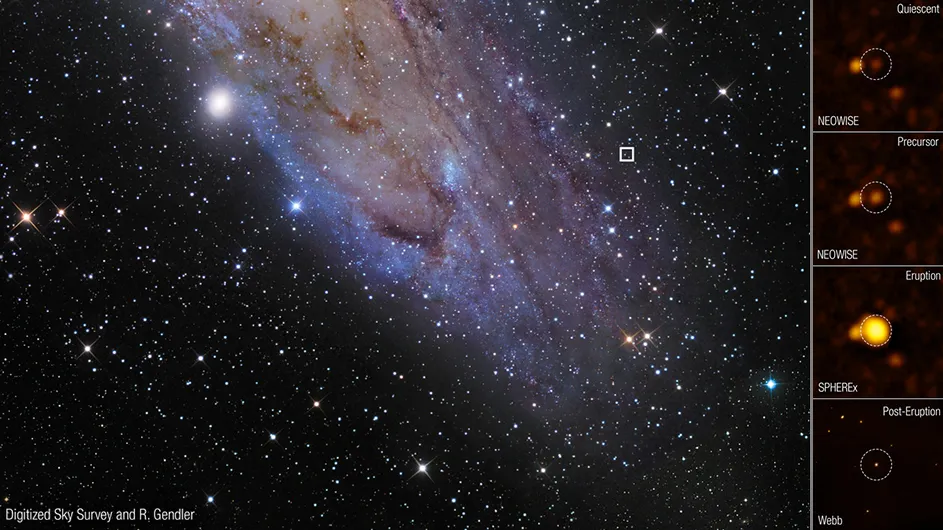
Image: courtesy of Ars Technica
How Astronomers Finally Caught a Giant Star Eating Its Neighbor in the Andromeda Galaxy
For the first time, researchers have observed a giant star in the Andromeda Galaxy slowly consume its smaller companion over a decade-long process that ended in a massive eruption in late 2025. The discovery confirms a theoretical concept first proposed in the 1970s known as common envelope evolution, offering unprecedented insight into how tightly bound binary star systems form and evolve.
Outlook
Background
First proposed by theoretical astrophysicists in the 1970s, common envelope evolution describes a chaotic phase where a bloated giant star engulfs a nearby stellar companion, dragging it inward through its outer layers. Until now, this process was understood only through mathematical modeling and circumstantial evidence. Led by Columbia University astronomer Viraj Karambelkar, a research team tracked the Andromeda event—featuring a giant star roughly seven times the mass of the Sun and a smaller companion about 70% of solar mass—publishing their findings in the journal Nature.
Precedents
Astrophysical observation has long relied on capturing remnants rather than active processes, much like forensic science after an accident. In 2023, astronomers documented a star consuming a planet, which provided an early glimpse into orbital decay on a planetary scale. The new Andromeda observation scales that phenomenon up to a stellar interaction, bridging decades of theoretical physics with empirical confirmation.
Binary star systems make up a significant portion of the stellar population in the universe, yet the mechanics of how they merge or tighten their orbits remained an open question. Confirming common envelope evolution helps scientists understand the precursors to exotic cosmic events, including gravitational wave sources like merging neutron stars and black holes. Without this empirical anchor, models of stellar population dynamics rested on unverified assumptions about how stars interact during their most volatile phases.
Scenarios
AnalysisAnalyses suggest that upcoming wide-field surveys could detect dozens of similar pre-explosion signatures over the next decade. One possible outcome is that researchers will identify different stages of the common envelope phase, creating a complete chronological picture of stellar engulfment. Alternatively, the extreme difficulty of detecting infrared transients in distant galaxies may mean such events remain rare observational trophies until significantly larger ground-based telescopes become operational.
Timeline
1970s
Theoretical Foundation
Astrophysicists first propose the concept of common envelope evolution to explain the existence of unusually close binary star systems.
2018
Detection Begins
Telescopes including NASA's NEOWISE mission and the WINTER telescope begin tracking unusual, prolonged brightness fluctuations in an Andromeda Galaxy star system.
Late 2025
The Eruption
The decade-long engulfment process culminates in a massive outburst of light that ejects a substantial amount of stellar material into space.
Shortly After Eruption
JWST Follow-Up
Astronomers direct the James Webb Space Telescope toward the system 47 days after peak eruption to analyze the aftermath and core interaction.
November 2026
Study Publication
The research team, led by Viraj Karambelkar, publishes the first direct observation of common envelope evolution in the journal Nature.
Frequently Asked Questions
It is a phase in stellar evolution where a bloated giant star expands and engulfs a companion star, forcing the smaller body to spiral inward through the giant's outer gas layers.
Discussion
Be the first to share your thoughts.