
Industrial automation is moving past the rigid, pre-programmed robotic arms that have defined automotive and electronics manufacturing for decades. At its Erlangen plant, Siemens is tackling the variability of incoming supply chains where boxes, crates, and component reels arrive in unpredictable shapes. Instead of forcing suppliers to standardise their packaging—a notoriously difficult feat in global manufacturing—Siemens is applying AI foundation models to let machines improvise. The system observes the workspace through cameras, calculates grip angles, opens cartons, and extracts component reels for downstream assembly. Alongside this physical hardware, Siemens also debuted an Autonomous Production Planner at the SPS 2026 conference, designed to test factory schedules inside digital twins and potentially reduce manual planning hours by seventy percent.
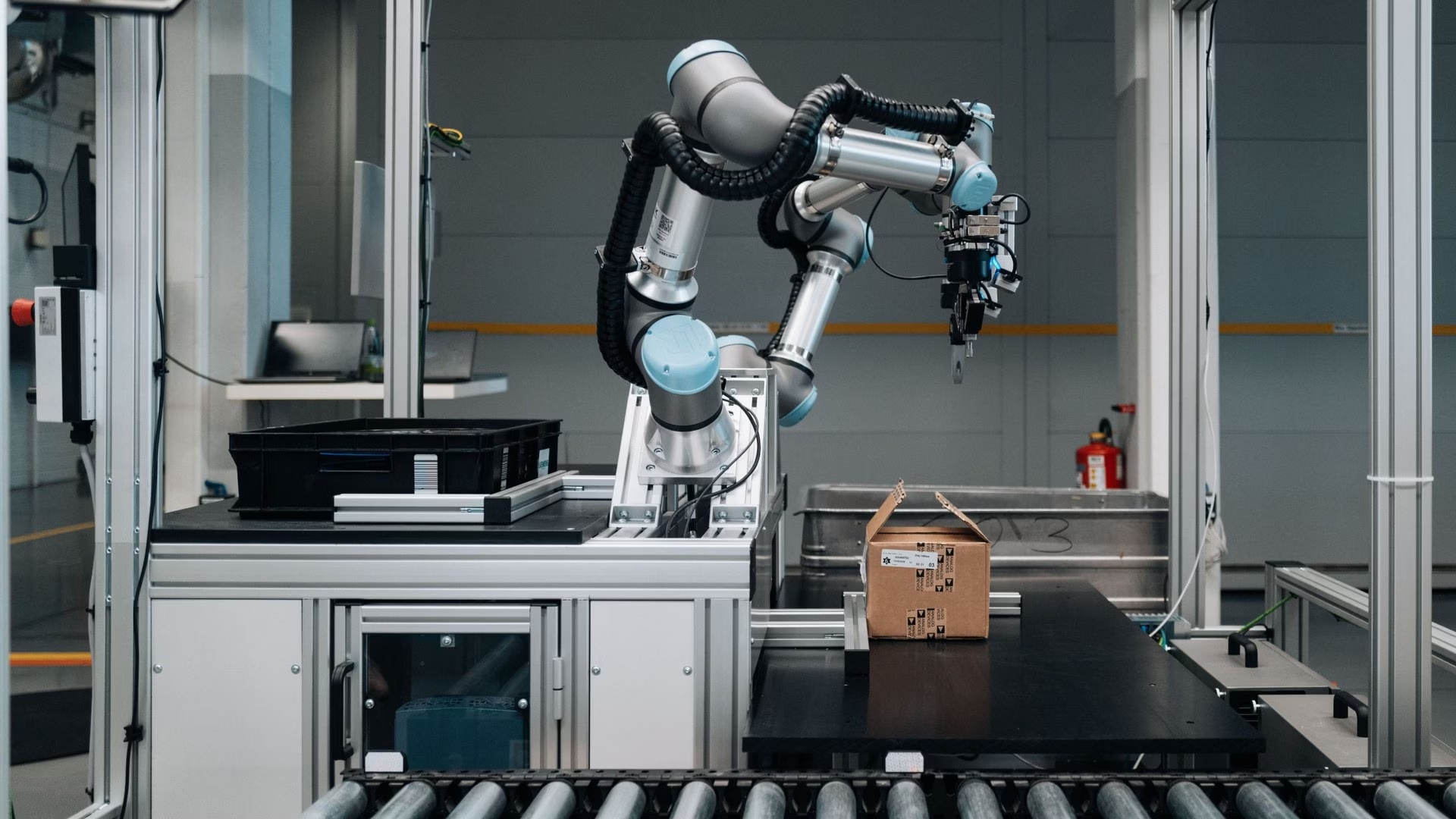
Image: courtesy of Thenextweb
Why Siemens Is Teaching Robots to Handle the Messiest Job in the Factory
Siemens is developing an AI-powered robotic system at its Erlangen electronics plant designed to autonomously unpack varied incoming component deliveries. Running on industrial hardware with Nvidia chips, the machine uses real-time computer vision and foundation models to handle packaging sizes that traditional automated assembly lines cannot process.
Outlook
Background
For half a century, industrial robotics excelled at repetition. Put the exact same bolt in the exact same orientation on the exact same belt ten thousand times an hour, and mechanical automation thrives. But the loading dock has always resisted this rigidity. Suppliers ship parts in corrugated boxes, wooden crates, and plastic bins of wildly varying dimensions, weights, and sealing methods. This makes unpacking one of the final stubborn bastards of factory labor—a task requiring human flexibility, spatial reasoning, and ad-hoc problem solving. Siemens is attempting to bridge this gap by combining industrial PCs with advanced AI chips from Nvidia, training the robotic system through teleoperation where human operators guide the machine through tricky maneuvers until the model learns the physical boundaries of the task.
Precedents
The factory floor has undergone multiple waves of automation, each eliminating a layer of human physical labor while creating new bottlenecks elsewhere. In the 1970s and 1980s, spot-welding and painting robots took over automotive shells. In the 1990s and 2000s, pick-and-place machines accelerated surface-mount electronics assembly. Yet the periphery of the factory—receiving docks, logistics staging areas, and material handling—has remained stubbornly manual because unstructured environments defeat deterministic code. Every previous generation of vision-guided robotics struggled with occlusion, lighting changes, and deformed packaging. The current shift toward vision-language-action models marks a departure, replacing hand-coded exception handling with neural networks trained to generalize physical interaction.
The real constraint in modern electronics manufacturing is no longer how fast a machine can solder a circuit board, but how quickly components can move from a truck to the production line. Labor shortages across Western Europe and North America have made manual logistics bottlenecks increasingly painful for heavy industrial firms. By targeting the receiving dock, Siemens is addressing a foundational vulnerability in supply chain resilience. If an industrial plant can automate unpacking without redesigning its entire vendor ecosystem, factory operators can absorb labor churn and supply volatility without slowing down primary assembly cells.
Scenarios
AnalysisIndustrial deployments of this scale rarely move in a straight line from laboratory demonstration to global rollout. One possible outcome is that Siemens successfully validates the unpacking robot in Erlangen over the next two years, gradually commercializing the software stack as an add-on module for its broader Digital Enterprise portfolio by late 2027 or 2028. Another outcome is that edge-case failure rates—such as crushed boxes or jammed tape reels—prove too costly for high-speed continuous operations, confining the technology to specialized low-volume cells while manual labor retains its dominance on messy loading docks. A third scenario involves competitors rapidly licensing similar foundation models, turning autonomous warehouse unpacking from a proprietary Siemens advantage into a standard industrial software commodity.
Timeline
Frequently Asked Questions
Discussion
Be the first to share your thoughts.