
The immediate aftermath of the Super Micro raids suggests a period of intense scrutiny for the company and its operations in Taiwan. We can expect authorities to continue questioning the six individuals already summoned and potentially others as they trace the alleged flow of restricted Nvidia chips. For Super Micro, this means navigating a complex legal and public relations challenge. Its commitment to cooperation, while necessary, does not insulate it from potential fines or operational disruptions if culpability is established. The company's stock, which saw a notable drop on the news, may remain volatile as the investigation progresses and details emerge. Beyond Super Micro, the broader tech industry, particularly those involved in the distribution and integration of high-performance computing components, will likely be reviewing their own compliance protocols to avoid similar entanglements. This incident signals a heightened resolve by enforcement agencies to crack down on any perceived circumvention of export controls.
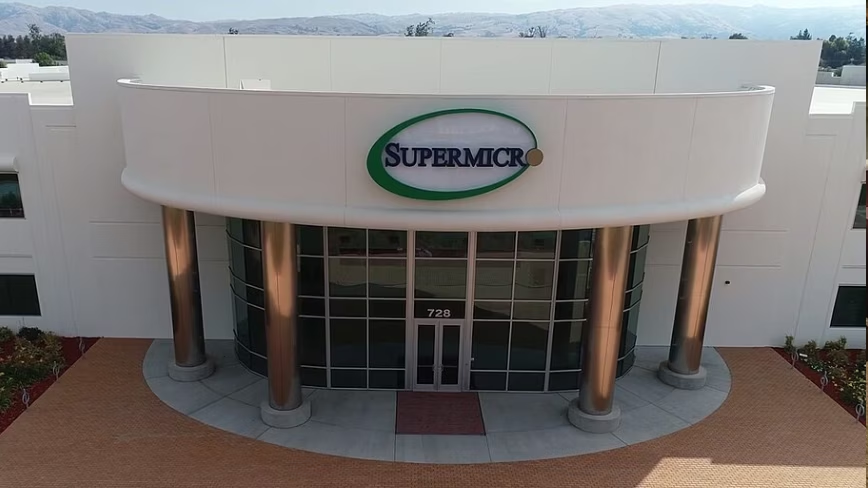
Image: courtesy of Thenextweb
Taiwan's Super Micro Raid: A New Front in the US-China AI Chip War
Taiwanese authorities raided the local offices of server giant Super Micro Computer on Monday, June 29, 2026, as part of a widening investigation into the alleged smuggling of high-end Nvidia artificial intelligence (AI) chips to China. The coordinated searches, which also included the residences of six individuals and the premises of affiliated companies like Chief Telecom and Albatron Technology across Taipei and New Taipei City, represent a significant escalation in the enforcement of US semiconductor export restrictions aimed at Beijing. Super Micro has confirmed its cooperation with law enforcement, but the news sent its shares plunging, reflecting investor anxiety over the potential fallout for a company deeply embedded in the global tech supply chain.
Outlook
Background
The raid on Super Micro's offices is not an isolated incident but rather a pointed action within the larger geopolitical contest for technological supremacy, particularly in artificial intelligence. At its core are high-end AI chips manufactured by Nvidia, such as the A100 and H100, which the United States has placed under strict export controls to China. These chips are considered strategic assets, fundamental to developing advanced AI systems for everything from military applications to cutting-edge research. The US government views their unrestricted access by China as a national security risk.
Super Micro, formally Super Micro Computer Inc., is a crucial player in this ecosystem. It designs and manufactures high-performance server and storage solutions, often incorporating these very Nvidia GPUs. Its servers are the backbone of many data centers and AI computing infrastructures worldwide. The company's global footprint, with significant manufacturing and operational hubs in Taiwan, places it at a sensitive intersection of international trade and geopolitical tensions.
Taiwan's role here is equally critical. As the global epicenter for advanced semiconductor manufacturing, it finds itself caught between its close economic ties to mainland China and its strategic alliance with the United States. The decision by Taiwanese authorities to actively pursue this investigation indicates a clear stance on upholding international trade regulations, even when it involves a major local player. The investigation centers on allegations that approximately 50 high-end Super Micro AI servers were involved in the alleged smuggling, a relatively small number that nonetheless carries significant symbolic weight in the context of export control enforcement.
Precedents
The current situation with Super Micro and Nvidia chips echoes a persistent theme in global trade and technology: the challenge of enforcing export controls in a deeply interconnected world. Historically, attempts by powerful nations to restrict access to critical technologies have often led to a 'cat and mouse' game of circumvention. During the Cold War, the Coordinating Committee for Multilateral Export Controls (CoCom) attempted to prevent advanced technology from reaching the Soviet bloc, often facing similar challenges in tracking illicit transfers.
More recently, the US government has used export controls as a primary tool in its economic competition with China. The restrictions placed on Huawei Technologies Co. in 2019, which severely limited its access to US technology and components, serve as a potent precedent. That action crippled Huawei's smartphone business and forced it to pivot significantly. Similarly, Semiconductor Manufacturing International Corp. (SMIC), China's largest chipmaker, has also faced US restrictions aimed at slowing its technological advancement.
These historical actions demonstrate the US's willingness to use its leverage over critical technology supply chains. However, they also reveal the inherent difficulties in fully sealing off a determined adversary. China, in response, has consistently accelerated its efforts to achieve self-sufficiency in key technologies, particularly semiconductors. This investigation in Taiwan, therefore, fits into a broader pattern of enforcement attempts meeting persistent efforts to bypass them, highlighting the ongoing tension between globalized supply chains and national security imperatives. Taiwan itself has a history of prosecuting economic crimes and intellectual property theft, indicating that its legal system is equipped to handle complex international trade cases, further adding to the institutional realism of the current investigation.
The raid on Super Micro's Taiwanese operations carries significant weight, reaching far beyond the company's immediate financial performance. For Super Micro itself, the stakes are substantial. A finding of complicity in smuggling could result in hefty fines, further damage to its brand reputation, and potentially lead to its inclusion on US entity lists, severely curtailing its access to critical American components and software. This would be an existential threat to its business model, which relies heavily on integrated global supply chains and access to leading-edge components like Nvidia's chips.
For Nvidia, while not directly implicated in the alleged smuggling, the incident casts a shadow. It underscores the difficulty of controlling the end-use of its powerful AI chips once they leave its direct custody. Continued incidents could prompt regulators to demand even stricter oversight on Nvidia's distribution networks, potentially slowing sales or increasing compliance costs across the entire industry. This could also accelerate the development of alternative AI chip architectures by Chinese firms, further fragmenting the global market.
From Taiwan's perspective, the investigation is a delicate balancing act. By actively pursuing these allegations, Taiwan signals its commitment to international norms and its alignment with US export control policies, which is vital for its strategic relationship with Washington. However, it also risks alienating some segments of its business community that rely on trade with mainland China. The outcome will be closely watched as a gauge of Taiwan's ability to navigate the intense pressures of the US-China tech rivalry while safeguarding its own economic interests and legal integrity.
More broadly, this incident signifies a hardening of the US-China tech decoupling. It shows that export controls are not merely theoretical policies but are being actively enforced with significant legal and economic consequences. This could compel other companies operating in the grey areas of tech trade to re-evaluate their compliance strategies, leading to a more bifurcated global tech ecosystem. Ultimately, the real stakes involve the future architecture of the global AI industry and who controls its foundational technologies.
Scenarios
AnalysisThe Super Micro investigation, still in its early stages, presents several potential pathways forward, each with distinct implications for the company and the broader tech landscape.
One possible outcome is that the investigation uncovers clear evidence of intentional circumvention of export controls by Super Micro employees or affiliates. This could lead to significant legal penalties for the company, including substantial fines and potential restrictions on its ability to operate or trade internationally. Such a scenario would likely force Super Micro to undertake a major restructuring of its supply chain and compliance protocols, potentially impacting its profitability and market share for an extended period. This would also send a strong message across the industry, likely prompting other companies to significantly tighten their internal controls and increase due diligence on their distributors and end-users, leading to a more fragmented and cautious global tech supply chain.
Alternatively, the investigation might conclude with findings of negligence or a limited scope of wrongdoing, perhaps involving a small number of rogue employees rather than systemic corporate policy. In this case, Super Micro might face moderate fines and reputational damage, but avoid severe operational restrictions. The company's commitment to cooperating with authorities could help mitigate the harshest outcomes. This could allow Super Micro to recover more quickly, though it would still need to demonstrate robust new compliance measures to regain full investor confidence and reassure its partners, including Nvidia, that its supply chain is secure from future diversions. The underlying incentives for circumvention, however, might persist, making enforcement a continuous challenge for regulators.
A third scenario involves a broader diplomatic or economic escalation. If China perceives the Taiwan investigation as an aggressive act orchestrated by the US to further stifle its technological development, it could react with retaliatory measures. This might involve new trade barriers, increased scrutiny on foreign companies operating in China, or even accelerating its own indigenous chip development efforts with renewed urgency. Such a response would further entrench the tech rivalry, making it more challenging for global companies to operate across both markets and potentially leading to a more pronounced 'two-bloc' system in global technology.
Timeline
Frequently Asked Questions
Discussion
Be the first to share your thoughts.