
Veridact
TechSportsFinanceGaming🎯 Predictions⭐ OpportunitiesAbout
Sign InSign Up
Veridact

Analysis before the headline. Veridact examines technology, finance, sports, and gaming events before they unfold through forecasting, probability modeling, historical precedent, and public prediction tracking.

Stay ahead of what's next

Forecasts, analysis, and prediction updates delivered to your inbox.

Coverage

  • Tech
  • Sports
  • Finance
  • Gaming

Company

  • About Us
  • Privacy Policy

© 2026 Veridact. Forecasting & analysis platform.

Content may include AI-assisted research and analysis. Predictions and opinions should not be considered financial, legal, medical, or investment advice.

tech
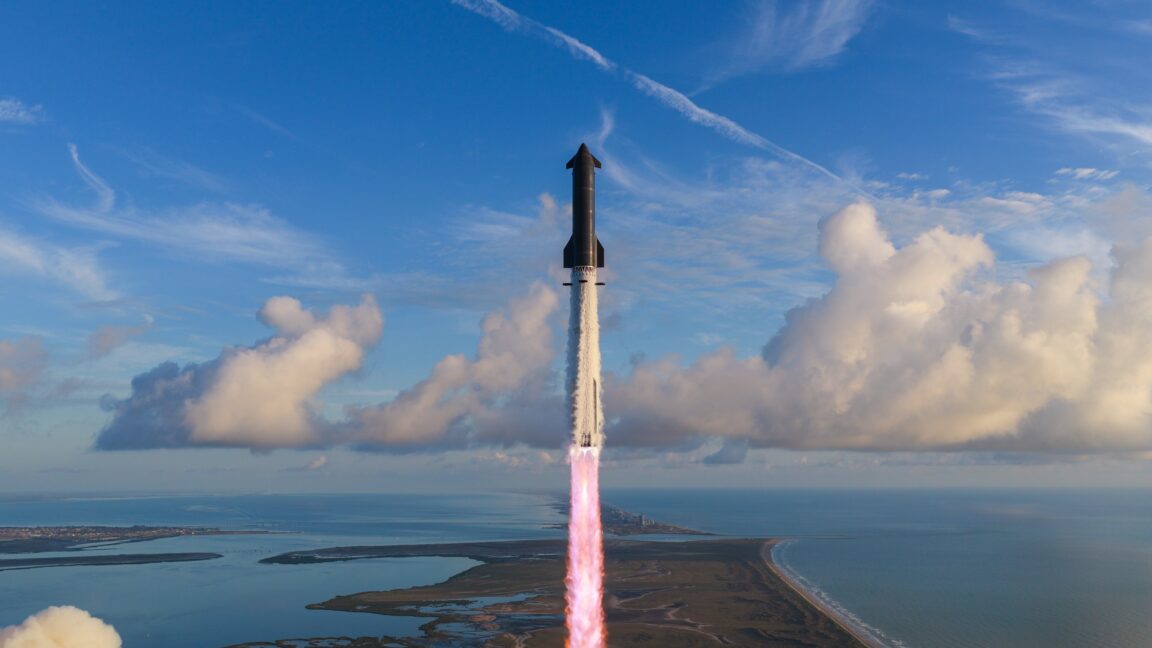
SpaceX to attempt Starship catch on next flight, with eye on rapid cadence increase

Image: courtesy of Ars Technica

techOctober 22, 2026By Veridact EditorialUpdated Oct 22

SpaceX Sets Sights on Double Tower Catch as Starship Targets Rapid Cadence Surge

Following a successful 14th test flight that saw the upper stage reach orbit, SpaceX is preparing for its 15th mission with an ambitious new objective: attempting to catch both the Super Heavy booster and the Starship upper stage using the launch tower's mechanical arms. Company leadership points to significant constructive engagement with the Federal Aviation Administration regarding return-to-launch-site operations, while projecting a dramatic acceleration in launch frequency toward a weekly cadence by 2027.

Outlook

The upcoming 15th test flight of SpaceX's Starship system, provisionally targeted for late autumn 2026, will introduce the most complex recovery sequence attempted in aerospace history. Following the successful orbital deployment test during Flight 14 on September 28, 2026, engineers have analyzed telemetry data from the vehicle's Raptor engines and structural components.

SpaceX plans to direct both the Super Heavy first stage and the Starship upper stage back to the launch site at Starbase in Boca Chica, Texas. There, the massive mechanical arms known colloquially as chopsticks will attempt to secure both descending elements mid-air. Chief Executive Officer Elon Musk stated that success in catching the upper stage on this upcoming flight is more likely than not, though the company maintains a deep inventory of hardware for subsequent attempts should technical anomalies arise.

Background

The transition from expendable testing to full and rapid reusability represents the core economic engine of the Starship program. Traditional rocket architectures discard expensive multi-engine boosters after a single use, imposing a structural floor on launch costs. By engineering a system where both the 33-engine Super Heavy booster and the stainless-steel upper stage return to the pad without needing traditional landing legs, SpaceX aims to slash the marginal cost per kilogram to low-Earth orbit.

President and Chief Operating Officer Gwynne Shotwell confirmed that regulatory discussions with the Federal Aviation Administration have progressed smoothly, clearing a path for the dual-catch profile. This regulatory agility contrasts sharply with the slow-moving approval processes that historically plagued commercial spaceflight, reflecting a maturing working relationship between private operators and federal safety regulators. Meanwhile, the company is balancing these flight-test objectives with preparations for a long-delayed orbital refueling test scheduled for early 2027, a technical prerequisite for NASA's Artemis lunar landing architecture.

See also

Before SpaceX IPO, investors in China secretly acquired stakes→SpaceX is now a public company valued for its AI potential, so what comes next?→

Precedents

The iterative development philosophy employed by SpaceX relies on rapid hardware fabrication and intentional destruction of test articles to expose engineering margins. This philosophy mirrors the early development cycles of the Falcon 9 booster, which spent years landing in the ocean before achieving routine vertical landings on autonomous droneships and return-to-launch-site pads.

However, scaling that iterative model to a vehicle standing nearly 400 feet tall with unprecedented structural mass introduces distinct mechanical risks. The mechanical catch tower method bypasses the weight penalty of carrying landing legs on the vehicle, but it concentrates recovery risk entirely on ground infrastructure. Historical precedent across aerospace engineering suggests that transitioning from single-stage recovery to multi-stage precision recovery frequently encounters unexpected aerodynamic interactions during atmospheric reentry, making the upcoming double-catch attempt a high-stakes stress test for both hardware and control algorithms.

The commercial viability of heavy-lift reusability dictates the financial health of the entire orbital economy, influencing capital allocation across satellite manufacturing, deep-space exploration, and orbital infrastructure. If SpaceX successfully executes a double tower catch, the operational bottleneck shifts immediately from vehicle manufacturing capacity to regulatory launch licensing and propellant loading limits.

For commercial competitors, institutional investors, and defense agencies, a reliable weekly launch cadence transforms satellite deployment timelines and opens the door for massive orbital compute constellations. The economic pressure will force legacy aerospace suppliers to reevaluate fixed-price development contracts, as the cost per ton to orbit drops toward levels previously considered economically impossible. For the aerospace labor market, the shift signals an impending demand spike for technicians, avionics specialists, and launch operations personnel capable of managing rapid vehicle turnaround.

Scenarios

Analysis

Analyses from industry observers suggest several distinct operational trajectories following the Flight 15 campaign:

1. Complete Dual-Catch Success: Both the Super Heavy booster and the Starship upper stage are successfully secured by the launch tower arms, validating the full reusability architecture and clearing the way for an aggressive acceleration toward weekly flight rates in early 2027.

2. Partial Recovery and Hardware Loss: The booster is caught successfully, but the upper stage experiences guidance or thermal protection anomalies during reentry, resulting in a controlled ocean splashdown or loss of vehicle. This outcome would prompt a minor design iteration while keeping the overarching program timeline largely intact.

3. Ground Infrastructure Strike: An anomaly during the descent profile causes structural damage to the launch and catch tower itself, temporarily halting the flight test campaign for several months while pad repairs are completed.

Timeline

September 28, 2026
Flight 14 Achieves Orbit
Starship reaches low-Earth orbit for the first time and successfully deploys 26 modified satellite test units.
October 2026
Flight 15 Preparations
SpaceX secures Federal Aviation Administration clearance for return-to-launch-site operations for both vehicle stages.
Early 2027
Orbital Refueling Demonstration
SpaceX aims to execute a long-delayed cryogenic propellant transfer test in low-Earth orbit to support NASA lunar missions.
Second Half 2027
Cadence Surge Target
Company leadership projects an increase toward twice-weekly launch attempts as vehicle version 3 hardware enters service.

Frequently Asked Questions

Discussion

0/100
0/1000

Be the first to share your thoughts.

Related Coverage

tech

Why Jon McCormack's Departure From Apple's Camera Team Matters More Than the Title Suggests

Nov 20
tech

How the Gig Economy Infiltrated American Nursing Homes — And Why Patient Safety Is Paying the Price

Nov 20
tech

When Silicon Valley Royalty Becomes a Liability for Taiwan's Night Markets

Nov 20
tech

Why Vendor Breaches at Chase, Visa, and Mastercard Expose the Soft Underbelly of Modern Finance

Nov 20

Stay ahead of the story

AI analysis delivered before events unfold. No spam.

ⓘ

Methodology: Veridact combines public data, historical precedent, and analytical models to evaluate the likelihood of future outcomes.