
Expect the next generation of telecommunications to function as a pervasive environmental sensor suite. By utilizing sub-terahertz frequencies, 6G towers will effectively generate 3D holographic maps of their surroundings, identifying objects and tracking trajectories with sub-centimeter precision. This shift will likely render dedicated, standalone radar hardware obsolete in many urban applications, as the Radio Access Network itself assumes the role of an omnipresent sensory organ. However, the operational reality of this transition hinges on managing massive computational loads at the network edge and navigating the inherent energy costs of continuous, high-fidelity sensing. The technology will fundamentally alter how carriers monetize their infrastructure, moving away from being mere connectivity pipes toward becoming providers of real-time environmental data-as-a-service.
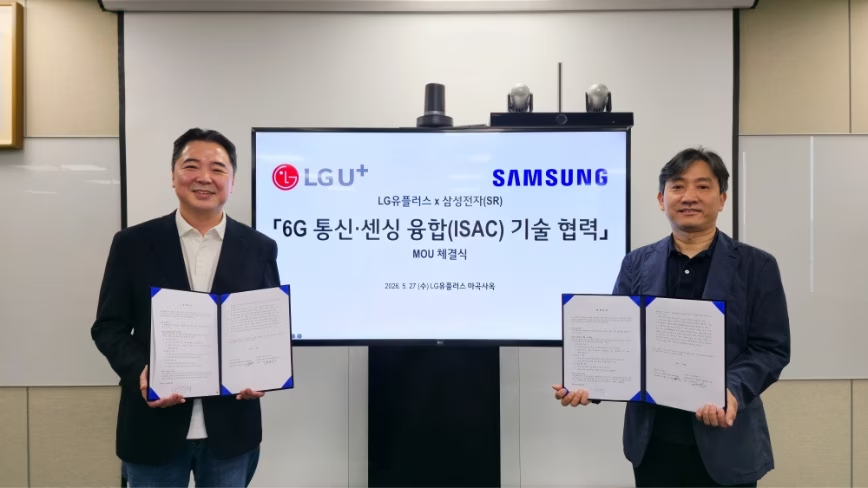
Image: courtesy of Thenextweb
The Invisible Grid: Why 6G Towers Are Morphing Into Massive Radar Arrays
Samsung and LG Uplus are spearheading a radical transformation of cellular infrastructure, moving beyond simple data transmission to turn 6G base stations into high-resolution, city-wide radar systems capable of tracking movement and physical environments.
Outlook
Background
The technical leap relies on the transition from 5G's millimeter-wave to the sub-terahertz frequency range, where wavelengths are short enough to interact with physical objects like light. Unlike traditional Wi-Fi sensing, which struggled with low bandwidth and environmental noise, 6G’s massive MIMO arrays provide the resolution required to distinguish individual actors in dense crowds. This development forces a collision between private corporate interests and public privacy expectations, creating a new regulatory front. Furthermore, the move shifts the competitive landscape, challenging existing radar manufacturers while forcing chipset giants to reconsider how sensing capabilities are integrated into baseband processors. The economic model is equally transformative, as the physical footprint of a carrier becomes a high-value real estate asset for urban planners and autonomous systems.
Precedents
The evolution of the cell tower mirrors the transformation of the smartphone from a single-purpose voice device to a multi-sensor suite equipped with GPS, cameras, and accelerometers. Just as 4G LTE towers evolved from simple transceivers into compute-heavy nodes, 6G represents the next logical step in infrastructure scaling. This trajectory is also reminiscent of the 'Smart Grid' transition in power utilities, where sensory nodes were added to existing lines to monitor demand, inadvertently creating a granular, real-time monitoring network. Early attempts at Wi-Fi sensing served as the 'blurry charcoal sketch' that failed due to signal noise, whereas Samsung and LG Uplus are now attempting to deliver a high-resolution, reliable photograph of the physical environment, learning from the technical limitations that plagued earlier, less sophisticated iterations of network sensing.
The core of this issue is the commoditization of physical space and the centralization of environmental perception. If the network becomes the primary mechanism through which we 'see' a city, the entity that controls that network effectively controls the interpretation of reality. This is not merely a technical upgrade; it is a profound shift in the power dynamics of urban governance and public safety. By turning every tower into a radar, carriers are positioning themselves as the gatekeepers of real-time urban intelligence, which could either optimize city efficiency or create a surveillance apparatus that outpaces existing legal frameworks. The societal stakes are high, as the line between a 'safety feature' and a 'tracking tool' remains dangerously thin, and the economic benefits of this data may come at the cost of public trust in the infrastructure that sustains our daily lives.
Scenarios
Analysis1. The Privatized Sensing Monopoly: Sensing data becomes a high-margin, proprietary product locked behind API gates. This creates a fragmented urban landscape where only the wealthiest entities can access real-time environmental data, deepening the digital divide between high-tech urban centers and underserved areas. 2. The Regulatory Firewall: Public backlash over mass surveillance forces governments to implement strict 'Sensing Privacy Laws.' These regulations mandate aggressive edge-based anonymization, stripping the radar capability of its granular identification features and relegating the technology to niche roles like weather monitoring. 3. The Open-Sensing Standard: Regulators treat sensing data as a public utility, similar to water or electricity metrics. This leads to a standardized interface that allows cities and researchers to tap into the 'sensing grid' for public good, though it leaves unresolved questions regarding how the immense costs of the hardware are distributed between taxpayers and private telecommunications operators.
Timeline
Frequently Asked Questions
Discussion
Be the first to share your thoughts.