
The Government Accountability Office (GAO) will now review Rocket Lab's claims. This process typically triggers an automatic stay on the awarded contract, meaning Blue Origin cannot proceed with significant work on the Mars Telecommunications Network until the protest is resolved. The GAO is mandated to issue a decision within 100 calendar days of the protest filing, which places the expected outcome around mid-December 2026. During this period, both NASA and Blue Origin will be required to respond to Rocket Lab's allegations, providing documentation and arguments to the GAO.
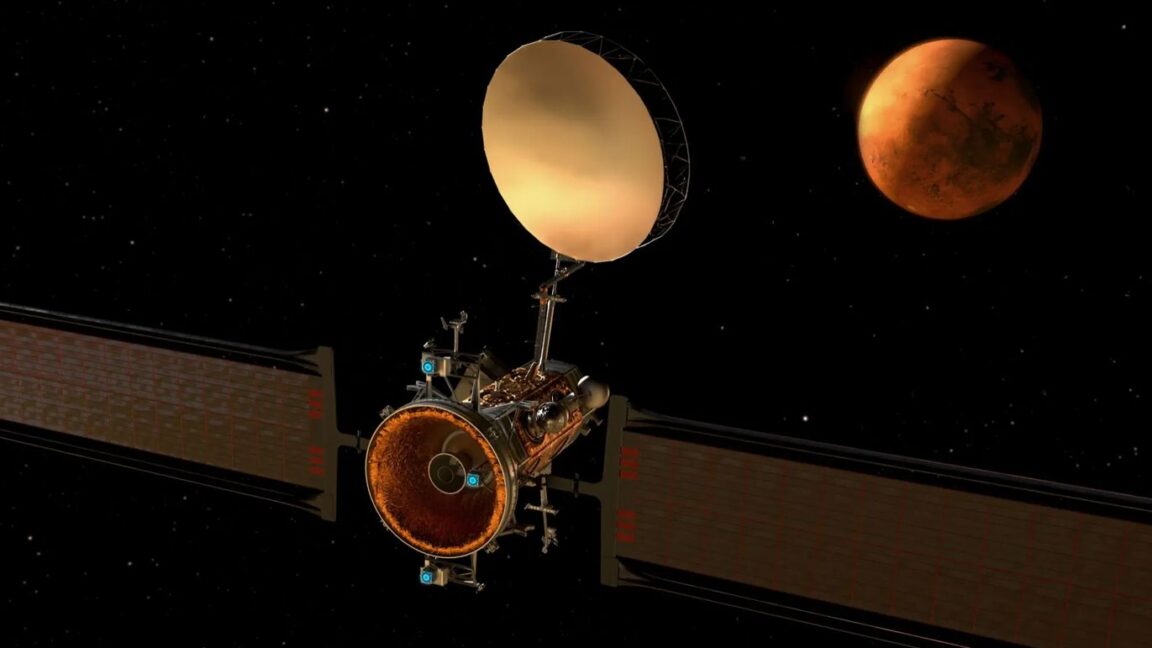
Image: courtesy of Ars Technica
The Battle for Mars: Rocket Lab Challenges Blue Origin's $700 Million NASA Contract
Rocket Lab has formally protested NASA's decision to award a $700 million contract for the Mars Telecommunications Network (MTN) to Blue Origin. The protest, filed with the Government Accountability Office (GAO) on September 11, 2026, alleges inconsistencies with Congressional eligibility criteria and flaws in NASA's technical review process. This challenge could significantly delay the development and launch of a critical piece of infrastructure for future Mars missions, which is currently slated for a 2028 launch.
Outlook
Background
On September 1, 2026, NASA announced its intention to award Blue Origin a contract with a ceiling of approximately $700 million for the development, launch, and operation of the Mars Telecommunications Network (MTN). This network is designed to be a high-bandwidth communication backbone, crucial for relaying data from future human and robotic missions on or around Mars back to Earth. Blue Origin's contract stipulates delivery of the orbiter by the end of 2028, with full operational status at Mars expected by 2030.
Just ten days later, on September 11, 2026, Rocket Lab publicly announced it had filed a formal protest with the GAO. The company's stated grounds for the protest center on two main points: alleged inconsistencies with Congressional eligibility criteria for the contract, and claims of flaws in NASA's technical review process during the selection phase. This implies Rocket Lab believes the evaluation was either improperly conducted or that Blue Origin did not meet specific, mandated requirements.
While Rocket Lab is challenging this specific contract, the company is already engaged in other Mars-related endeavors. NASA previously confirmed Rocket Lab's ESCAPADE mission, a small satellite interplanetary mission, for Mars under the agency’s Small Innovative Missions for Planetary Exploration (SIMPLEX) program. This demonstrates Rocket Lab's existing capabilities and aspirations in deep-space exploration.
Precedents
Protests against major government contract awards are a regular feature of the aerospace and defense industries, and the space sector is no exception. Companies often lodge these challenges when they believe the procurement process was unfair, inconsistent, or did not adhere to established rules.
One prominent example occurred in 2021 when Blue Origin itself challenged NASA's decision to award SpaceX the Human Landing System (HLS) contract for the Artemis program. That protest, also filed with the GAO, temporarily halted work on the lunar lander program, though the GAO ultimately denied Blue Origin's claims, allowing SpaceX to proceed. This historical precedent highlights that while protests can cause significant delays, they do not guarantee a reversal of the original award.
The GAO's role is to act as an independent arbiter, scrutinizing the awarding agency's (in this case, NASA's) compliance with federal procurement laws and the specific terms of the solicitation. The outcomes vary: some protests are denied, others are sustained, leading to corrective action, and a small number are sometimes withdrawn by the protesting party if a resolution is reached.
This pattern suggests that companies see the protest mechanism as a legitimate, if sometimes disruptive, avenue to challenge perceived injustices in high-stakes government contracting.
Rocket Lab's protest against the Mars Telecommunications Network contract carries significant implications, not just for the companies involved, but for NASA's ambitious deep-space exploration agenda and the broader commercial space industry.
For NASA, the primary concern is the potential for delays. The MTN is not merely another mission; it is envisioned as a foundational communications layer for future robotic and human missions to Mars. A significant delay in its 2028 launch target or 2030 operational readiness could ripple through the agency's long-term plans for Martian exploration and scientific data return. Any prolonged uncertainty around the contract could also impact planning for other missions reliant on the MTN.
For the commercial space sector, this protest underscores the intensifying competition for lucrative government contracts. As private companies take on increasingly critical roles in national space infrastructure, the stakes for these awards grow higher. The outcome of this protest will be closely watched by other players, as it could signal the GAO's approach to complex, multi-faceted space contracts and the weight it gives to technical review processes versus eligibility criteria.
Finally, the challenge places NASA's procurement transparency and decision-making under renewed scrutiny. If Rocket Lab's claims of inconsistencies or flaws are sustained, it could prompt a re-evaluation of how the agency manages its contracting processes for future high-value missions. This could lead to procedural changes aimed at increasing clarity and fairness, but also potentially adding complexity to future solicitations.
Scenarios
AnalysisThe Government Accountability Office's review of Rocket Lab's protest could lead to several distinct outcomes, each with different consequences for NASA, Blue Origin, and the future of the Mars Telecommunications Network:
One possible outcome is that the GAO denies Rocket Lab's protest. This would mean the GAO finds no merit in Rocket Lab's claims regarding eligibility criteria or technical review flaws, affirming NASA's original decision. If this happens, Blue Origin would be cleared to proceed with the $700 million contract without further procedural delays, allowing work on the MTN to resume or commence in earnest.
Alternatively, the GAO could sustain Rocket Lab's protest, finding that NASA indeed made an error in its award to Blue Origin. If the protest is sustained, the GAO would likely recommend 'corrective action' to NASA. This could take various forms, such as requiring NASA to re-evaluate the original proposals, reopen the competition to new bids, or even cancel the existing solicitation and issue a new one entirely. Any of these corrective actions would introduce significant delays to the MTN mission timeline.
A third, less common scenario is that Rocket Lab could withdraw its protest before a formal GAO decision. This might occur if the company reaches a resolution with NASA or Blue Origin outside of the formal protest process, or if it decides that continuing the challenge is no longer strategically beneficial. Such a withdrawal would allow Blue Origin to move forward with the contract, though the reasons for withdrawal would likely remain private.
Timeline
2026-09-01
NASA Awards Mars Telecom Contract
NASA announces the award of a contract worth up to $700 million to Blue Origin for the Mars Telecommunications Network (MTN).
2026-09-11
Rocket Lab Files Formal Protest
Rocket Lab publicly announces it has filed a formal protest with the Government Accountability Office (GAO) against NASA's award to Blue Origin, citing eligibility and technical review inconsistencies.
2026-12-19
Expected GAO Decision
The Government Accountability Office is mandated to issue a decision on Rocket Lab's protest within 100 calendar days of the filing date.
2028-12-31
MTN Orbiter Delivery Target
Blue Origin's contractual target for the delivery of the Mars Telecommunications Network orbiter.
2030-01-01
Expected MTN Operations at Mars
The anticipated start of operations for the Mars Telecommunications Network at Mars, pending successful delivery and deployment.
Frequently Asked Questions
The Mars Telecommunications Network (MTN) is a planned high-bandwidth communication system designed to support future NASA missions to Mars. It aims to provide faster, more robust data transfer capabilities between Earth and spacecraft or assets on the Martian surface, enhancing scientific returns and mission safety.
Discussion
Be the first to share your thoughts.