Veridact
TechSportsFinanceGaming🎯 PredictionsAbout
Sign InSign Up
Veridact

Analysis before the headline. Veridact examines technology, finance, sports, and gaming events before they unfold through forecasting, probability modeling, historical precedent, and public prediction tracking.

Stay ahead of what's next

Forecasts, analysis, and prediction updates delivered to your inbox.

Coverage

  • Tech
  • Sports
  • Finance
  • Gaming

Company

  • About Us
  • Privacy Policy

© 2026 Veridact. Forecasting & analysis platform.

Content may include AI-assisted research and analysis. Predictions and opinions should not be considered financial, legal, medical, or investment advice.

tech
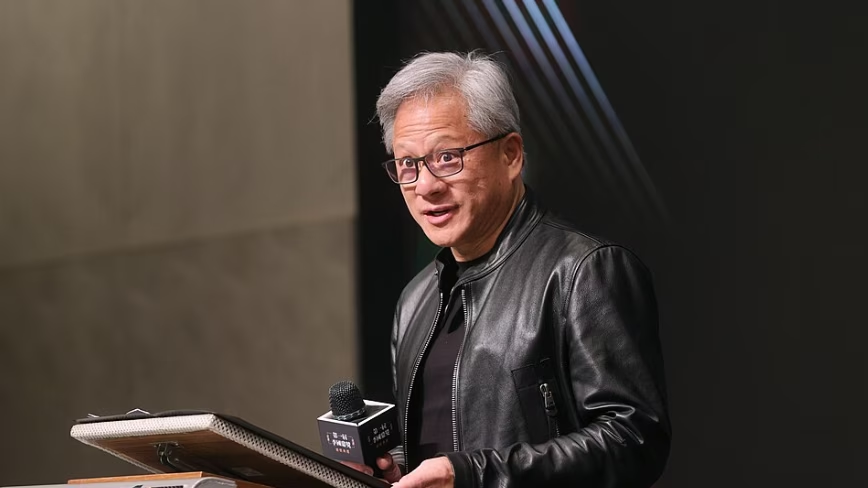
Nvidia CEO Jensen Huang says smuggled data centres are a dead end and national security comes first

Image: courtesy of Thenextweb

techJune 25, 2026By Veridact EditorialUpdated Jun 25

Nvidia CEO Jensen Huang Declares Smuggled AI Data Centers a 'Dead End,' Prioritizing National Security

Nvidia CEO Jensen Huang stated that data centers built with smuggled chips are unworkable and will receive no support, emphasizing that national security takes precedence over commercial opportunities. The remarks, made at the company's annual stockholder meeting on June 24, 2026, directly address the challenges of U.S. export controls and the integrity of AI infrastructure.

Outlook

Jensen Huang, the head of the world's leading AI chip maker, has drawn a clear line in the sand: there is no future for AI data centers constructed from illegally obtained components. His declaration on Wednesday signals a hardening stance from Nvidia, indicating that the company intends to align more strictly with national security directives, particularly those from the U.S. government regarding technology exports to restricted markets like China.

This is not merely a verbal commitment. Huang's statement implies a future where Nvidia will likely intensify efforts to ensure its products are used within regulated frameworks, potentially leading to stricter oversight of its distribution channels and greater scrutiny of end-users. For any entity considering bypassing official export controls, the message is unequivocal: such operations will be left without essential technical support, rendering advanced AI systems largely useless.

Background

The context for Huang's remarks is a complex web of escalating geopolitical tensions, particularly between the United States and China, over advanced technology. Washington has increasingly tightened export controls on cutting-edge AI chips and related hardware, aiming to slow China's technological and military advancements. These controls have created a 'gray market' where high-demand chips find their way into restricted regions through unofficial channels.

Building an advanced AI data center is not just about acquiring chips. It involves sophisticated hardware, intricate software integration, robust networking, and continuous technical support and updates from the manufacturer. Without these integrated elements, and crucially, without ongoing support, even the most powerful smuggled chips quickly become obsolete or operate far below their potential. Huang's statement directly addresses this operational reality, framing smuggled setups as inherently fragile and unsustainable.

Recent concerns in the U.S. have also focused on the supply chain for components beneath the chips themselves, such as Chinese-made printed circuit boards (PCBs), raising broader questions about national security implications even within seemingly innocuous parts of the tech stack.

See also

SpaceX is now a public company valued for its AI potential, so what comes next?→

Precedents

The history of technology export controls is replete with examples of nations attempting to restrict access to strategic technologies, often leading to the emergence of shadow markets. During the Cold War, the CoCom (Coordinating Committee for Multilateral Export Controls) aimed to prevent advanced Western technology from reaching the Soviet bloc, prompting extensive smuggling operations. More recently, sanctions against companies like Huawei have showcased the challenges and complexities of enforcing such restrictions.

In the semiconductor industry, companies often face a difficult balancing act. On one hand, there's significant commercial opportunity in large markets like China. On the other, there's pressure from governments to comply with national security policies. Nvidia's previous attempts to create 'de-tuned' chips for the Chinese market, designed to fall below U.S. export thresholds, illustrate this tension. However, even these efforts have faced scrutiny and further restrictions, suggesting that the U.S. government's intent is to limit any advanced AI capability reaching certain adversaries.

Huang's current statement marks a pivot from attempting to navigate these restrictions with modified products to a more absolute declaration of non-cooperation with illicit channels, aligning more firmly with the U.S. government's security priorities.

The real stakes here extend far beyond Nvidia's quarterly revenue. This declaration by Jensen Huang has profound implications for the global AI race, national security frameworks, and the very structure of the semiconductor supply chain. For the U.S., it's about maintaining a technological lead and preventing adversaries from acquiring the computational power needed for advanced military applications, surveillance, and economic competition. For China, it means the path to building cutting-edge AI infrastructure just became significantly harder, pushing them closer to indigenous, albeit potentially slower, development.

What does this mean for companies that have relied on these gray market channels? It means their investments in AI infrastructure built on smuggled chips are now at severe risk. Without official software updates, security patches, or even basic troubleshooting, these systems are effectively stranded assets, vulnerable to failure, cyberattacks, and rapid obsolescence. This creates a significant operational and financial headache for any organization that has circumvented official channels.

For Nvidia, the decision solidifies its position as a critical partner in the U.S.'s national technology strategy. It also underscores the growing reality that global technology companies can no longer operate solely on commercial logic; geopolitical considerations are now a primary driver of strategic decisions. This shift could redefine market access, force supply chain reconfigurations, and accelerate the bifurcation of the global tech ecosystem into distinct, geopolitically aligned spheres.

Scenarios

Analysis

Huang's explicit stance could lead to several distinct outcomes across the industry:

1. Increased Enforcement and Compliance: Nvidia is likely to implement more stringent internal policies and auditing mechanisms for its global distribution network. This would involve stricter contracts with partners, enhanced tracking of chip sales, and potentially cutting ties with distributors found to be facilitating gray market activities. The goal would be to trace products from factory to legitimate end-user, making it harder for smuggled chips to enter restricted regions without immediate detection and consequence.

2. Accelerated Indigenous Development in Restricted Markets: Facing a near-total block on advanced foreign AI chips and support, nations like China will likely double down on their efforts to develop fully domestic AI chip alternatives. This could involve massive state-backed investments in R&D, manufacturing, and talent acquisition, aiming to create a self-sufficient AI ecosystem. While this path is challenging and time-consuming, it could eventually lead to a more fragmented global AI market with distinct, non-interoperable technology stacks.

3. Market Shifts and Competitor Opportunities: A vacuum created by Nvidia's strict adherence to export controls could open limited opportunities for other chip manufacturers, particularly those not based in the U.S. or those with less advanced, but still capable, technology. Companies outside the immediate U.S. regulatory sphere might try to fill some of the demand, albeit likely with less powerful or specialized chips. Additionally, it could incentivize the development of open-source AI hardware and software alternatives, though these would struggle to match the performance of state-of-the-art proprietary systems.

4. Escalation of Geopolitical Tensions: The hardening of positions from a dominant player like Nvidia, in line with U.S. policy, may be perceived as an aggressive move by affected nations. This could lead to retaliatory measures, such as restrictions on U.S. companies operating in those markets, or increased state-backed cyber activities targeting U.S. tech interests. The tech decoupling trend would intensify, making it even more challenging for multinational corporations to operate globally.

Timeline

2022-10-07
U.S. Imposes Sweeping Export Controls
The Biden administration announces broad restrictions on the export of advanced semiconductors and chip-making equipment to China, citing national security concerns. This significantly impacts Nvidia's ability to sell its most powerful AI GPUs.
2023-08-01
Nvidia Develops China-Specific Chips
Nvidia introduces 'de-tuned' versions of its AI chips, such as the A800 and H800, designed to meet U.S. export control thresholds, attempting to maintain market access in China.
2023-10-17
U.S. Further Tightens Export Rules
The U.S. Commerce Department announces new rules, closing loopholes and expanding the scope of restrictions, effectively limiting sales of even the de-tuned chips to China without a license.
2026-06-24
Jensen Huang's 'Dead End' Declaration
Nvidia CEO Jensen Huang states at the company's annual meeting that AI data centers built with smuggled chips are a 'dead end' and that national security takes precedence, signaling no support for such operations.

Frequently Asked Questions

It means that even if someone manages to acquire Nvidia's advanced AI chips through unofficial or illegal channels, building a functional, reliable, and continuously supported data center with them is impossible. Modern AI infrastructure requires integrated hardware, software, networking, and ongoing technical support from the manufacturer. Without that official support, the system will not perform optimally, cannot be updated, and will eventually fail or become obsolete.

Discussion

0/100
0/1000

Be the first to share your thoughts.

Related Coverage

tech

Washington's Chip War Pits Security Against European Industry, With ASML at the Center

Jun 25
tech

Micron Technology Emerges as Key Beneficiary in Deepening Global Memory Chip Shortage

Jun 25
tech

Samsara Deploys New Bluetooth Labels to Combat Surging Cargo Theft

Jun 25
tech

Pentagon Reinstates Mandatory Flu Shots for Recruits After Rapid Outbreak at Lackland Air Force Base

Jun 25

Stay ahead of the story

AI analysis delivered before events unfold. No spam.

ⓘ

Methodology: Veridact combines public data, historical precedent, and analytical models to evaluate the likelihood of future outcomes.