
If the mission proceeds, the PROMISE rover will be tasked with exploring the challenging terrain of the lunar south pole. This region is of particular interest due to the confirmed presence of water ice in permanently shadowed craters, a resource critical for future human missions. The rover's nuclear power source, likely a Multi-Mission Radioisotope Thermoelectric Generator (MMRTG) similar to those used on Mars, would allow it to operate for extended periods without relying on solar power, a significant advantage in areas with extreme temperature swings and prolonged darkness. The mission is expected to test operational procedures for long-duration lunar surface exploration, gathering data on the composition of the polar regolith and the distribution of volatiles. Adapting a rover designed for Mars to the Moon's different gravity, dust environment, and communication requirements will present specific engineering challenges that NASA will need to address before launch. The timeline for a 2026 launch is ambitious, indicating a high priority for this type of lunar reconnaissance.
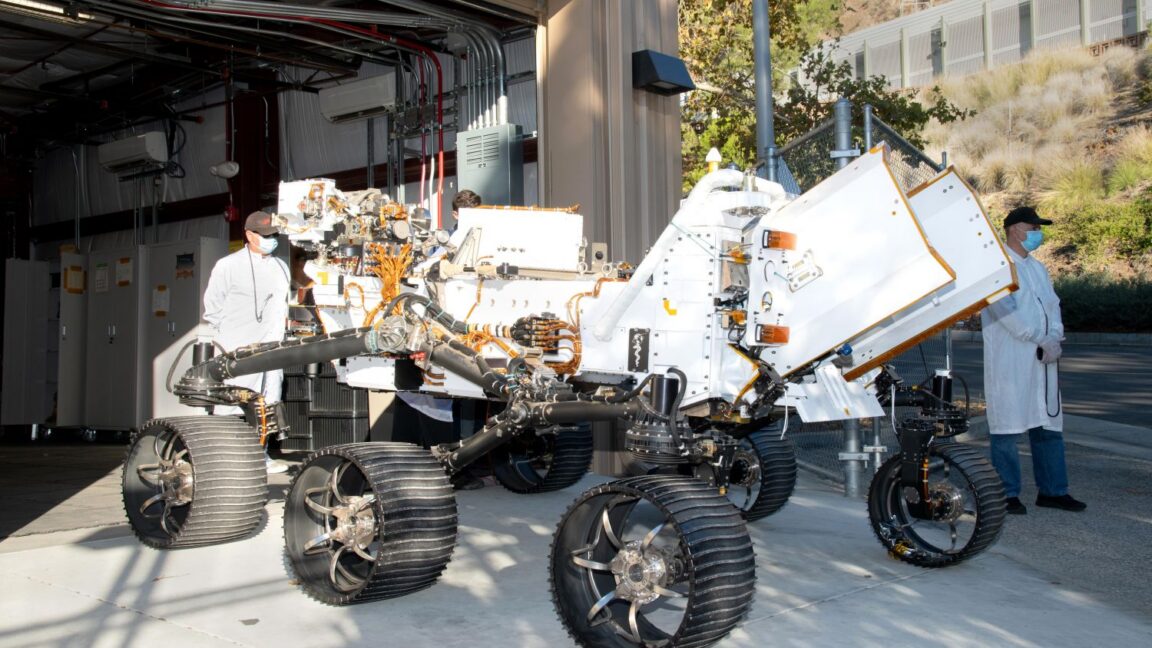
Image: courtesy of Ars Technica
NASA's Nuclear-Powered PROMISE: Why a Mars Rover Testbed Could Unlock the Moon's South Pole
NASA is considering an unconventional path to lunar exploration, potentially repurposing a backup Mars rover named PROMISE for a mission to the Moon's south pole in 2026. This move, announced yesterday, aims to leverage existing nuclear-powered technology and engineering expertise from the Mars program to tackle the harsh, permanently shadowed regions of the Moon. The decision suggests a strategic push to accelerate NASA's Moon-to-Mars objectives by making efficient use of its assets.
Outlook
Background
The PROMISE rover, short for 'Polar Rover for Observation, Mapping, and In-Situ Exploration,' began its life as an engineering development model for NASA's Perseverance and Curiosity rovers. These 'twin' testbeds, like OPTIMISM for Perseverance, are crucial for simulating mission operations and troubleshooting potential issues on Earth before they occur millions of miles away. Repurposing PROMISE for a lunar mission represents a significant pivot, moving a robust, nuclear-powered platform from a test environment to an active exploration role on a different celestial body.
The lunar south pole is a prime target for NASA's Artemis program, which aims to return humans to the Moon. The water ice found there could be processed into drinking water, breathable oxygen, and rocket fuel, making it a potential 'gas station' for missions further into space, including Mars. However, the region's extreme cold, rugged terrain, and communication challenges make it a difficult environment for conventional, solar-powered rovers. Nuclear power offers a solution to these constraints, providing consistent energy regardless of sunlight availability. NASA has also confirmed plans for a separate nuclear-powered interplanetary spacecraft, Space Reactor-1 Freedom, to launch to Mars before the end of 2028, signaling a broader commitment to nuclear technology in deep space exploration.
Precedents
NASA has a long history of adapting and repurposing technology across its space programs, often driven by budget constraints, technological advancements, or evolving scientific priorities. For instance, the Mercury capsules were significantly modified for the Gemini program, and the Apollo Command/Service Module was adapted for the Skylab space station. In the realm of planetary exploration, while not a direct repurposing of a testbed for a new mission, the successive generations of Mars rovers (Sojourner, Spirit and Opportunity, Curiosity, Perseverance) have built upon previous designs, sharing core technologies and operational lessons.
More recently, the agency's focus on commercial partnerships for lunar landers under the Commercial Lunar Payload Services (CLPS) initiative shows a willingness to explore flexible and cost-effective approaches to Moon exploration. Using a fully developed, albeit test, rover like PROMISE aligns with this strategy of maximizing existing investments. The concept of nuclear power in space is also not new; radioisotope thermoelectric generators (RTGs) have powered missions like Voyager, Cassini, and the Mars rovers for decades, providing reliable, long-duration energy far from the Sun. The challenge here is less about the technology itself and more about the specific adaptation of a Mars-centric design to a lunar environment.
This potential mission with the PROMISE rover changes several things for NASA and the broader space community. First, it represents a highly efficient use of resources. Instead of building a new lunar rover from scratch for a high-priority polar mission, NASA is considering deploying an existing, robust test platform. This could save significant time and money, accelerating the pace of lunar exploration. Second, it's a critical step in validating the operational viability of nuclear-powered vehicles for sustained lunar operations, particularly in the challenging polar regions. Success here would de-risk future, more complex robotic and human missions to the Moon's south pole, directly supporting the Artemis program's long-term goals of establishing a sustainable human presence.
Third, by testing procedures and gathering data with a nuclear-powered rover, NASA would gain invaluable experience that could inform the design and deployment of future vehicles for both lunar and Martian missions. The lessons learned from adapting PROMISE for the Moon could streamline the development of future Moon-to-Mars technologies. Finally, it signals NASA's resourcefulness and adaptability in pursuing its ambitious exploration agenda, demonstrating a pragmatic approach to achieving its objectives under real-world constraints. The mission could provide crucial scientific data about lunar water ice, which is not only a resource but also a record of the early solar system.
Scenarios
AnalysisOne possible outcome is that NASA successfully adapts and launches the PROMISE rover to the Moon in 2026. This would provide valuable data from the lunar south pole, validate nuclear power for long-duration lunar missions, and demonstrate a highly efficient use of existing assets. Such a success could influence future lunar vehicle designs, potentially leading to more nuclear-powered rovers for deep space and polar exploration.
Another outcome could see the mission face unexpected technical or budgetary hurdles during the adaptation phase. Modifying a rover designed for Mars's atmosphere and gravity to the Moon's vacuum and different gravitational pull is not trivial. If these challenges prove too great, or if other priorities emerge, the PROMISE mission could be delayed or even cancelled. This would force NASA to re-evaluate its strategy for early lunar polar reconnaissance, potentially requiring the development of a new, purpose-built lunar rover or relying more heavily on commercial partners.
A third scenario involves the mission proceeding but encountering operational difficulties on the lunar surface. While nuclear power offers advantages, the extreme temperatures and abrasive regolith of the lunar south pole still pose significant challenges. The mission's success would then be measured by how much data could be collected before any potential system failures, still providing lessons for future missions but perhaps not fully achieving all scientific objectives.
Timeline
Frequently Asked Questions
Discussion
Be the first to share your thoughts.