
The robotic spacecraft, LINK, is scheduled to launch today, June 30, 2026, aboard an airplane-launched Pegasus rocket from an atoll in the Pacific's Marshall Islands. Following a successful launch, LINK will begin its chase to rendezvous with the Swift Observatory. This process involves complex orbital mechanics to match Swift's speed and position. Once in proximity, LINK, equipped with three robotic arms, will attempt to physically connect with Swift. After a secure connection is established, LINK will then use its own propulsion system to push Swift into a higher, safer orbit, extending its mission for several more years. The entire reboost operation is expected to take time, with the initial rendezvous and docking being the most critical early phases. Confirmation of a successful reboost will come once Swift's new orbital parameters are verified.
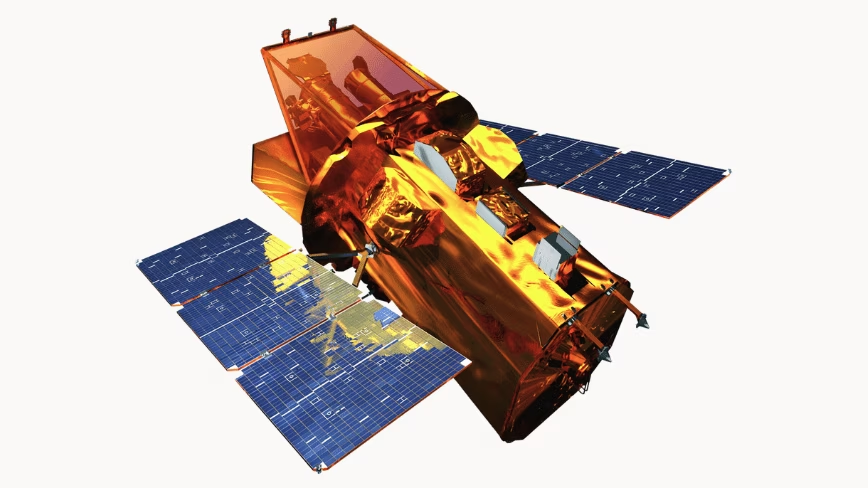
Image: courtesy of Thenextweb
NASA's High-Stakes Swift Rescue: A Test Case for Commercial Space Maintenance
NASA has embarked on a critical mission to save its Swift Observatory, a $500 million space telescope that is slowly falling back to Earth. The agency hired Katalyst Space Technologies, an Arizona-based startup, for a $30 million contract to launch a robotic spacecraft named LINK. Scheduled for liftoff today, June 30, 2026, the mission aims to rendezvous with Swift, capture it, and propel it into a higher, more stable orbit, effectively extending its operational life. This daring operation is not just about saving a valuable scientific asset; it represents a significant step in the commercialization of in-orbit servicing and a crucial test for private companies handling vital government space infrastructure.
Outlook
Background
The Swift Observatory, launched in 2004, is a multi-wavelength space telescope designed to detect and study gamma-ray bursts (GRBs), the most powerful explosions in the universe. Originally designed for a two-year mission, Swift has far exceeded expectations, operating for over two decades and providing groundbreaking data on cosmic phenomena. Its longevity, however, has led to its current predicament: its orbit has gradually decayed due to atmospheric drag, a natural process for satellites in low Earth orbit. Without intervention, Swift would eventually re-enter Earth's atmosphere, likely burning up, resulting in the loss of a valuable scientific instrument.
NASA awarded the $30 million contract to Katalyst Space Technologies in September 2025. This timeline means Katalyst had less than a year, and by some accounts as little as seven months, to design, build, test, and prepare the LINK spacecraft for launch. This rapid development cycle for a complex space mission is highly unusual for traditional aerospace programs, which often span many years, and highlights the agility that startups like Katalyst can bring to the sector. The mission's success or failure will offer valuable lessons for the burgeoning in-orbit servicing industry and NASA's strategy for maintaining its aging fleet of satellites.
Precedents
The concept of in-orbit servicing (IOS) is not entirely new, but its widespread commercial application is. Historically, complex satellite servicing missions have been the domain of government agencies, often involving astronauts or highly specialized robotic systems developed by large aerospace contractors. The most famous example is the Hubble Space Telescope, which received multiple servicing missions by Space Shuttle astronauts, significantly extending its life and upgrading its capabilities. However, these missions were incredibly expensive, complex, and high-risk, requiring human crews and specialized vehicles.
More recently, there have been robotic servicing efforts, primarily by large defense contractors. Northrop Grumman, for instance, launched its Mission Extension Vehicle (MEV-1) in 2020, which successfully docked with and extended the life of an Intelsat communications satellite. This demonstrated the viability of robotic reboosting for commercial geostationary satellites.
What makes the Swift mission distinct is the scale and speed of the contract with a relatively young startup like Katalyst. It signals a potential shift in how NASA and other space agencies approach satellite maintenance: moving away from solely bespoke, in-house solutions towards leveraging the innovation and potentially lower costs offered by the commercial space sector. This mirrors a broader trend seen in launch services, where companies like SpaceX have significantly disrupted the market once dominated by government and established contractors. The challenge, however, remains immense. Docking with a non-cooperative, tumbling, or un-designed-for-servicing satellite in low Earth orbit is significantly more complex than servicing a large, stable geostationary satellite with pre-installed docking features, as was the case with MEV-1. The Swift mission pushes the boundaries of this commercial approach, testing its limits in a truly 'daring' context.
The rescue mission for the Swift telescope is more than an engineering challenge; it is a critical proving ground for the future of space operations and the role of commercial enterprise within it. Success would validate NASA's strategy of partnering with agile startups for crucial, high-stakes missions. It demonstrates that valuable government assets, once considered disposable after their fuel ran out or their orbit decayed, can be maintained and extended at a fraction of their replacement cost. A $30 million rescue for a $500 million telescope, if successful, represents a significant return on investment and a template for future missions.
For the burgeoning in-orbit servicing (IOS) industry, a successful Swift reboost would be a powerful endorsement. It would signal to other satellite operators, both government and commercial, that extending the life of existing assets through robotic servicing is a viable, cost-effective alternative to launching new ones. This could unlock a massive market for services like refueling, repair, and orbital adjustments, reducing space debris by preventing premature deorbiting and making space operations more sustainable.
Conversely, a failure would cast a shadow over the commercial IOS sector and potentially make NASA more hesitant to entrust critical infrastructure to smaller, newer companies. It would reinforce the perception that space operations demand the deep pockets and decades of experience typically found only in large, established aerospace firms. The stakes, therefore, extend far beyond a single telescope; they touch upon the economic models, technological capabilities, and strategic direction of the entire space industry for the next decade.
Scenarios
AnalysisThe mission to reboost the Swift Observatory presents several distinct outcomes, each with significant implications for NASA, Katalyst Space Technologies, and the broader space industry.
Outcome 1: Successful Reboost and Extended Mission.
If Katalyst's LINK spacecraft successfully launches, navigates to Swift, performs a secure capture, and executes the orbital reboost as planned, it would be a landmark achievement. This outcome would confirm the viability of rapid-response commercial in-orbit servicing for critical scientific assets. For NASA, it means continued access to Swift's unique observational capabilities, extending its scientific output for years. It would also validate the agency's decision to trust a startup with such a complex and high-value mission, potentially paving the way for more such partnerships in the future. Katalyst Space Technologies would gain immense credibility, likely attracting further investment and contracts within the growing in-orbit servicing market. This success could accelerate the development of standardized docking interfaces and operational protocols for future satellite servicing missions.
Outcome 2: Partial Success or Limited Extension.
It is possible that the mission encounters technical challenges that prevent a full reboost to the desired higher orbit, but still manages to raise Swift enough to extend its life for a shorter period than initially hoped. For example, LINK might successfully capture Swift but experience a propulsion issue, or be unable to achieve the full delta-V (change in velocity) required. This scenario would still be considered a technical achievement, demonstrating key capabilities in rendezvous and docking, but might lead to a more cautious approach from NASA regarding the expected lifespan extension. It would provide valuable data on the practical limits of current commercial servicing technology and the challenges of dealing with non-cooperative targets. Katalyst would still learn valuable lessons, but the commercial impact might be less pronounced than a full success.
Outcome 3: Mission Failure.
Failure could manifest in several ways: a launch anomaly with the Pegasus rocket, a failure of LINK's navigation or propulsion systems to reach Swift, an inability to securely capture the telescope, or a catastrophic malfunction during the reboost attempt. A complete failure would result in the inevitable loss of the Swift Observatory as it continues its descent towards Earth. For NASA, this would mean the premature end of a valuable scientific mission and a $30 million expenditure without the desired outcome. For Katalyst, it would be a significant setback, potentially impacting investor confidence and future contract opportunities. Such a failure could also lead to increased scrutiny of commercial space ventures and a more conservative approach from government agencies when considering partnerships for critical space infrastructure. It could also highlight the inherent risks and complexities involved in operating in the unforgiving environment of space, even with advanced robotic systems.
Timeline
Frequently Asked Questions
Discussion
Be the first to share your thoughts.