
Expect continued development and testing of Helsing's AI systems, particularly with the CA-1 Europa combat drone's maiden flight scheduled for 2027. Germany's defense spending on AI will likely increase, and there could be further clarifications or adjustments regarding its role within the larger, multinational FCAS program. The tension between a software-first approach and traditional hardware-focused defense will also be a key dynamic to watch. The German parliament's approval of the necessary funding, particularly the €580 million allocated for software, will be a critical near-term milestone.
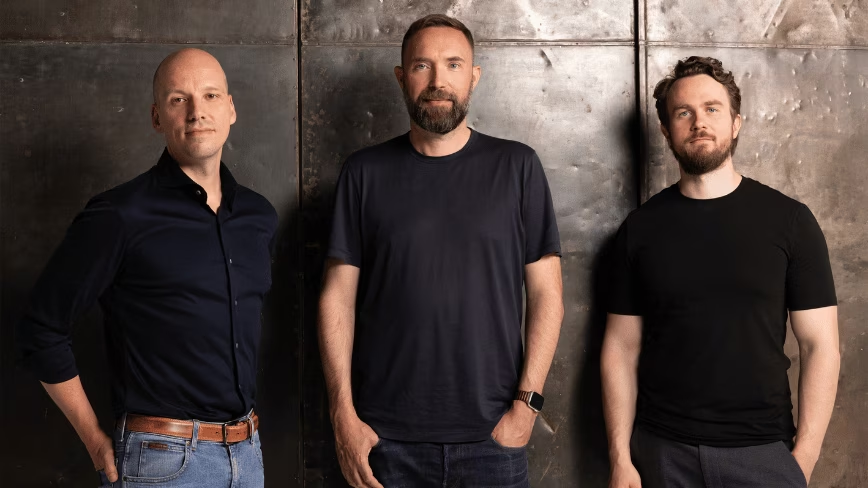
Image: courtesy of Thenextweb
Germany's AI Bet: How Helsing's Software-First Approach Is Reshaping Europe's Future Combat Air System
Germany has placed a significant strategic wager on artificial intelligence, selecting Berlin-based defense startup Helsing to develop the core AI for its Future Combat Air System (FCAS). This move signals a deliberate shift towards software-driven warfare and autonomous systems, underlined by Helsing's unveiling of the CA-1 Europa combat drone, slated for its first flight in 2027. The decision comes amid existing complexities and disagreements within the broader Franco-German FCAS initiative, suggesting Germany is pushing its own vision for next-generation air capabilities.
Outlook
Background
Germany's decision to entrust Helsing with the 'brain' of its next air war machine represents a pivot. The Future Combat Air System (FCAS) is an ambitious, multi-billion-euro European defense project aiming to develop a system of systems, including next-generation fighter jets, drones, and networked capabilities. It is primarily a Franco-German initiative, with Spain also involved, but has been plagued by political disagreements and industrial workshare disputes, particularly between Germany and France. The selection of Helsing, a company founded in 2020 that specializes in AI software rather than traditional hardware, marks a departure from reliance on established defense giants.
Helsing's track record includes securing contracts to provide electronic warfare capabilities for the Eurofighter update in June 2023, and winning the broader AI backbone contract for FCAS in August 2023. The company has also demonstrated its AI's ability to take control of a fighter jet in 2025 and unveiled its own combat drone, the CA-1 Europa, in the same year. This drone, designed for autonomous operation and swarming capabilities, is scheduled for its inaugural flight in 2027. Germany's intent to build autonomous drones by 2026 further solidifies this strategic direction. The investment in Helsing, reportedly involving €580 million for software, highlights a significant financial commitment to this new defense paradigm.
Precedents
The history of European defense cooperation is replete with ambitious joint projects that have faced delays, cost overruns, and nationalistic disputes. Programs like the Eurofighter Typhoon, despite their ultimate success, were born out of complex multinational negotiations and often saw participating nations pursue parallel national interests or preferred industrial partners. The FCAS program itself has followed a similar pattern, with France and Germany frequently at odds over leadership, design control, and industrial allocation.
Historically, defense procurement has been dominated by large, established aerospace and hardware manufacturers such as Dassault, Airbus, and BAE Systems. These companies possess decades of experience in complex systems integration, manufacturing, and supply chain management. However, the emergence of 'software-first' defense startups like Helsing mirrors a broader trend seen in commercial technology, where agile, AI-native companies are disrupting traditional industries. This shift challenges the entrenched industrial base and introduces new questions about intellectual property, data security, and the integration of rapidly evolving software with long-lifecycle hardware platforms. The move towards autonomous combat drones also reflects lessons from recent conflicts, where cheaper, more dispensable unmanned aerial vehicles have proven highly effective, pushing air forces globally to rethink traditional air superiority doctrines that rely solely on expensive manned fighter jets.
Germany's decision is more than a procurement contract; it is a strategic repositioning within European defense. By selecting Helsing, Germany is asserting its commitment to a future where AI and autonomous systems are central to military power, potentially even prioritizing this vision over strict adherence to the original, often contentious, Franco-German FCAS framework. This could accelerate the development of critical AI capabilities for Germany, giving it a lead in a crucial area of modern warfare.
For the broader FCAS program, this German-led AI initiative creates a complex dynamic. While Germany insists it wants to continue with the established setup, the move with Helsing could be seen as an alternative path or a way to strengthen its negotiating position against French assertions of majority control over design domains. It introduces a new, agile player into a traditionally slow-moving industry, potentially disrupting the dominance of legacy defense contractors.
Furthermore, this focus on AI-driven combat drones like the CA-1 Europa suggests a future where air warfare relies less on expensive, manned fighter jets and more on networked swarms of intelligent, cheaper, and more dispensable unmanned systems. This could fundamentally alter the cost structures and tactical doctrines of air forces, making advanced air power more accessible but also raising ethical and strategic questions about autonomous decision-making in combat. The investment also positions Germany as a key player in shaping the ethical and regulatory frameworks for AI in military applications.
Scenarios
AnalysisOne possible outcome is that Germany's strong push with Helsing could provide a much-needed injection of modern AI capabilities into the FCAS program, potentially accelerating its overall development. This might lead to a more modular and adaptable FCAS architecture, where AI components from Helsing are integrated alongside traditional hardware from other partners. This outcome would necessitate greater flexibility and cooperation from France and Spain, potentially softening previous disagreements over workshare and design control. The success of Helsing's CA-1 Europa drone could prove the viability of a software-first approach, encouraging broader adoption of similar technologies across European defense.
Alternatively, this independent German initiative could further strain the Franco-German relationship within the FCAS program. If France perceives Germany's move as undermining the joint effort or shifting too much control to a German-led AI component, it could lead to renewed disputes over design authority and intellectual property. This might result in a more fragmented FCAS, or even a scenario where Germany develops its AI-centric air combat capabilities largely in parallel, reducing the overall integration and commonality of the European project. Such an outcome could also force traditional defense contractors to rapidly acquire or develop their own advanced AI capabilities to remain competitive, leading to a wave of mergers, acquisitions, or new partnerships in the defense tech sector.
Timeline
2023-06
Helsing Secures Eurofighter Contract
Helsing and its partner SAAB were selected by the German government to provide new electronic warfare capabilities for an upcoming update to the Eurofighter aircraft.
2023-08
Helsing Wins FCAS AI Backbone Contract
Helsing and its partners secured the contract to provide the artificial intelligence backbone for the Future Combat Air System (FCAS) program.
2024-02-24
Helsing Mentioned by Ukrainian Minister
The Ukrainian Minister of Strategic Industries, Alexander Kam, made a public statement referencing Helsing, though the full context of the mention is not detailed in available reports.
2025
Helsing AI Takes Control of Fighter Jet & Unveils Drone
Helsing demonstrated its AI's capability by having it take control of a fighter jet during a test. The company also unveiled its CA-1 Europa combat drone in the same year.
2026
Germany Aims for Autonomous Drones
Germany plans to build autonomous drones by this year, aligning with its strategic focus on AI-powered combat systems.
2026-06-29
Germany's AI Strategy for FCAS Confirmed
The German government's selection of Helsing to develop the AI for its Future Combat Air System (FCAS) was reported, with an internal note flagging 'considerable communication needs' regarding the contract.
2027
CA-1 Europa First Flight Expected
Helsing's CA-1 Europa combat drone is scheduled to conduct its first flight, marking a critical milestone in the development of Germany's AI-driven air combat capabilities.
Frequently Asked Questions
The FCAS is a major European defense initiative aiming to develop a next-generation air combat system. It's envisioned as a 'system of systems' that includes manned fighter jets, unmanned combat aerial vehicles (drones), and a highly networked operational environment, primarily led by France and Germany with Spain's participation.
Discussion
Be the first to share your thoughts.