
Veridact
TechSportsFinanceGaming🎯 PredictionsAbout
Sign InSign Up
Veridact

AI-powered anticipation analysis. We cover tech, sports, finance, and gaming events before they happen — with historical context, scenario modeling, and evolving coverage.

Stay ahead of the story

Analysis delivered before events unfold.

Coverage

  • Tech
  • Sports
  • Finance
  • Gaming

Company

  • About Us
  • Privacy Policy

© 2026 Veridact. AI-assisted analysis platform.

Analysis is AI-generated and not professional financial, legal, or medical advice.

Tech
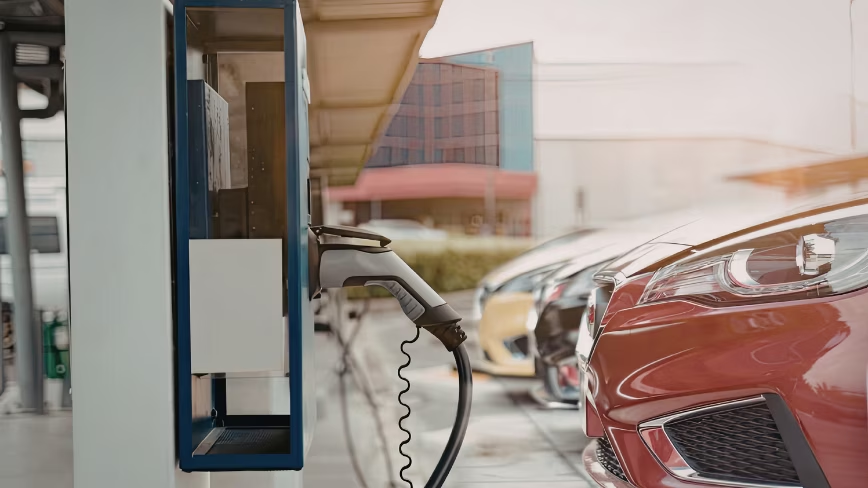
Chinese EVs are circling the US market. Detroit’s best option may be to partner with them.

Image: courtesy of Thenextweb

techJune 7, 2026By Veridact EditorialUpdated Jun 7

The NUMMI Solution: Why Detroit's Survival Now Depends on Partnering with Its Chinese Rivals

As Washington erects high tariff barriers to keep Chinese electric vehicles out of the United States, legacy domestic automakers face a deeper structural crisis. Insulated from global competition, Detroit risks falling permanently behind in battery technology and cost-efficient manufacturing. To survive, American carmakers may need to look to history and form uneasy alliances with the very Chinese competitors they are trying to keep at bay.

What to Expect

The high tariff wall erected by Washington to protect the American automotive industry from cheap Chinese electric vehicles is starting to look less like a defensive shield and more like a gilded cage. In mid-2024, the federal government imposed a 100% tariff on Chinese-made electric vehicles, a policy designed to give Detroit legacy giants the breathing room needed to scale up their own EV programs. Yet, two years later, the domestic transition to battery power has slowed to a crawl, plagued by high development costs, consumer hesitation, and persistent production bottlenecks. Meanwhile, Chinese manufacturers like BYD and Geely are expanding their footprint across Europe, Latin America, and Southeast Asia, refining their technology and driving down costs at a pace Western executives can barely comprehend.

Detroit is running out of time to solve its manufacturing cost dilemma. While American automakers focus on high-margin, heavy electric pickup trucks and SUVs that frequently retail for over $60,000, Chinese competitors have mastered the art of building reliable, tech-forward compact EVs for a fraction of that price. The tension is no longer about whether Chinese vehicles will enter the North American market, but how they will do so. Even with a doubling of tariffs, the raw cost advantage of Chinese manufacturing is so pronounced that a vehicle like the BYD Seagull could theoretically land on American shores, pay the tariff, and still retail for thousands of dollars less than the cheapest domestic alternative.

This reality leaves legacy brands with a stark, uncomfortable choice. They can continue to hide behind protective trade policies, slowly losing relevance in every neutral global market where those tariffs do not apply. Or, they can pursue a strategy of pragmatism over pride, forming joint ventures and licensing agreements with Chinese companies to access the battery chemistry, supply chains, and software-defined vehicle architectures that they have struggled to develop on their own. It is a politically radioactive path, but historically, it is the only one that has ever saved Detroit from a superior foreign competitor.

Key Context

To understand the scale of the challenge facing General Motors, Ford, and Stellantis, one must look closely at the underlying economics of vehicle production. A teardown analysis of the BYD Seagull by engineering firm Caresoft Global revealed that the compact hatchback costs BYD roughly $9,000 to manufacture in China. The car is not a flimsy, low-quality runabout; it features modern safety systems, an advanced infotainment platform, and a highly efficient battery pack. In contrast, the cheapest electric vehicles currently built by American automakers carry production costs that make retailing them for under $35,000 structurally unprofitable. The average transaction price for an EV in the United States remains stubborn, hovering near $55,000, far out of reach for the median American household.

So why can't American engineering simply bridge this cost gap through automation and manufacturing scale?

The answer is almost never about the assembly line itself; it is about the deep, vertical integration of the Chinese battery supply chain. Companies like CATL and BYD do not merely assemble battery packs; they own the lithium mines, run the chemical processing facilities, manufacture the cathode active materials, and design the battery management software. China currently controls over 80% of the global refining capacity for key battery minerals and more than 70% of the world's lithium-ion cell production. When Ford or GM attempts to build an EV in Michigan, they are purchasing components from a fragmented supply chain that ultimately leads back to Chinese processing facilities. Every step in that journey adds margin, logistics costs, and regulatory compliance fees, inflating the final price of the vehicle.

Efforts to build localized, independent supply chains in North America have met with severe operational headwinds. Ford’s ambitious $3.5 billion BlueOval Battery Park in Marshall, Michigan, was designed to produce low-cost lithium iron phosphate (LFP) batteries. However, because the underlying technology belongs to China's CATL, the project became a lightning rod for congressional scrutiny, forcing Ford to scale back the plant's planned capacity by over 40% and delay its operational timeline. This political friction highlights the central contradiction of current US industrial policy: Washington wants domestic automakers to build cheap EVs quickly, but it has outlawed the use of the only supply chains capable of doing so.

Related Coverage

Apple destroyed the mid-tier watch market. Now it’s coming for the $200 billion eyewear industry.→

Historical Patterns

This is not the first time Detroit has found itself outmatched by foreign manufacturing methods. In the late 1970s and early 1980s, American automakers faced a similar existential threat from fuel-efficient, highly reliable Japanese imports from Toyota, Honda, and Nissan. As domestic market share plummeted, Washington responded with political pressure, forcing Japan to accept voluntary export restraints in 1981. Just as they are doing now with tariffs, policy experts believed these limits would buy Detroit the time it needed to redesign its product lineups and match Japanese quality.

The strategy did not work as intended. Instead of retreating, Japanese automakers responded by building assembly plants directly inside the United States, employing American workers and bypassing import restrictions entirely. This shift led to one of the most significant industrial experiments in American history: the New United Motor Manufacturing, Inc. (NUMMI) joint venture. Established in 1984 in Fremont, California, NUMMI was a co-equal partnership between General Motors and Toyota. GM provided an idle assembly plant and a unionized workforce that had been notorious for poor quality and labor strife; Toyota provided its legendary lean manufacturing system.

For GM, NUMMI was an educational laboratory. It allowed American executives and union leaders to see firsthand how Toyota achieved defect-free manufacturing without massive capital investments in automation. For Toyota, the venture was a low-risk way to learn how to manage American labor and navigate the domestic regulatory environment before building its own wholly-owned factories in Kentucky and Ohio. The partnership lasted for a quarter of a century, proving that even the most bitter industrial rivals could find mutual benefit in sharing technology and operational philosophy. Today's domestic automakers need a modern equivalent of the NUMMI model, focused not on lean assembly, but on battery integration and software architecture.

The Strategic Choice: Global Isolation or Technological Integration

The long-term consequences of Detroit's current trajectory extend far beyond the borders of North America. If US automakers rely solely on trade barriers to protect their domestic market, they will find themselves increasingly isolated from the global automotive economy. In regions like South America, the Middle East, and Africa, where trade barriers against China do not exist, Chinese brands are rapidly capturing market share. Ford and GM have already drastically scaled back their operations in Europe and South America because they cannot compete on price. If they cannot build a globally competitive, low-cost EV platform, they risk being reduced to regional manufacturers, relying entirely on a protected North American market for large pickup trucks and combustion-engine SUVs.

This isolation presents a severe risk to domestic engineering capabilities. When an industry is shielded from the global state-of-the-art, its own technological development stagnates. By refusing to partner with Chinese firms, American engineers are denied direct access to the rapid iteration cycles occurring in China's tech hubs, where vehicle development times have been compressed from the traditional five years down to just twenty-four months. The real danger for Detroit is not that Chinese cars will take over American roads, but that American cars will become obsolete everywhere else.

Potential Outcomes

Analysis

Analysis of potential strategic paths reveals several distinct directions for the North American automotive sector:

In the first scenario, US automakers adopt a clean-room licensing model, heavily borrowing from the pharmaceutical industry. Under this arrangement, Detroit legacy brands license battery chemistries, cell designs, and software platforms from Chinese firms but manufacture the actual components within North America using local labor and non-Chinese machinery. This structure allows domestic firms to qualify for federal subsidies under the Inflation Reduction Act while still capturing the cost and performance benefits of Chinese technology. Ford's current, albeit embattled, relationship with CATL serves as the early prototype for this model, and other domestic manufacturers may be forced to follow suit to lower their entry-level EV prices.

A second, more disruptive outcome involves the exploitation of regional trade agreements. Rather than partnering directly, Chinese automakers are establishing massive manufacturing hubs in Mexico to utilize the United States-Mexico-Canada Agreement (USMCA). By building local supply chains that meet the 75% regional value content requirement, companies like BYD can legally export vehicles duty-free into the United States. This development would present Washington with a major policy dilemma: either dismantle the USMCA to block Chinese-branded, Mexican-made cars, or accept that localized Chinese manufacturing is the only way to bring affordable electric vehicles to American consumers.

A third, more conservative outcome is characterized by protectionist stagnation. Political pressure succeeds in completely severing US automakers from Chinese technology and suppliers. Deprived of low-cost LFP batteries and integrated supply chains, Detroit legacy brands struggle to make their EV portfolios profitable. They respond by scaling back their electric vehicle ambitions, focusing instead on hybrid vehicles and traditional internal combustion engines for the domestic market. While this preserves short-term profitability, it permanently cedes leadership of the global automotive transition to Chinese OEMs, leaving domestic manufacturers highly vulnerable to future fuel price shocks and shifting global regulatory standards.

Timeline

2024-05-14
US Imposes 100% Tariffs on Chinese EVs
The Biden administration announces a dramatic increase in Section 301 tariffs on Chinese imports, raising the tariff on electric vehicles from 25% to 100% to protect domestic manufacturing.
2025-08-12
Stellantis Launches Leapmotor International
Stellantis begins shipments of affordable electric vehicles developed in partnership with Chinese EV startup Leapmotor to European markets, demonstrating a viable joint-venture model.
2026-02-18
Ford Scales Back Michigan Battery Plant
Under intense regulatory and political scrutiny over its licensing of CATL technology, Ford officially reduces the planned capacity of its Marshall, Michigan LFP battery plant.
2026-05-20
BYD Confirms Mexico Manufacturing Site Search
BYD executives confirm they are evaluating final locations for a major assembly plant in central Mexico, aiming to supply the Latin American market and prepare for potential US export compliance.

Frequently Asked Questions

Chinese automakers benefit from a highly integrated domestic supply chain, direct state subsidies, lower labor costs, and dominant control over battery mineral refining. They have also mastered lithium iron phosphate (LFP) battery technology, which is significantly cheaper to produce than the nickel-cobalt chemistries favored by US manufacturers.

Discussion

0/100
0/1000

Be the first to share your thoughts.

Related Coverage

tech

Apple Pulls the Plug on European AI Timeline as Regulatory Standoff Deepens

Jun 9
tech

The Neural Cold War Begins: Inside China's Approval of the First Commercial Brain Implant

Jun 9
tech

The Automated Ring: Inside the Tri-National AI and Robotics Network Securing the 2026 World Cup

Jun 8
tech

Lauf’s eElja is an $8,500 Play to Prove Boutique Gravel Design Can Survive the Brutal e-MTB Market

Jun 8

Stay ahead of the story

AI analysis delivered before events unfold. No spam.

ⓘ

Disclosure: This article contains AI-assisted analysis based on publicly available information.