
Given the UK's current tariff structure, Chinese car brands are expected to continue expanding their presence in the market. Consumers will likely see an increasing array of affordable electric and plug-in hybrid models, driving down average vehicle prices and intensifying competition for established European and Asian automakers. This influx suggests continued pressure on legacy manufacturers to innovate and adapt, particularly in the mid-range EV segment. The UK market could become a testbed for new Chinese models before they potentially enter more tariff-heavy markets, or even a re-export hub, though the latter is less certain due to complex rules of origin.
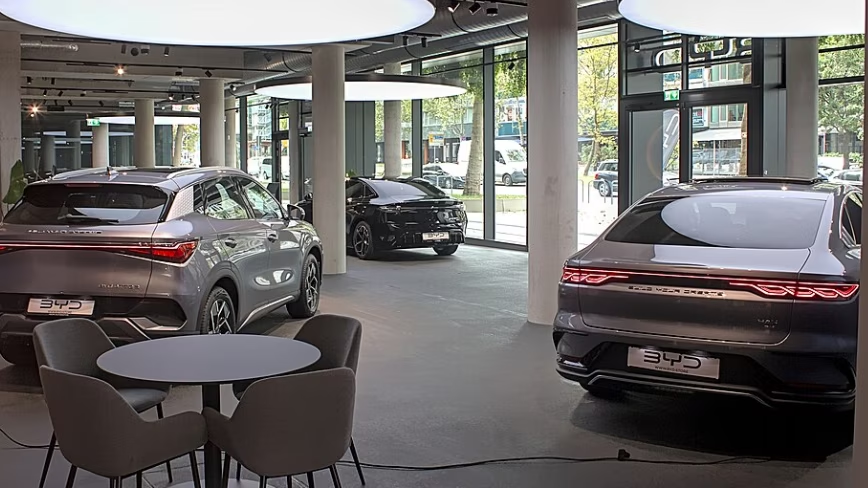
Image: courtesy of Thenextweb
The UK's Unconventional Tariff Stance Fuels Chinese EV Boom, Setting Up a Future Policy Test
Chinese car sales in the UK have seen a dramatic increase, surging from 384 vehicles in 2015 to 285,000 in 2025. This rapid growth is directly linked to the UK's current trade policy, which does not impose additional tariffs on Chinese plug-in hybrid electric vehicles, a stark contrast to measures adopted by the European Union and the United States. This open market approach has made the UK a primary entry point for Chinese automakers in Western markets, boosting consumer choice and competition but also creating a potential policy dilemma as global trade tensions rise.
Outlook
Background
The growth of Chinese car sales in the UK has been exponential. From a mere 384 units sold in 2015, the figure exploded to 285,000 vehicles by 2025, a dramatic increase that has reshaped the British automotive landscape. This translates to Chinese brands capturing approximately 9.7% of the 2 million new cars registered in the UK last year, according to preliminary figures from the Society of Motor Manufacturers and Traders (SMMT). By June 2026, one in ten cars sold in the UK were of Chinese origin, indicating an approximate 10% market share that continues to climb. Brands like BYD, Omoda, and Jaecoo are among those rapidly gaining traction.
This trajectory has been significantly influenced by the UK's specific tariff policy. While a standard 10% import tariff applies to all cars, the UK has not introduced additional duties on Chinese plug-in hybrids or electric vehicles. This stands in stark contrast to the European Union, which has implemented anti-subsidy duties, and the United States, which has levied unilateral tariffs on Chinese EVs. This difference effectively lowers the entry barrier for Chinese automakers into the UK market, making it a more attractive destination.
The competitive pricing advantage offered by Chinese manufacturers is a major factor. The average price of a car exported from China last year was about $19,000, which is substantially lower than the average new car price of around $50,000 in the United States. This price differential means Chinese EVs can offer compelling value to UK consumers, particularly as the demand for more affordable electric options grows.
Precedents
The automotive industry has a long history of shifting global dominance, often influenced by trade policies and technological advancements. In the 1970s and 1980s, Japanese manufacturers disrupted Western markets with fuel-efficient, reliable vehicles, leading to protectionist measures like voluntary export restraints and, eventually, significant manufacturing investments in the US and Europe. A similar pattern emerged with South Korean brands in the 1990s and 2000s, which gradually built market share through competitive pricing and improving quality.
The current surge of Chinese electric vehicles, however, presents a new dynamic. It is driven by a rapid technological leap in battery and powertrain development, combined with substantial state subsidies that have allowed Chinese companies to achieve immense scale and cost efficiencies. The response from many Western governments—tariffs in the US and EU—echoes past protectionist measures aimed at safeguarding domestic industries. The UK's divergence from this trend marks a distinct departure from its allies. Historically, countries that maintain more open trade policies can benefit from lower consumer prices and increased competition, but they also risk pressure on domestic industries. The UK's current position is a significant test of whether the immediate benefits of market openness outweigh the potential long-term industrial policy concerns that have driven its allies towards protectionism.
The rapid rise of Chinese car sales in the UK matters for several critical reasons, extending beyond simple market share. For UK consumers, it means greater choice and, crucially, more affordable electric vehicles. As the push for EV adoption intensifies, lower-priced options from China could accelerate the transition away from internal combustion engines, helping the UK meet its emissions targets faster. This directly impacts household budgets, making EV ownership more accessible to a broader segment of the population.
However, this influx creates significant competitive pressure on established European, Japanese, and Korean carmakers operating in the UK. These legacy automakers are forced to compete on price and features in a way they haven't experienced in decades, potentially impacting their profitability and investment strategies in the region. It also raises questions about the future of domestic automotive manufacturing, particularly if local production cannot match the cost efficiencies of Chinese imports without substantial government intervention or technological leaps.
From a geopolitical standpoint, the UK's open-door policy stands in contrast to its major allies. This 'tariff gap' could become a point of tension, as the US and EU seek to protect their own industries from what they view as unfair Chinese competition, often citing state subsidies. The UK is effectively a strategic loophole for Chinese brands to access a major Western market, which could draw scrutiny and potential pressure to align its trade policies more closely with its partners. The long-term implications for the UK's industrial strategy, its trade relationships, and the overall structure of its automotive market are substantial.
Scenarios
AnalysisThe current trajectory of Chinese car sales in the UK is heavily dependent on the government's future policy decisions. Several outcomes appear plausible:
* The UK Maintains Its Current Stance: If the UK government continues its policy of not imposing additional tariffs on Chinese EVs, the market share of Chinese brands is likely to grow further. This could solidify the UK's position as a highly competitive and consumer-friendly EV market, potentially accelerating EV adoption due to lower prices. However, it would also intensify pressure on legacy automakers and could lead to calls for domestic industrial support to offset the competitive disadvantage. The UK might face continued diplomatic pressure from the EU and US to align its trade policies, potentially creating friction in broader trade relationships.
* The UK Introduces Additional Tariffs: Facing pressure from domestic industry, or seeking to align more closely with its major trading partners like the EU and US, the UK government could introduce additional tariffs on Chinese EVs. This would likely slow the growth of Chinese car sales, potentially raising prices for consumers and reducing the immediate competitive pressure on other brands. However, such a move could also be seen as anti-consumer, hindering the affordability of EVs, and might strain trade relations with China, potentially leading to retaliatory measures impacting other UK exports.
* Chinese Automakers Establish UK Production: To circumvent potential future tariffs or to deepen their market presence and build brand loyalty, Chinese automakers may consider investing in manufacturing facilities within the UK. This would create jobs, contribute to the local economy, and integrate Chinese brands more deeply into the European supply chain. However, such investments would require significant capital and strategic long-term commitments, and would likely only occur if the UK market demonstrates sustained, substantial demand and a stable policy environment.
Timeline
2015
Chinese Car Sales Begin to Register
Chinese automakers sold 384 vehicles in the UK, marking a nascent presence in the market.
2019
UK Car Sales Peak
Total new car sales in the UK last topped the 2 million mark, a benchmark for the market's overall health.
2025
Significant Surge in Chinese Car Sales
Chinese car sales in the UK jumped to 285,000 vehicles. Preliminary figures from the SMMT showed Chinese brands accounted for 9.7% of the 2 million new car registrations that year.
Q1 2026
Chinese EV Exports to Europe Boom
Chinese vehicle exports to Europe reached 438,400 units, an 84.7% surge year-on-year, with battery-electric vehicles up 94.6% and plug-in hybrids up 152.4%.
April 2026
Chinese Brands Gain European Market Share
Chinese brands captured 9.8% of the overall European market, an all-time high, according to Gasgoo Automotive Institute data.
June 2026
One in Ten UK Cars Made in China
Industry figures confirm that approximately one in ten cars sold in the UK during this month were manufactured in China, reflecting a market share of around 10%.
Frequently Asked Questions
The 'tariff gap' refers to the difference in import duties applied to Chinese cars between the UK and other major Western economies. While the UK imposes a standard 10% import tariff on all cars, it has not introduced additional duties specifically targeting Chinese electric or plug-in hybrid vehicles. In contrast, the European Union has implemented anti-subsidy duties, and the United States has levied significant unilateral tariffs on Chinese EVs. This makes the UK a relatively more open and cost-effective market for Chinese automakers.
Discussion
Be the first to share your thoughts.