
The immediate consequence is clear: BMW faces a tougher financial year than anticipated, with its core automotive business expected to deliver significantly lower returns. This revision sends a ripple through the broader European automotive sector, which has long relied on China as a primary growth engine. Other European automakers, particularly those with substantial exposure to the Chinese market and similar premium positioning, are now under heightened scrutiny. Analysts will be watching closely for any further profit warnings or shifts in strategy from companies like Mercedes-Benz and Volkswagen, which face similar competitive headwinds. The situation also brings into sharper focus the vulnerability of global supply chains to geopolitical events, as the conflict in the Middle East adds another layer of complexity to an already challenging market.
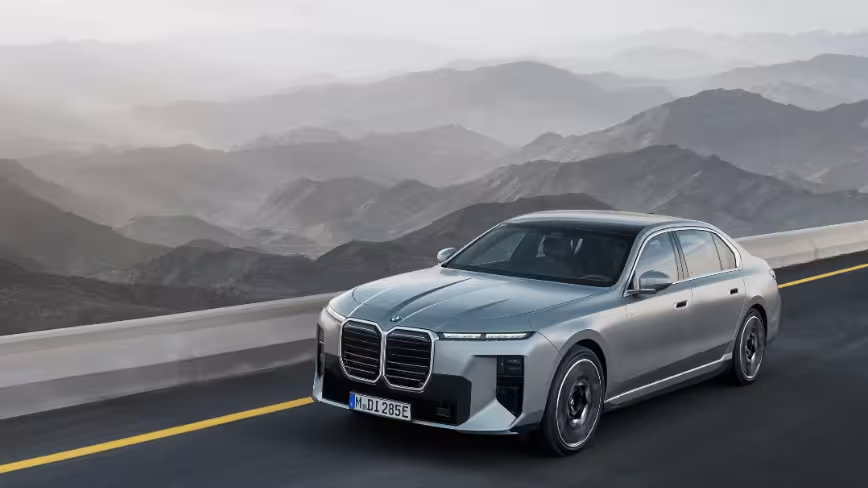
Image: courtesy of Thenextweb
BMW Slashes Profit Forecast as China's EV Makers Tighten Squeeze on Europe
BMW has significantly reduced its profit expectations for 2026, citing a sharp slowdown in demand within China and the disruptive economic fallout from the ongoing Iran war. This profit warning, which projects the automotive EBIT margin to fall to a range of just 1-3%, highlights the intensifying pressure on European luxury carmakers struggling to compete with increasingly sophisticated and aggressively priced Chinese electric vehicles.
Outlook
Background
BMW's revised outlook stems from two powerful, converging forces. The first is the dramatic shift in China's automotive market. What was once a lucrative, high-growth arena for foreign brands has rapidly transformed, with local electric vehicle manufacturers now dominating. According to McKinsey & Company’s 2025 Automotive Outlook, Chinese carmakers control nearly 60% of their home market. This surge has been driven by brands like BYD, NIO, and Li Auto, which offer advanced electric models at competitive prices, eroding the premium positioning and market share traditionally held by European giants. Data from Automobility indicates that foreign brands' share of China's car market has plummeted from 64% in 2020 to a mere 32% this year.
The second major factor is the economic disruption caused by the Iran war. While the specifics of how the conflict directly impacts BMW's operations are not fully detailed, such geopolitical instability typically leads to higher energy costs, supply chain bottlenecks, and a general dampening of consumer confidence globally. For a company with intricate global manufacturing and sales networks, these disruptions translate into increased operational costs and reduced sales volumes, particularly in sensitive regions. The combined effect of these pressures has created a challenging environment for BMW, forcing a fundamental reassessment of its financial targets. This is not just a blip; it is a structural shift in the global automotive power balance, exacerbated by external shocks.
Precedents
The current struggles of European automakers in China are not without historical precedent, though the speed and scale of the shift are notable. Over decades, foreign brands have entered and sought to dominate emerging markets, often leveraging superior technology and brand prestige. However, local competitors frequently emerge, learning from foreign entrants and eventually outcompeting them on price, local relevance, and sometimes even technology. Japan's automotive industry rose to global prominence by first challenging American and European dominance, as did South Korea's later. China's EV sector appears to be following a similar, albeit accelerated, trajectory.
Historically, market share erosion in a critical region like China has signaled a need for significant strategic recalibration. Companies that adapt by localizing production, R&D, and product portfolios to better suit local tastes often fare better. Those that cling to outdated strategies or fail to innovate quickly risk being marginalized. The current situation echoes past periods where established players faced strong challengers, forcing them to either innovate or retreat. The geopolitical component, while specific to the Iran war, also fits a pattern of global events periodically disrupting trade and supply lines, forcing companies to build more resilient and diversified operations. The lessons from past oil crises or trade wars often point to the need for agility and reduced dependence on single markets or supply routes.
The implications of BMW's profit warning extend far beyond its balance sheet. This is a bellwether moment for the entire European automotive industry and, by extension, for Europe's industrial competitiveness. For decades, German luxury carmakers have been symbols of engineering prowess and economic strength. Their struggles in China, a market they once dominated, signal a fundamental shift in global manufacturing and technological leadership, particularly in the critical electric vehicle sector.
This matters for several reasons. First, it threatens the long-term profitability and investment capacity of European auto giants, which employ millions and form the backbone of several national economies. Reduced profits mean less capital for research and development, potentially slowing down Europe's own transition to electric vehicles and its ability to compete globally. Second, it raises questions about Europe's trade policy. As Chinese EVs gain market share globally, the pressure will mount on European policymakers to protect domestic industries, potentially leading to increased tariffs or other trade barriers, as hinted by discussions around 'price undertakings' for Chinese exporters. Third, for consumers, this could mean a more diverse, and potentially more affordable, EV market, but also raises concerns about the future of traditional European brands. Lastly, the geopolitical instability underscored by the Iran war component highlights the fragility of global supply chains and the need for greater resilience in an increasingly fragmented world order. The outcome of this struggle will redefine the future of automaking, impacting jobs, investment, and technological direction for decades.
Scenarios
AnalysisThe current pressures on BMW and other European automakers could lead to several distinct outcomes, each with significant implications for the global industry.
One likely outcome is an accelerated strategic pivot by European carmakers towards deeper localization in China. This could involve shifting more research, development, and even design functions to local teams, creating vehicles specifically tailored for the Chinese market rather than adapting global models. This suggests a move away from simply exporting European luxury to building 'China-for-China' products that can directly compete with local EV offerings on features, technology, and price. This would require substantial capital allocation and potentially new joint ventures or partnerships.
Another significant possibility is the intensification of trade tensions between the European Union and China. As Chinese EV exports continue to grow and put pressure on European manufacturers, the EU may feel compelled to implement stricter trade defense measures. While 'price undertakings' — agreements by exporters to sell at a certain minimum price — are one option, the EU could also impose tariffs on Chinese-made electric vehicles. This would aim to level the playing field for European manufacturers but could also provoke retaliatory measures from Beijing, impacting other European export sectors.
Furthermore, European automakers may re-evaluate their global production and supply chain strategies. The disruption from the Iran war, alongside the challenges in China, could prompt companies to diversify their manufacturing footprint away from over-reliance on any single region. This could mean investing more in production facilities in Europe, North America, or other emerging markets to build greater resilience against geopolitical shocks and reduce shipping complexities. Such a shift would be costly and take years to implement, but the long-term strategic benefits of de-risking supply chains may outweigh the immediate expenses.
Finally, there is a possibility of consolidation or strategic alliances within the European automotive sector, or even with non-Chinese partners. Faced with immense competitive pressure and the need for massive investment in EV technology, some automakers might seek mergers or deeper collaborations to pool resources, share technology, and gain scale. This could lead to a leaner, more consolidated European industry, albeit one that has undergone significant restructuring.
Timeline
Frequently Asked Questions
Discussion
Be the first to share your thoughts.