
Expect ongoing updates from NASA and Katalyst Space Technologies regarding the status of the LINK spacecraft. The focus will be on the technical progress of restoring LINK to full operational capacity. Should LINK's issues be resolved, the subsequent phase will involve the delicate maneuvers required for rendezvous and docking with the Swift observatory. The ultimate success or failure of this initial recovery effort for LINK will dictate the viability of the entire Swift Boost mission.
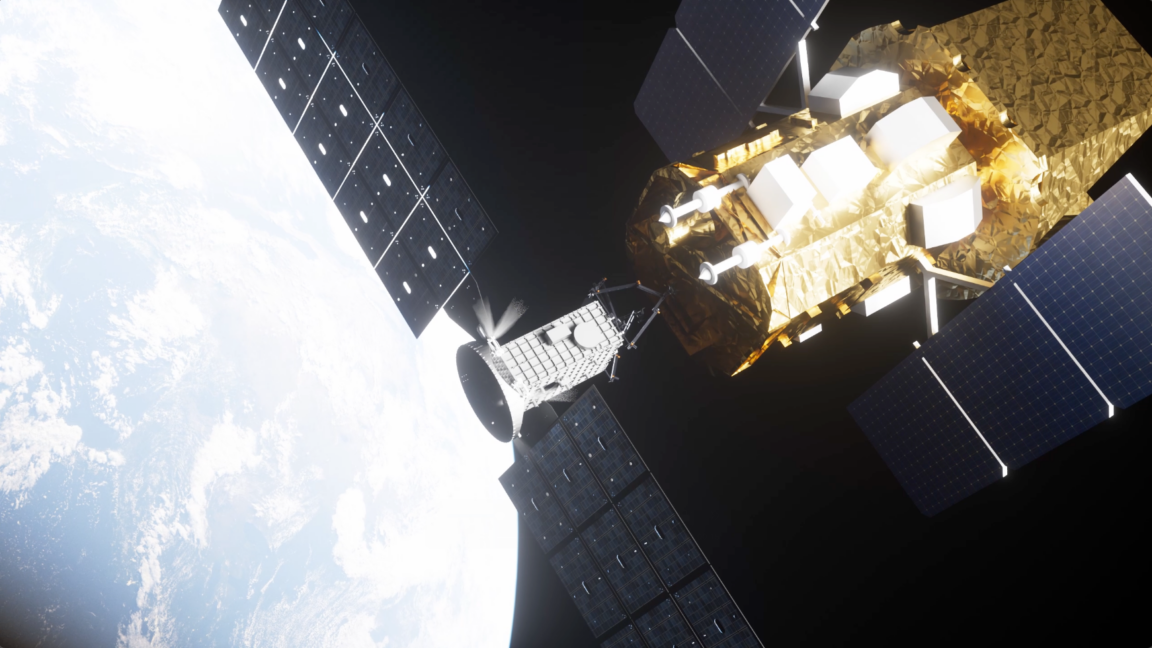
Image: courtesy of Ars Technica
NASA's Satellite Rescue Mission Hits a Snag: Can Engineers Save the Craft Sent to Save Swift?
NASA's ambitious $30 million mission to save its aging Swift observatory from orbital decay has encountered a critical setback. The LINK spacecraft, launched by commercial partner Katalyst Space Technologies to boost Swift's orbit, is itself experiencing post-launch issues. Engineers are now in a dual race against time, working to resolve LINK's problems before Swift falls out of the sky, raising questions about the complexities of in-orbit servicing and the future of critical space assets.
Outlook
Background
NASA's Swift Gamma-Ray Burst Explorer, launched in 2004, is a crucial astronomical observatory designed to detect gamma-ray bursts (GRBs) and their afterglows across multiple wavelengths. The satellite's orbit in low Earth orbit (LEO) has been rapidly decaying, putting it on a collision course with Earth's atmosphere, where it would burn up. To prevent this, NASA contracted Arizona-based Katalyst Space Technologies for a $30 million mission to launch the LINK spacecraft. The LINK mission, which saw its spacecraft launch on July 3, 2026, aboard Northrop Grumman's final air-launched Pegasus XL rocket, was designed to rendezvous with Swift, dock, and then use its own propulsion system to raise Swift's orbit, extending its operational life. However, after its launch last month, LINK has developed problems, forcing engineers to shift their immediate focus from saving Swift to saving the rescue vehicle itself.
Precedents
Satellite servicing missions, while increasingly common, remain technically challenging. Historically, efforts to extend the life of satellites in orbit have ranged from successful refueling missions, like the Space Shuttle's repairs of the Hubble Space Telescope, to more recent robotic servicing endeavors. These operations are fraught with risks, including precise navigation, complex docking procedures, and the inherent difficulties of remote diagnosis and repair in the harsh space environment. When anomalies occur post-launch, as with LINK, engineers rely heavily on telemetry data, ground simulations, and iterative command sequences to troubleshoot. The urgency of Swift's orbital decay amplifies the pressure on Katalyst, recalling other time-sensitive space operations where every day counts. The use of commercial partners like Katalyst for such critical missions also reflects a broader trend in space exploration, leveraging private sector innovation while also exposing NASA to the operational risks inherent in commercial ventures.
The fate of the LINK spacecraft carries significant weight, extending far beyond the $30 million investment. For NASA, the Swift observatory represents a valuable scientific asset, providing unique data on some of the universe's most energetic events. Losing Swift prematurely would mean a substantial blow to astrophysics research. For Katalyst Space Technologies, the mission is a high-profile demonstration of its commercial satellite servicing capabilities. Success would validate its technology and approach, potentially opening doors for future contracts in the growing orbital servicing market. Failure, however, could cast a long shadow over the commercial space servicing sector, highlighting the extreme technical and financial risks involved. More broadly, the incident underscores the inherent fragility of complex space missions and the intricate dance between human ingenuity and the unforgiving mechanics of orbital mechanics. It also tests NASA's strategy of outsourcing critical operational tasks, balancing innovation against reliability.
Scenarios
AnalysisOne immediate outcome, if engineers successfully diagnose and resolve LINK's current issues, would be the resumption of its primary mission. This would involve a renewed focus on the rendezvous and docking procedures with the Swift observatory, likely on a revised timeline given the delays. If LINK can then successfully boost Swift's orbit, the mission would be hailed as a testament to commercial space servicing capabilities and NASA's adaptive engineering.
Conversely, if the technical problems with LINK prove insurmountable, or if the time taken to fix them exceeds Swift's remaining orbital life, the mission would fail. In this scenario, Swift would continue its rapid orbital decay, eventually re-entering Earth's atmosphere and burning up, resulting in the loss of a key scientific instrument. This outcome could lead to a reassessment of future satellite servicing contracts and potentially impact investor confidence in the commercial space sector.
A third possibility involves a partial success, where LINK's issues are mitigated but its full operational capacity, particularly its propulsion, is compromised. This could still allow for a limited orbital boost, extending Swift's life by a shorter duration than originally planned, or perhaps enabling a controlled deorbit if a full boost is not possible. Such a result would highlight the challenges of 'fixing' complex systems remotely.
Timeline
2004
NASA's Swift Observatory Launched
NASA launches the Swift Gamma-Ray Burst Explorer, a multi-wavelength space telescope designed to study gamma-ray bursts and their afterglows.
April 15, 2026
LINK Vibration Chamber Testing
Engineers from Katalyst Space stabilize their LINK robotic servicing spacecraft as it undergoes vibration chamber testing at NASA's Goddard Space Flight Center.
April 17, 2026
LINK Thermal Vacuum Testing
During thermal vacuum testing in the Space Environment Simulator, LINK fires its three ion thrusters and deploys one of its three robotic arms, simulating space conditions.
July 3, 2026
LINK Spacecraft Launches
NASA launches the Swift Boost mission, sending the Katalyst Space-built LINK spacecraft into low Earth orbit on the final flight of Northrop Grumman's Pegasus XL rocket.
Late July - Early August 2026
LINK Spacecraft Experiences Issues
Following its launch, the LINK spacecraft encounters unexpected problems, delaying its primary mission to service the Swift observatory. Engineers begin efforts to diagnose and resolve the anomalies.
Frequently Asked Questions
The Swift observatory is a NASA space telescope launched in 2004. Its primary mission is to detect and study gamma-ray bursts, which are the most powerful explosions in the universe, providing vital data across X-ray, optical, and ultraviolet wavelengths.
Discussion
Be the first to share your thoughts.