
Following this significant funding round, K2 Space is expected to accelerate its manufacturing expansion and workforce growth. The company has a stated goal of producing up to 100 large satellites annually, which will require substantial investment in new facilities and specialized talent. Its next mission, codenamed Trinity, is scheduled to launch multiple satellites in the second quarter of 2027. Further down the line, K2 plans to introduce its next-generation 100-kilowatt 'Giga' satellite platform in the second half of 2028, specifically designed to enable compute-intensive orbital applications, which will include advanced onboard AI processing. This ramp-up in production and technological development will allow K2 to fulfill its growing backlog of over $1 billion in signed contracts.
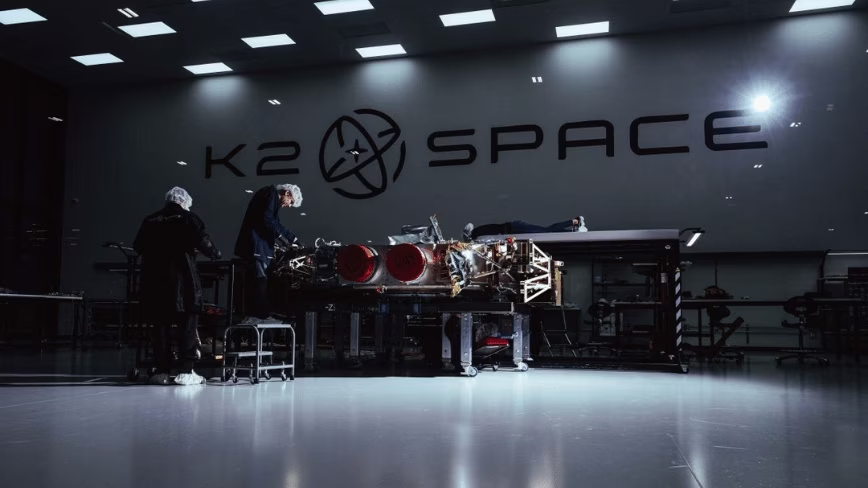
Image: courtesy of Thenextweb
K2 Space Raises $500 Million to Build Giant Satellites, Pushing Orbital AI to the Forefront
K2 Space, a California-based company with an engineering hub in Seattle, recently secured $500 million in a Series D funding round. This latest investment values the company at $6.8 billion and brings its total capital raised to over $1 billion. The funding supports K2's unique strategy in the space industry: building large, powerful satellites equipped with advanced computing capabilities, including artificial intelligence, a direct counterpoint to the prevailing trend of miniaturization. The company aims to scale its production to as many as 100 large satellites per year and has already secured over $1 billion in government and commercial contracts.
Outlook
Background
The satellite industry has largely moved towards smaller, more numerous satellites, often deployed in large constellations to provide services like global internet access or continuous Earth observation. Companies like SpaceX, with its Starlink constellation, epitomize this approach, emphasizing mass production and lower individual launch costs. K2 Space, however, is taking a deliberate counter-strategy.
Karan Kunjur, Co-Founder and CEO of K2 Space, stated that when he and his brother Neel founded the company four years ago, they made a 'contrarian bet that building bigger would be the future for exploring and developing space.' This strategy emphasizes satellites with significantly higher power budgets and larger internal volumes, allowing for more robust payloads, longer operational lifespans, and, crucially, greater onboard processing capabilities.
The $500 million Series D round was led by prominent venture capital firms Kleiner Perkins and ICONIQ, with additional participation from Capiter. This investment follows a $250 million Series C round in December 2025, which valued K2 at $3 billion, and a $110 million Series B in February 2025. The rapid increase in valuation and total capital raised suggests strong investor confidence in K2's vision and its ability to execute. The company has also demonstrated significant market traction, with its secured government and commercial contracts now exceeding $1 billion, up from $500 million announced at the time of its Series C. K2 launched its first 'mega-class' satellite, Gravitas, in March 2026, marking a tangible step in its larger satellite deployment strategy. The company's focus on 'compute-intensive orbital applications' for its upcoming 'Giga' platform clearly signals a move towards integrating artificial intelligence directly into its space infrastructure, enabling more sophisticated data processing and autonomous operations in orbit.
Precedents
The history of satellites has swung between extremes. Early satellites, launched in the dawn of the Space Age, were typically large, complex, and expensive, designed for singular, high-value missions. Think of large communication satellites or early scientific observatories. Over decades, as technology advanced and costs became a critical factor, there was a strong push towards miniaturization. The advent of CubeSats in the early 2000s, for example, showcased how small, standardized units could perform specific tasks at a fraction of the cost and size of traditional satellites.
This trend accelerated with the rise of 'New Space' companies, which prioritized rapid iteration, commercial off-the-shelf components, and large constellations of small satellites to achieve global coverage or high-revisit imaging. This approach has proven effective for many applications, particularly those requiring broad, continuous coverage where the failure of a single unit is acceptable due to redundancy.
K2 Space's strategy appears to be a re-evaluation of this miniaturization trend, not as a rejection of small satellites entirely, but as an argument for the necessity of some large, highly capable platforms. Historically, when computing power or specialized instruments were needed, larger platforms were the only option. Now, with advancements in power systems, propulsion, and AI, K2 is effectively arguing that a new generation of 'mega-class' satellites can combine the best of both worlds: the power and capability of older, larger systems with the advanced digital intelligence and efficiency of modern technology. This approach draws parallels to the evolution of computing, where specialized, high-performance servers coexist with distributed networks of smaller devices, each serving different purposes within a larger ecosystem.
K2 Space's contrarian approach could fundamentally reshape how certain critical space missions are conceived and executed. If successful, its strategy suggests a future where high-value orbital operations – particularly those involving complex data processing, advanced analytics, and autonomous decision-making – are performed directly in space rather than relying on ground stations. This shift has several profound implications.
For defense and intelligence applications, on-orbit AI could significantly reduce latency and increase the speed of analysis, providing more immediate and actionable insights from remote sensing data. It also creates more resilient and autonomous assets, less reliant on vulnerable ground links. For commercial uses, this could unlock new possibilities in areas like real-time environmental monitoring, sophisticated weather forecasting, and advanced telecommunications with onboard processing capabilities.
Moreover, the capacity to build 100 large satellites per year indicates a potential for industrial-scale deployment of these advanced platforms. This isn't about one-off specialized missions; it's about making highly capable orbital infrastructure more accessible and scalable. It could create a distinct market segment for 'orbital compute' and 'smart satellites,' offering a different value proposition than the 'data pipes' provided by smaller constellations. This could force other space companies to re-evaluate their own strategies, potentially leading to a more diversified and specialized space economy, where both small and large satellites find their niche based on the specific demands of their missions.
Scenarios
AnalysisThe path forward for K2 Space, while well-funded, presents a few distinct scenarios:
One possible outcome is that K2 Space successfully validates its 'bigger is better' thesis, establishing itself as a dominant player in the high-power, AI-enabled satellite market. If K2 can consistently meet its production targets and deliver on the promised capabilities of its Giga platform, its large satellites could become indispensable for government defense programs, advanced scientific research, and commercial applications requiring significant onboard processing. This could lead to a bifurcation in the space industry: one segment focused on mass-produced, lower-cost small satellites for broad coverage, and another specializing in highly capable, data-intensive 'mega-class' platforms that serve as orbital data centers or intelligent sensor nodes. This success would likely attract more investment into similar ventures and spur innovation in high-power space systems and orbital AI.
Conversely, K2 Space could face significant challenges in scaling production and deploying such complex, large satellites. Building 100 large satellites per year is an ambitious goal, potentially encountering bottlenecks in supply chains, manufacturing processes, and specialized labor. The cost per satellite, even with efficiencies, remains higher than smaller units, meaning a smaller customer base and higher stakes per launch. If the market for these highly specialized, compute-intensive orbital applications develops slower than anticipated, or if technical hurdles prove more difficult to overcome than projected, K2 might struggle to maintain its growth trajectory. Furthermore, competition for launch slots with larger rockets, or the emergence of distributed computing solutions using smaller, networked satellites, could also complicate K2's path, potentially forcing a pivot or refinement of its core strategy.
Timeline
Frequently Asked Questions
Discussion
Be the first to share your thoughts.