
Expect Apple to intensify its search for suitable acquisition targets within the AI chip sector. While details on specific companies remain undisclosed, the focus will likely be on startups or smaller firms specializing in high-performance, data center-grade AI accelerators. Any successful acquisition would then trigger a complex integration process, aiming to fold new chip designs and engineering talent into Apple's formidable, but currently lagging, server AI strategy. The market will be watching for signals of these potential deals and how Apple plans to bridge the performance gap with rivals like Nvidia.
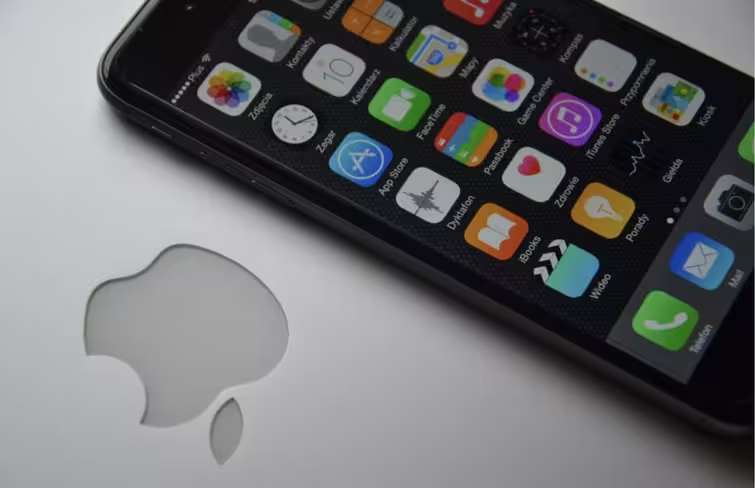
Image: courtesy of Thenextweb
Apple's AI Server Ambitions Hit a Wall, Forcing Chip Acquisition Hunt
Apple, a company renowned for its in-house chip design, is reportedly exploring acquisitions of artificial intelligence (AI) chip companies to bolster its server capabilities. This strategic shift comes as the company's existing M2 Ultra chips are proving insufficient for demanding AI workloads, leading to a reliance on external providers like Google Cloud for crucial AI infrastructure. The move highlights a significant challenge for Apple in the rapidly evolving AI hardware race, particularly in the server domain where its mobile-focused chip expertise falls short.
Outlook
Background
The news, initially reported by The Information, reveals a surprising vulnerability for Apple. For years, the company has staked its claim on vertical integration, designing its own processors for iPhones, iPads, and Macs. This strategy has delivered market-leading performance and power efficiency in consumer devices.
However, the demands of server-side AI are fundamentally different. Training and running large language models, like Google's Gemini that powers Siri AI, requires immense computational power, sustained throughput, and specialized architectures. Apple's M2 Ultra chips, while powerful for personal computing, have reportedly struggled with these heavy AI tasks when deployed in server environments.
This performance bottleneck has forced Apple to lean on external infrastructure. CONFIRMED: The 'heavy lifting' for some of Apple's AI services, including the Gemini model behind Siri AI, is handled by Nvidia chips running on Google Cloud. This reliance on a direct competitor for core AI functionality is a significant departure from Apple's long-standing philosophy of controlling its own technology stack.
CONFIRMED: Apple engineers reportedly attempted to run these advanced AI models on Apple's own server infrastructure but found its capabilities lacking. Furthermore, INFERRED: the company's planned 'Baltra' chip, a future version intended to address some of these server AI needs, has reportedly been delayed. This delay exacerbates the immediate pressure to find external solutions, making acquisitions a more urgent priority.
INFERRED: The core issue appears to be Apple's historical focus. Its chip design team has excelled at creating energy-efficient processors for battery-powered mobile devices. This expertise does not directly translate to the high-wattage, parallel processing requirements of data center AI accelerators, where companies like Nvidia have a multi-year head start and specialized intellectual property. Apple's current search for AI chip companies and discussions with bankers about potential deals indicate a clear recognition of this gap and a strategic push to close it rapidly.
See also
Why Apple Might Put Cameras Into Its Next AirPods→The FBI built a fake town to train agents for cyberattacks. It has a hospital, a power company, and 200 servers.→Apple destroyed the mid-tier watch market. Now it’s coming for the $200 billion eyewear industry.→For the second time, Apple Intelligence is delayed in Europe, and this time there is no timeline→
Precedents
Apple has a well-established history of strategic acquisitions, particularly in the semiconductor space, to secure key technologies and talent. These deals often fly under the radar until the acquired technology surfaces in a future Apple product. For instance, Apple acquired PA Semi in 2008, a move that laid the groundwork for its custom A-series chips, which now power its iPhones and iPads. The acquisition of Dialog Semiconductor's power management team and IP in 2018 further cemented its control over critical component design.
INFERRED: These past acquisitions consistently aimed at achieving greater vertical integration and reducing reliance on third-party suppliers, allowing Apple to optimize hardware and software in tandem. The current pursuit of AI chip companies for server infrastructure aligns perfectly with this historical pattern. It suggests Apple is attempting to replicate its successful 'control everything' model for consumer devices in the server AI domain, a critical area it currently does not fully control.
However, the scale of this challenge is different. While Apple has acquired smaller chip design firms, the AI server chip market is dominated by giants like Nvidia, with highly specialized and complex architectures. INFERRED: A large-scale acquisition to immediately compete with Nvidia would be unprecedented for Apple in terms of size and complexity within the chip sector. This suggests Apple may be looking for niche players with specific IP or talent that can accelerate its internal development, rather than attempting to buy a direct competitor outright.
This development carries significant implications for Apple's long-term strategic independence, its financial performance, and its competitive standing in the AI era.
Strategic Independence: Apple's brand promise is built on seamless integration and proprietary control. Relying on Google Cloud and Nvidia for foundational AI server infrastructure compromises this. It means Apple is paying a competitor for a core service, and potentially ceding some control over data, performance, and future innovation roadmaps. Acquiring AI chip companies is a direct effort to reclaim this independence, ensuring Apple can tailor its AI hardware precisely to its software needs, just as it does with its mobile processors.
Competitive Edge in AI: The speed of AI innovation is directly tied to underlying hardware. Companies with superior, custom-designed AI chips can develop and deploy more powerful, efficient, and unique AI features. If Apple lags in server AI hardware, its 'Apple Intelligence' features, including the revamped Siri, could face performance limitations, higher operational costs, or slower development cycles compared to rivals like Google, Microsoft, and Amazon, all of whom are heavily investing in custom AI silicon.
Operational Costs: Running large AI models is expensive. Relying on external cloud providers incurs significant operational costs. Building out its own, more efficient AI server infrastructure with custom chips could reduce these expenditures over time, improving Apple's margins as AI services scale.
Talent and IP: The market for AI chip talent and intellectual property is fiercely competitive. By actively seeking acquisitions, Apple aims to secure critical expertise and patents that would take years, if not decades, to develop purely in-house. This is a shortcut to catch up.
For consumers, the outcome of this strategy will directly impact the performance, capabilities, and privacy features of future AI-powered services like Siri and other 'Apple Intelligence' offerings. A stronger, in-house AI infrastructure could mean faster, more capable, and potentially more private AI experiences on Apple devices. A failure to catch up, however, could leave Apple's AI feeling less capable than its rivals.
Scenarios
AnalysisApple's exploration of AI chip acquisitions could lead to several distinct outcomes, each with varying impacts on the company's future AI strategy and market position.
1. Successful Acquisitions and Accelerated Internal Development:
Apple could identify and acquire one or more suitable AI chip startups. This scenario would allow Apple to rapidly integrate specialized chip designs, engineering talent, and intellectual property. INFERRED: Such acquisitions would likely accelerate the development of Apple's proprietary server AI chips, potentially allowing them to reduce reliance on Google Cloud and Nvidia within a few years. This would strengthen Apple's vertical integration strategy and provide a more customized, potentially more efficient, foundation for its 'Apple Intelligence' features. The company could then optimize its AI hardware and software in a tightly controlled ecosystem, similar to its mobile chip success.
2. Challenges in Acquisition and Continued External Reliance:
Apple may face difficulties in securing appropriate acquisition targets. SPECULATIVE: High valuations, competitive bids from other tech giants, or a lack of suitable companies with the right technology could hinder its efforts. Alternatively, even with an acquisition, the integration process could prove complex, leading to delays in bringing new chips to market. In this outcome, Apple would likely continue its significant reliance on external cloud providers and Nvidia's hardware for its most demanding AI workloads. This would mean ongoing operational costs and a potential strategic vulnerability, as Apple would be dependent on competitors for a critical aspect of its future growth.
3. A Hybrid Approach with Strategic Partnerships:
Rather than a full acquisition, Apple could opt for strategic partnerships or licensing agreements with chip design firms, or even a more significant collaboration with existing players like Broadcom for specific non-SOC related IP, as some discussions have suggested. This approach would allow Apple to leverage external expertise without the full financial and integration burden of an acquisition. INFERRED: It could be a faster way to enhance certain aspects of its server infrastructure while still pursuing its own long-term chip development. This outcome might offer a middle ground, providing some immediate relief to its server AI performance issues while it continues to build out its internal capabilities, albeit at a potentially slower pace than a full acquisition.
Timeline
2008
Acquisition of PA Semi
Apple acquired PA Semi, a chip design firm, laying the groundwork for its custom A-series processors for mobile devices.
2018
Acquisition of Dialog Semiconductor IP and Team
Apple acquired parts of Dialog Semiconductor, including power management IP and engineering talent, further strengthening its in-house chip capabilities.
2023
Emergence of Generative AI
The rapid advancement and public adoption of generative AI models, like ChatGPT, significantly increased demand for high-performance AI server chips.
2024
Apple Intelligence Announcement
Apple officially announced 'Apple Intelligence,' its suite of AI features, signaling a deeper commitment to integrating AI across its ecosystem.
2026-07-15
Reports of Apple Seeking AI Chip Acquisitions
CONFIRMED: News reports emerged that Apple is actively exploring acquisitions of AI chip companies due to performance issues with its M2 Ultra chips in servers and delays with its planned 'Baltra' chip.
Frequently Asked Questions
Apple's chip design expertise has historically focused on optimizing processors for battery-powered mobile devices, prioritizing power efficiency and integrated performance for consumer-grade tasks. Server-side AI, however, demands sustained, high-wattage computing power and specialized architectures for training and running large AI models. The M2 Ultra, while powerful for a Mac, is not designed for these specific, intensive data center workloads, leading to performance bottlenecks.
Discussion
Be the first to share your thoughts.