
The immediate aftermath of Section 851 taking effect will likely see Alibaba and Tencent scrambling to redefine their Washington strategies. Losing established lobbying firms means losing direct access, experienced advocates, and crucial intelligence on policy shifts. We can expect these companies to explore alternative avenues for influence. This could involve increasing their internal government relations teams, engaging public relations firms that do not directly lobby, or relying more heavily on industry associations that represent broader tech interests, even if those associations can only advocate on general policy without directly naming specific companies. The impact on smaller Chinese tech firms, or those not yet on the Pentagon's blacklist but vulnerable to future inclusion, will also become apparent as they assess the costs and benefits of maintaining a Washington presence.
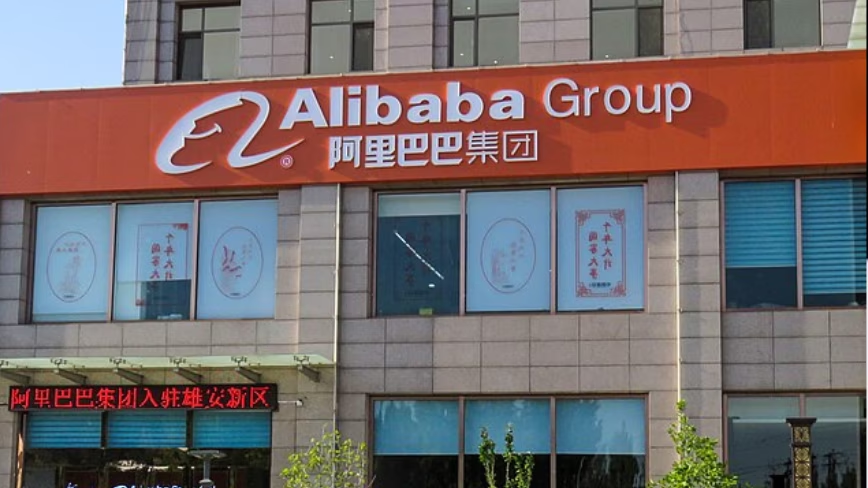
Image: courtesy of Thenextweb
Washington's New Firewall: What the Lobbying Ban Means for Alibaba and Tencent
Chinese tech giants Alibaba Group Holding and Tencent Holdings have lost nearly all their Washington lobbying representation as a new Pentagon rule, Section 851 of the FY 2025 National Defense Authorization Act, took effect today, June 30, 2026. This regulation bars the Defense Department from contracting with firms that also lobby for companies on its Chinese military blacklist. The practical consequence has been a forced choice for lobbying firms: retain lucrative U.S. defense contracts or continue representing major Chinese tech entities. Alibaba has seen five lobbying firms depart, while Tencent has lost four, significantly curtailing their direct influence in the U.S. capital.
Outlook
Background
The new rule, specifically Section 851 of the FY 2025 National Defense Authorization Act, represents a significant escalation in the U.S. government's efforts to curb the influence of Chinese companies perceived as tied to Beijing's military. The Defense Department's prohibition extends to any company that retains a "covered lobbyist," defined as an entity engaging in federal lobbying for companies on the Pentagon's annually updated list of "PRC military companies." This creates a direct conflict of interest for lobbying firms that traditionally serve a diverse client base, including both U.S. defense contractors and foreign corporations. For firms, the calculus is straightforward: the multi-billion dollar U.S. defense contracting market outweighs the fees from individual Chinese tech clients.
While the law includes a "safe harbor" for companies that conduct "reasonable inquiries" into their contractors' lobbying activities, and the Secretary of War retains waiver authority with congressional notification, these provisions are unlikely to offer broad relief for companies explicitly on the blacklist. The loss of prominent firms means Alibaba and Tencent will have to rebuild their advocacy efforts from the ground up, likely with less experienced or less connected representatives, if they can find any willing to take on the reputational and regulatory risks.
Precedents
The U.S. government has a long history of using legislative and regulatory tools to limit the influence of foreign entities perceived as national security risks. This new Pentagon rule follows a pattern of increasing scrutiny on Chinese technology companies. Over the past several years, Washington has imposed export controls, investment restrictions, and outright bans on specific Chinese tech firms like Huawei and ZTE, citing national security concerns. The 'Entity List' maintained by the Commerce Department and the Pentagon's 'PRC military company' list are examples of these tools.
Historically, foreign governments and companies have invested heavily in Washington lobbying to shape policy, mitigate regulatory risks, and promote their interests. However, as geopolitical tensions rise, particularly between the U.S. and China, the political cost of representing certain foreign clients has become prohibitive for many lobbying firms. This reflects a broader trend where economic engagement with China is increasingly viewed through a national security lens, forcing companies and their advocates to choose sides in an intensifying rivalry. The current situation echoes past periods of heightened geopolitical tension, where associations with certain foreign powers became politically toxic, limiting their access to traditional influence channels.
This rule change is more than a bureaucratic adjustment; it fundamentally alters the playing field for major Chinese tech companies in Washington. For Alibaba and Tencent, it means a significant reduction in their ability to directly advocate for their business interests, influence regulatory outcomes, or counter negative narratives within the U.S. capital. This comes at a critical time when both companies are facing intense scrutiny over data security, intellectual property, and their perceived ties to the Chinese government.
For the U.S. government, the rule represents a clear signal that it intends to isolate companies it deems a national security threat, even if those companies are global economic players. It also forces a professional reckoning for Washington's lobbying industry, highlighting the growing pressure on firms to align with U.S. national security priorities. The broader consequence is a further hardening of the U.S.-China tech split, potentially leading to more fragmented global markets and increased operational complexity for companies operating across borders. It sets a precedent that could be expanded to other sectors or other nations if geopolitical tensions continue to escalate, reshaping the entire foreign lobbying ecosystem.
Scenarios
AnalysisOne possible outcome is that Alibaba and Tencent, along with other Chinese companies on or potentially facing the blacklist, will shift their lobbying efforts towards indirect influence. This could involve funding think tanks, academic research, or non-profit organizations that can advocate for broader policies favorable to their business models without directly lobbying for the companies themselves. They might also intensify efforts in state capitals or through international bodies, seeking to bypass the federal Washington restrictions. This approach, while less direct, could still allow them to subtly shape public opinion and policy discussions.
Another scenario suggests these companies may be forced to significantly restructure their U.S. operations or even divest certain assets to reduce their exposure to U.S. regulatory pressure. If direct advocacy becomes impossible and indirect routes prove insufficient, the long-term viability of their U.S. market presence for specific products or services could be called into question. This might lead to a more insular approach, focusing on markets less sensitive to U.S. geopolitical concerns, or a complete withdrawal from certain U.S.-facing business lines that attract the most scrutiny. The effectiveness of the 'safe harbor' and waiver provisions will be critical in determining whether some limited, albeit indirect, engagement remains possible.
Timeline
Frequently Asked Questions
Discussion
Be the first to share your thoughts.