
An examination of the physical and psychological toll of high-level retro gaming, the microscopic margins defining the modern Super Mario Bros. any-percent leaderboard, and why wearing a fake mustache somehow unlocked a near-flawless performance.
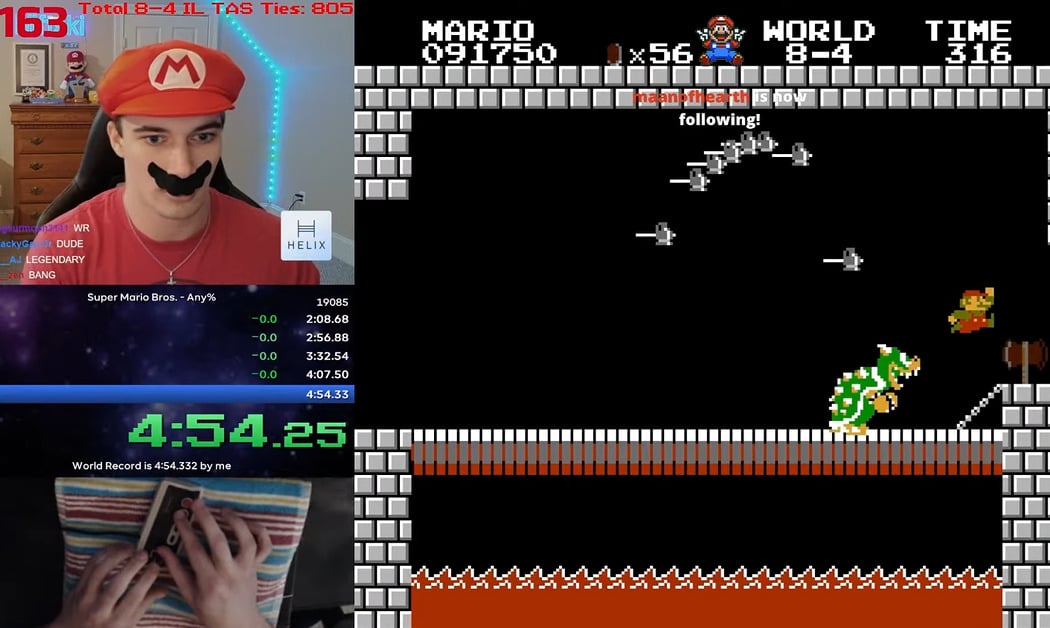
Image: courtesy of Kotaku
Two Frames From Perfection: How a Mario Costume Stumbled Into Gaming History
Speedrunner Niftski shaved crucial fractions of a second off the Super Mario Bros. world record during an October 31, 2026 Halloween livestream, completing the 1985 Nintendo classic in 4:54.299 while fully attired as the title character.
Outlook
Background
On October 31, 2026, the prominent speedrunner known as Niftski achieved a milestone in the Super Mario Bros. speedrunning community by recording a time of 4:54.299. The run shaved 0.33 seconds off his previous personal best set in August 2026. Performing live on a Halloween broadcast, Niftski maintained character voiceovers and kept a prop mustache attached to his face throughout the grueling attempt—a lighthearted presentation choice that he later credited with keeping his nerves in check during high-stakes inputs.
See also
Precedents
The pursuit of the ultimate Super Mario Bros. time has evolved from chaotic playground claims into an exact, mathematically scrutinized science. For decades, players chipped away at the code, utilizing pixel-perfect positioning, sub-pixel movement manipulation, and rigorous frame counting. When the barrier of sub-4:55 seemed nearly untouchable due to human reaction limits and controller tolerances, elite runners began treating the 1985 cartridge less like a casual pastime and more like a high-altitude athletic event. The community has long documented how psychological pressure alters execution during the final worlds, making atypical focus strategies—like costume gimmicks or intentional distraction—ironically effective tools for managing adrenaline.
When a runner inches within two frames of a theoretical limit in a 41-year-old game, the achievement transcends simple nostalgia. It exposes the absolute ceiling of human motor skills interacting with legacy silicon. For the broader competitive gaming community, Niftski's run demonstrates how mental framing and artificial levity can short-circuit the performance anxiety that plagues esports professionals and speedrunners alike. When stakes reach microscopic fractions of a second, the enemy is rarely the game code—it is the runner's own nervous system.
Scenarios
AnalysisAnalysis: Elite runners will likely intensify attempts to capture those remaining two frames, pushing the human-achievable time down to the absolute mathematical limit of 4:54.265. Analysis: As hardware aging and controller preservation become more pronounced constraints for original Nintendo Entertainment System consoles, community standards for acceptable input devices may face rigorous debate.
Timeline
September 13, 1985
Super Mario Bros. Releases
Nintendo launches the iconic platformer in Japan, unintentionally spawning a multi-decade competitive subculture.
August 2026
Previous Record Set
Niftski establishes a dominant baseline for the modern era of the any-percent category before his Halloween breakthrough.
October 31, 2026
The Halloween Record Run
Dressed as Mario, Niftski completes the run in 4:54.299, landing just two frames away from the theoretical limit.
Frequently Asked Questions
The game runs at 60 frames per second. Being two frames away from perfection means the run was off by roughly 0.033 seconds.
Discussion
Be the first to share your thoughts.