
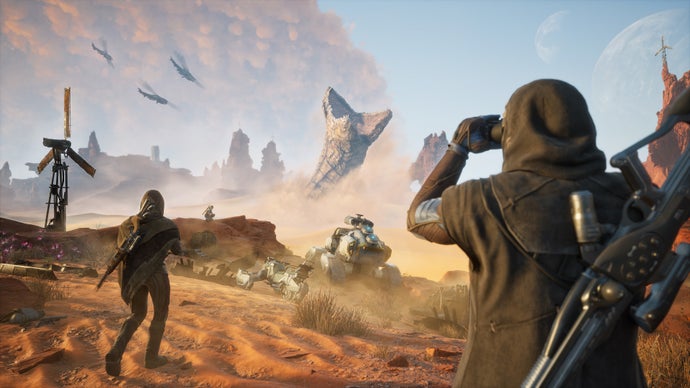
Image: courtesy of EuroGamer
Why Dune: Awakening’s Lack of Crossplay Could Strand Console Players on Arrakis
Funcom has confirmed that its highly anticipated open-world survival MMO, Dune: Awakening, will not feature crossplay between PC and consoles at launch. For a genre that relies entirely on massive, active player bases to keep servers alive, this decision is a massive gamble. While PC players will get to experience the harsh sands of Arrakis first, those waiting on PlayStation 5 and Xbox Series X/S will find themselves isolated in their own separate ecosystems when the console versions eventually arrive. This split threatens to fragment the community before the game even finds its footing, raising serious questions about how Funcom plans to maintain long-term player engagement on consoles.
What to Expect
When Dune: Awakening finally makes its way to consoles, players will enter an Arrakis that feels significantly smaller than the one their PC counterparts inhabit. Without crossplay, you will only be able to build shelters, harvest spice, and wage war alongside people on your specific platform. If you are playing on PlayStation 5, your world will be entirely populated by other PS5 players. Your friends on Xbox or PC will be completely out of reach.
This separation will immediately impact the game's player-driven economy. In survival MMOs, the market for rare resources and crafted gear thrives on high server populations. With the player base split into three distinct pools, console servers are highly likely to experience slower economies and quieter open worlds. You should expect longer queue times to get into active battles and a much harder time finding large clans to join. Funcom will have to manage three entirely separate server infrastructures, which means updates, hotfixes, and balance patches might not roll out at the same time across all platforms.
Key Context
Developing a massive multiplayer game on Unreal Engine 5 is a notoriously difficult technical challenge, and Arrakis is not a simple world to build. Funcom has designed Dune: Awakening to support thousands of players sharing a single map, complete with shifting sandstorms that physically alter the terrain every week. Doing this on high-end PCs is hard enough. Translating that dynamic, physics-heavy world to consoles—especially with the hardware limitations of the Xbox Series S—presents a massive bottleneck.
Historically, Microsoft requires feature parity between the Xbox Series X and the weaker Series S. This rule has already delayed several major releases, most notably Baldur's Gate 3, because developers struggled to get complex multiplayer systems running smoothly on the cheaper console. By skipping crossplay at launch, Funcom buys its development team precious time. They do not have to worry about synchronizing PC players running at 144 frames per second with Xbox Series S players struggling to maintain a stable 30 frames per second. However, this technical compromise comes at a steep social cost for a game built around community and faction warfare.
Related Coverage
Historical Patterns
We have seen this story play out before, and the results are rarely pretty for console players. When Rust finally came to PlayStation and Xbox years after its PC debut, it did so without crossplay with PC. The console version felt like a ghost town compared to the thriving, chaotic PC servers. The game had to be updated and balanced completely differently, leaving console players feeling like second-class citizens who were always months behind on content.
Conversely, games that embraced crossplay from the start have enjoyed immense longevity. Sea of Thieves and Ark: Survival Evolved managed to keep their console communities vibrant for years precisely because players could jump in with their friends regardless of hardware. When an MMO launches without crossplay, the console community usually spikes during the first month and then drops off sharply. Once a server's population dips below a certain threshold, the survival loop breaks down—there are not enough players to fight, trade with, or fear, leading to a rapid death spiral for that platform's community.
In the modern gaming market, crossplay is no longer a luxury feature; it is the baseline expectation for any multiplayer game that wants to survive past its first year. By launching without it, Funcom is fighting an uphill battle against player habits. Gamers are no longer willing to buy a game if it means they cannot play with their established friend groups. This decision immediately limits Dune: Awakening’s launch momentum on consoles, potentially turning what should be a major blockbuster into a niche PC-only success. For a studio that needs a massive hit to justify the high costs of the Dune license and years of development, splitting the player base is an incredibly risky strategy.
Potential Outcomes
AnalysisIn the first likely scenario, the PC version of Dune: Awakening launches to critical acclaim and high player counts, but the subsequent console launch struggles. Isolated on their own servers, PlayStation and Xbox players quickly abandon the game due to low population, forcing Funcom to pivot all its resources back to the PC version and leave the console editions on life support.
Alternatively, the backlash from the community could force Funcom to make a hard pivot. Under pressure from falling player numbers on consoles, the developers might delay future content updates to focus entirely on building a post-launch crossplay patch, eventually uniting the platforms six to twelve months after the console release.
In a third, more troubling scenario, technical disparities between PC and consoles prove too wide to bridge. The console versions remain permanently segregated, leading to a fractured community where the PC version thrives as a hardcore survival simulator while the console versions are eventually shut down or transitioned to smaller, local-only servers.
Timeline
Frequently Asked Questions
Discussion
Be the first to share your thoughts.