
Expect a continued tightening of government oversight on the development and deployment of advanced AI models. The 'voluntary' nature of programs like Gold Eagle is likely to be tested as companies navigate national security concerns and commercial pressures. Companies like Anthropic and OpenAI will face increased scrutiny and potentially longer timelines for product releases, as their partner lists and model capabilities will require White House approval. This shift may also prompt other nations to consider similar regulatory frameworks, potentially leading to a more fragmented global AI development environment. Innovators will need to factor government approval into their development cycles, potentially slowing the pace of independent research.
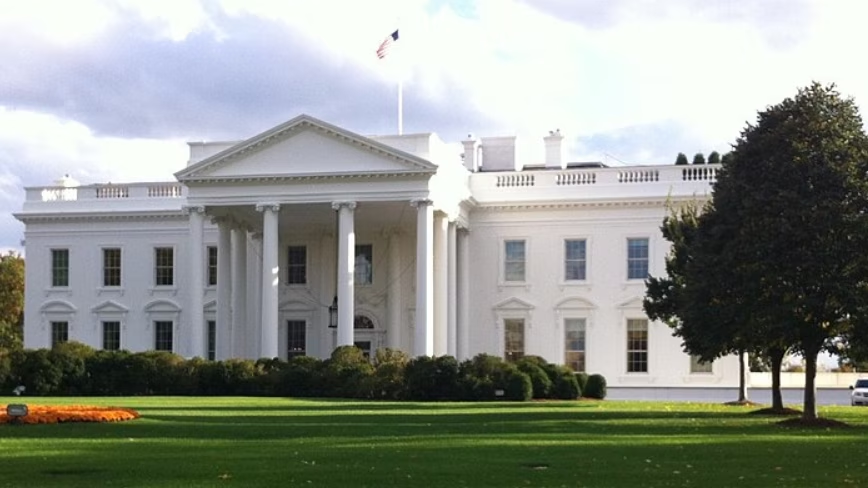
Image: courtesy of Thenextweb
The White House Takes Control: What Government Oversight Means for Frontier AI and Its Developers
The White House has asserted unprecedented control over who can access and deploy frontier artificial intelligence models, fundamentally shifting power dynamics from leading AI labs like Anthropic and OpenAI to the government. This intervention follows a series of executive orders from the Trump administration, culminating in the launch of the 'Gold Eagle' program. Confirmed reports indicate the government has already blocked the release of advanced models, marking the first time it has intervened before AI systems reached the market. This move suggests that what the White House terms 'voluntary' participation in its oversight programs is, in practice, becoming a mandatory requirement for companies developing the most powerful AI.
Outlook
Background
For years, the development and release of the most advanced artificial intelligence models, often termed 'frontier AI,' rested solely with the companies creating them. Labs like Anthropic and OpenAI established their own controlled rollout programs, carefully selecting partners to test and deploy their powerful systems. This autonomy has now been curtailed. The White House, under the Trump administration, has taken decisive steps to dictate access to these models, citing national security concerns.
This new posture is anchored in a December 2025 executive order that laid the groundwork for greater government involvement in AI safety and security. A subsequent executive order, signed on June 2, 2026, specifically requested companies to participate voluntarily in benchmarking and assessment programs for new AI models before their public release. The 'Gold Eagle' program appears to be the operational arm of this initiative.
However, the 'voluntary' aspect has quickly come into question. Last month, the White House blocked the release of two Anthropic models, Claude Mythos 5 and Fable 5, marking the first confirmed instance of direct government intervention before an AI model reached the market. This action indicates that the government's role extends beyond mere consultation; it now includes the power to veto releases. Both Anthropic's 'Glasswing' and OpenAI's 'Daybreak' partner programs, which manage access to their most capable models, now require explicit government approval for their participant lists. While the White House maintains participation is voluntary, sources close to the matter suggest that labs wishing to deploy their cutting-edge systems will have little choice but to comply.
Precedents
Government intervention in emerging technologies is not without precedent, though the speed and scope of this AI oversight are notable. Historically, new technologies with significant societal impact — from nuclear energy and biotechnology to encryption and even early aviation — have eventually drawn the attention of regulators and national security agencies. The rationale often centers on managing dual-use technologies, those with both civilian and military applications, or technologies deemed critical infrastructure.
In the past, such oversight typically followed the widespread adoption and demonstrated risks of a technology. For instance, the regulation of pharmaceuticals intensified after public health crises, and internet content moderation evolved in response to societal harms. What makes the current AI situation distinct is the proactive nature of the White House's intervention, stepping in before models reach the broader market. This suggests a recognition of AI's potentially transformative, and disruptive, capabilities on a scale perhaps not seen with previous technologies. The government appears to be attempting to shape the technology's trajectory from its nascent 'frontier' stage, rather than reacting to its consequences after the fact. This mirrors, in some ways, the early days of nuclear weapons development, where government control was asserted from the outset due to the immense national security implications.
This shift in control over frontier AI models is a critical development for several reasons. For AI developers, it represents a new layer of complexity and potential constraint. Innovation, which thrives on rapid iteration and open exchange, could face delays and limitations as government approvals become a prerequisite for deployment. This may force companies to reconsider their development roadmaps, potentially leading to more cautious and less ambitious projects if the regulatory hurdles become too high.
For national security, the White House's move is framed as essential for preventing misuse of powerful AI. Frontier models could, in theory, be weaponized or exploited by hostile actors, making government oversight a logical step from a defense perspective. However, it also raises questions about who within the government possesses the technical expertise to make these complex decisions, and whether these interventions will genuinely enhance security without stifling progress.
Economically, this could reshape the competitive landscape. Smaller AI startups, lacking the resources to navigate complex regulatory frameworks, may struggle to bring their innovations to market, consolidating power among larger, more established players. It also sets a precedent for how future foundational technologies might be governed, potentially ushering in an era where government rather than market forces dictates the pace and direction of technological advancement. The broader consequence is a fundamental re-evaluation of the relationship between government, industry, and the public in the age of advanced artificial intelligence.
Scenarios
Analysis1. Increased Centralization and Bureaucracy in AI Development: The White House's direct involvement may lead to a more centralized approach to frontier AI development. Labs could find themselves spending significant resources on compliance, security audits, and navigating bureaucratic processes. This could slow down the pace of innovation, as the agility that characterized early AI development is replaced by a more structured, government-approved release cycle. It could also lead to a brain drain, with top researchers leaving for less regulated environments or academic settings, if the perceived restrictions become too stifling.
2. Emergence of a 'National AI' Ecosystem: With the government dictating access and deployment, the U.S. could effectively foster a 'national AI' ecosystem, prioritizing domestic security and economic interests. This might involve directing research funding towards specific, government-approved projects or incentivizing collaborations that align with national objectives. Such a move could accelerate certain applications deemed critical for national defense or economic competitiveness, but potentially at the expense of broader, open-source AI development and international collaboration.
3. Global Regulatory Fragmentation: Other major global powers, including China and the European Union, are closely watching the U.S. approach to AI regulation. The White House's assertive stance could prompt these regions to develop their own, potentially divergent, frameworks for controlling frontier AI. This might lead to a fragmented global AI landscape, where models developed in one region face significant barriers to deployment or even research collaboration in another, complicating international scientific and commercial efforts.
4. Heightened Scrutiny and Public Debate: The direct intervention by the White House into what was previously a corporate decision-making domain is likely to spark intense public debate. Discussions will center on the balance between national security and technological freedom, the potential for government overreach, and the definition of 'frontier AI' itself. This increased scrutiny could lead to legal challenges, advocacy campaigns, and a more informed, but potentially polarized, public discourse on the future of AI governance.
Timeline
Frequently Asked Questions
Discussion
Be the first to share your thoughts.