
Consumers and financial institutions can expect to see Visa integrate BioCatch's behavioral biometric technology deeper into its payment processing and fraud prevention services. This means more sophisticated, real-time fraud detection that operates before a payment is authorized, rather than merely checking the transaction itself. For banks, this could translate into reduced fraud losses and fewer false positives, where legitimate transactions are mistakenly blocked. For users, the hope is a more seamless and secure digital experience, though the underlying biometric analysis will largely be invisible. The payment industry as a whole is likely to see further consolidation and investment in AI-powered security solutions, particularly those focused on user behavior and identity verification, as the fight against generative AI-enabled fraud intensifies.
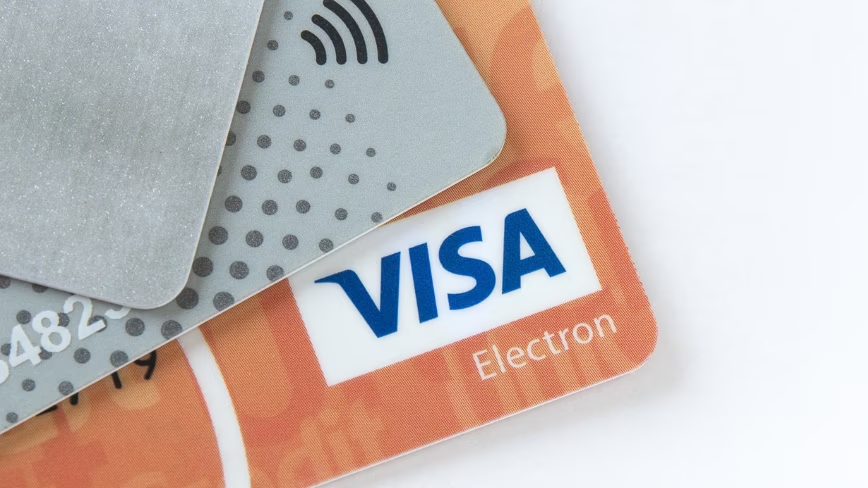
Image: courtesy of Thenextweb
Visa's $2.4 Billion BioCatch Deal: A Bet on Behavioral Biometrics to Fight a Trillion-Dollar AI Scam Epidemic
Visa is acquiring BioCatch, a Tel Aviv-based fraud detection startup, for $2.4 billion in cash. The deal, announced yesterday, August 3, 2026, is a direct response to the escalating threat of AI-driven scams and account takeovers, which Visa estimates cost the global economy over $1 trillion annually. BioCatch uses advanced behavioral biometrics — analyzing user interactions like keystroke timing and swipe patterns — to identify fraudsters in real time, protecting 760 million users across 350 banks. This acquisition signals a major strategic move by Visa to bolster its value-added services and stay ahead in the rapidly evolving digital fraud arms race.
Outlook
Background
The digital payments world has been grappling with increasingly sophisticated fraud for years, but the advent of generative AI has fundamentally changed the nature and scale of the threat. Andrew Torre, Visa’s president of value-added services, confirmed that AI is enabling these attacks at an 'unprecedented scale,' costing the global economy more than $1 trillion each year. Traditional fraud detection systems often focus on transaction details or known fraud patterns, which can be bypassed by scams where a legitimate user is tricked into authorizing a fraudulent payment themselves – known as 'authorized push payment' fraud or social engineering scams. These are particularly challenging because the payment appears legitimate. BioCatch's technology offers a different layer of defense by analyzing how a user interacts with their device and applications. It looks at subtle cues like typing cadence, touchscreen pressure, mouse movements, and how a device is held. This creates a unique 'digital fingerprint' of legitimate user behavior, allowing the system to flag deviations that suggest a bot, a scammer, or an account takeover in progress. The company currently works with approximately 350 banking clients in 21 countries, including 100 of the largest banks, and monitors 1.8 billion devices, protecting 760 million users. Visa, which processes over 329 billion transactions, has been aggressively expanding its value-added services business, investing more than $13 billion in technology and infrastructure over the past five years to build out its capabilities beyond core payment processing.
See also
Precedents
The acquisition of specialized security firms by major payment networks is a well-established pattern in the financial technology sector. As new threats emerge, incumbents like Visa, Mastercard, and American Express often acquire innovative startups rather than building competing technologies from scratch. This allows them to quickly integrate cutting-edge solutions and expand their service offerings to financial institutions. For example, payment giants have previously acquired companies specializing in tokenization, data analytics, and traditional fraud scoring. The current wave of acquisitions, however, is increasingly focused on AI and machine learning capabilities, specifically those that move beyond static data points to dynamic, real-time behavioral analysis. This shift reflects a recognition that signature-based or rule-based fraud detection is becoming less effective against adaptive, AI-powered attacks. The history of cybersecurity is an arms race: as defenses improve, attackers evolve, and vice versa. This acquisition is Visa's latest move in that continuous cycle, mirroring similar strategic investments made by competitors in recent years to enhance their defensive postures against an ever-changing threat landscape. The focus on 'value-added services' also reflects a broader trend among payment networks to diversify revenue streams beyond transaction fees by offering banks and merchants a suite of security, data, and consulting tools.
This acquisition changes the calculus for both financial institutions and their customers. For banks, it offers a more proactive defense against a type of fraud — AI-driven social engineering and account takeovers — that has proven incredibly difficult to stop with traditional methods. By detecting suspicious behavior before a payment is authorized, BioCatch's technology aims to prevent losses that would otherwise fall on banks or their customers. The sheer scale of the $1 trillion annual cost of AI scams suggests that the existing defenses are insufficient. For consumers, the implications are significant. While the technology operates in the background, its effectiveness could mean fewer instances of personal financial loss, less time spent dealing with fraud claims, and greater trust in digital banking platforms. The risk of being tricked into sending money to a scammer, or having an account taken over, becomes a little lower. However, it also raises questions about data privacy and the extent of behavioral monitoring, even if anonymized. Ultimately, this deal is Visa's strategic move to maintain its position as a trusted intermediary in a world where digital identity and transaction authenticity are under constant assault. If successful, it could set a new standard for fraud prevention, forcing other players in the financial ecosystem to adopt similar advanced behavioral analytics to keep pace.
Scenarios
Analysis1. Enhanced Fraud Prevention Across Visa's Network: BioCatch's technology could be integrated across Visa's vast network, offering a more robust and proactive layer of fraud detection to its client banks worldwide. This could significantly reduce the $1 trillion annual cost of AI-driven scams, improving security for millions of users and reducing financial losses for institutions. This integration could also lead to new, bundled security offerings from Visa for its financial partners.
2. Increased Competition and Innovation in Fraud Detection: Visa's significant investment may spur other major payment processors and financial technology companies to accelerate their own acquisitions or development of AI-powered behavioral biometrics and similar advanced fraud prevention tools. This competitive pressure could drive further innovation in the sector, leading to even more sophisticated solutions for combating evolving fraud tactics.
3. New Industry Standards for Digital Identity Verification: As behavioral biometrics prove their effectiveness, they could become a de facto standard for verifying user identity and intent in high-value digital transactions. This might lead to a broader adoption of these techniques beyond just banking, potentially influencing how other industries, such as e-commerce and online services, approach security and user authentication.
4. Challenges in Integration and Scalability: While BioCatch has a strong client base, integrating its technology seamlessly into Visa's massive global infrastructure presents operational and technical challenges. Scaling its behavioral models to Visa's 329 billion-plus transactions and diverse global markets will require significant engineering effort and may encounter unforeseen complexities or regulatory hurdles in different jurisdictions. The effectiveness of the technology will also face a continuous challenge from rapidly evolving AI-powered scamming techniques.
Timeline
Frequently Asked Questions
Discussion
Be the first to share your thoughts.