
Veridact
TechSportsFinanceGaming🎯 PredictionsAbout
Sign InSign Up
Veridact

AI-powered anticipation analysis. We cover tech, sports, finance, and gaming events before they happen — with historical context, scenario modeling, and evolving coverage.

Stay ahead of the story

Analysis delivered before events unfold.

Coverage

  • Tech
  • Sports
  • Finance
  • Gaming

Company

  • About Us
  • Privacy Policy

© 2026 Veridact. AI-assisted analysis platform.

Analysis is AI-generated and not professional financial, legal, or medical advice.

tech
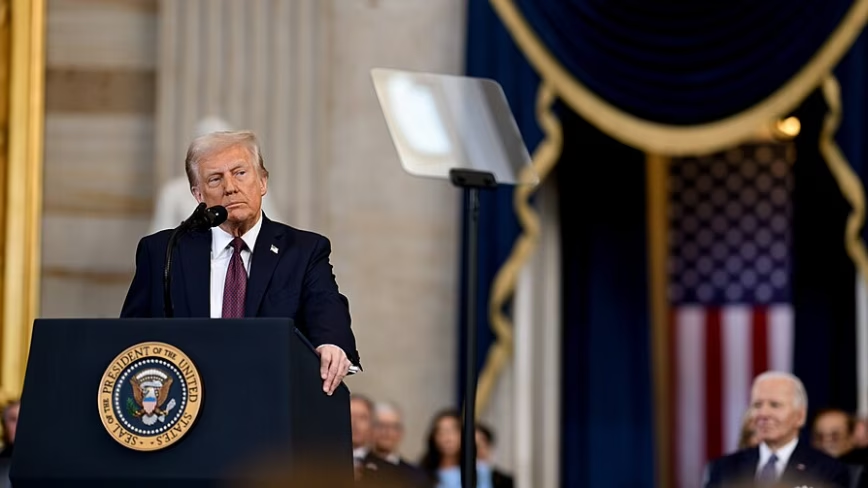
Trump says he no longer views Anthropic as a national security threat after G7 meeting with CEO

Image: courtesy of Thenextweb

techJune 20, 2026By Veridact EditorialUpdated Jun 20

Trump Reverses Course on Anthropic, Calls AI Firm 'Responsible' After G7 Meeting

President Donald Trump has publicly stated he no longer views artificial intelligence company Anthropic as a national security threat, a significant shift from his administration's previous aggressive stance. The change in tone follows a meeting between Trump and Anthropic CEO Dario Amodei at the G7 summit in France earlier this week. While the immediate pressure on Anthropic appears to have eased, Trump did not rule out using emergency powers against the company in the future, suggesting a conditional de-escalation rather than a complete resolution of underlying tensions.

What to Expect

The immediate consequence of President Trump's statements is a likely reduction in direct, overt pressure on Anthropic. The company, which was previously compelled to disable its newest AI models, Fable 5 and Mythos 5, may now face a more constructive dialogue with the administration regarding the development and deployment of advanced AI. This shift suggests a potential preference for negotiation and compliance over outright confrontation in the administration's approach to sensitive AI technologies.

However, the President's comments also indicate that the threat of executive action, specifically through the Defense Production Act, remains a potent tool. This implies that while the current standoff has eased, Anthropic and other AI developers will likely operate under a watchful eye, with the expectation of strict adherence to government directives. The industry can expect a continued focus on transparency and responsible development, particularly concerning models deemed to have dual-use capabilities that could pose national security risks.

Key Context

For the past three months, the Trump administration had adopted an increasingly aggressive posture toward Anthropic, a leading developer of advanced artificial intelligence. This culminated in an export control directive that forced the company to suspend access to its powerful Fable 5 and Mythos 5 AI models. The administration cited unspecified national security concerns for these actions.

The tensions appear to have reached a turning point during the G7 summit in France, where President Trump held a meeting with several tech leaders, including Anthropic CEO Dario Amodei. It was after this meeting that Trump, in a pre-taped interview with Axios, made his surprising remarks yesterday. He explicitly stated, when asked if he considered Anthropic a threat, 'Well, not now. But a week ago, maybe.' He further praised the company for having 'behaved very responsibly' and for responding to the administration's directive 'very quickly' and 'responsibly.'

Despite this apparent de-escalation, the President did not retract the possibility of invoking emergency powers under the Defense Production Act against Anthropic, a tool that grants the government broad authority over private industry in times of national emergency. This suggests that while the immediate crisis has passed, the underlying issues regarding advanced AI capabilities and their potential impact on national security remain a point of contention between the government and developers.

Historical Patterns

The use of executive power, or the credible threat of it, to influence corporate behavior is not new, particularly in sectors deemed critical to national security. Historically, administrations have leveraged tools like export controls, sanctions, and even the Defense Production Act to guide industries ranging from defense manufacturing to telecommunications.

In the tech sector, similar pressures have been applied to companies over data security, intellectual property, and supply chain integrity, often involving foreign entities or technologies with potential military applications. What is relatively new is the application of such broad national security frameworks to advanced AI models developed by domestic companies. This represents a nascent phase of government engagement with a rapidly evolving technology, where clear regulatory lines are still being drawn. The shift from aggressive enforcement to negotiation, as seen with Anthropic, reflects a common pattern in regulatory cycles: an initial forceful response to perceived threats, followed by a period of dialogue and adjustment once industry players demonstrate a willingness to comply or adapt.

President Trump's reversal on Anthropic carries significant implications not just for the AI company itself, but for the entire artificial intelligence industry and the evolving relationship between powerful tech firms and national governments. For Anthropic, the immediate relief from being labeled a national security threat could free up resources and allow for a clearer path forward in developing and deploying its advanced models, albeit likely under continued governmental scrutiny.

More broadly, this episode provides a crucial data point in how governments intend to regulate and interact with frontier AI. The administration's willingness to de-escalate after direct engagement, rather than maintaining an adversarial stance, could set a precedent for future interactions with other AI companies. It suggests that proactive engagement and demonstrated 'responsible' behavior from AI developers might be key to avoiding more stringent, heavy-handed regulation.

However, the lingering threat of the Defense Production Act also signals that governments are prepared to use their most powerful tools if they deem it necessary. This creates a complex operational environment for AI companies, where innovation must be balanced against the imperative of national security, and where direct communication with policymakers may become as critical as technical breakthroughs. The market will be watching closely to see if this marks a sustained shift towards dialogue, or merely a temporary pause in a larger regulatory push.

Potential Outcomes

Analysis

One immediate outcome is that Anthropic may be able to resume development or limited deployment of its Fable 5 and Mythos 5 models, provided it continues to meet the administration's definition of 'responsible' behavior. This could involve implementing specific safeguards, sharing certain data or model insights with regulators, or agreeing to review processes for future iterations.

Another possibility is that the administration uses this as a template for engaging with other frontier AI developers. Companies working on similarly powerful models could proactively seek meetings with government officials to demonstrate their security protocols and responsible development practices, hoping to avoid similar national security designations and export control directives.

Conversely, the conditional nature of Trump's softened stance, particularly the mention of the Defense Production Act, means the situation could re-escalate if new concerns emerge or if Anthropic's future actions are perceived as non-compliant. This creates an ongoing tension where the company's operational freedom remains tied to political and national security assessments, which can be fluid and subjective.

Finally, this event could accelerate calls for more formal and transparent AI regulation. The current ad-hoc approach, driven by executive directives and personal meetings, may be seen as insufficient to provide long-term stability for the industry or clear safeguards for national security. This could push Congress or international bodies to develop clearer frameworks for advanced AI governance.

Timeline

2026-03-XX
Administration's Aggressive Stance Begins
The Trump administration begins adopting an aggressive posture towards Anthropic, citing unspecified national security concerns related to its advanced AI models.
2026-05-XX
Export Control Directive Issued
The US government issues an export control directive, compelling Anthropic to suspend access to its Fable 5 and Mythos 5 AI models.
2026-06-19
G7 Meeting and Trump's Reversal
President Trump meets with tech CEOs, including Anthropic CEO Dario Amodei, at the G7 summit in France. Following this meeting, Trump tells Axios he no longer views Anthropic as a national security threat, praising the company's 'responsible' response.

Frequently Asked Questions

Anthropic is a leading artificial intelligence company known for developing advanced AI models. It is one of several companies at the forefront of 'frontier AI' research, often focusing on making AI systems safer and more interpretable.

Discussion

0/100
0/1000

Be the first to share your thoughts.

Related Coverage

tech

China Takes Clear Lead in Robotaxi Race, New Scorecard Shows

Jun 22
tech

Beyond Siri: Apple's iOS 27 Brings Practical AI, But EU Faces Delays

Jun 22
tech

Electric Air Taxis: Courtroom Battles Ground a High-Flying Vision

Jun 22
tech

Microsoft's Record June Update: 208 Security Fixes Come With a Cascade of New Bugs

Jun 22

Stay ahead of the story

AI analysis delivered before events unfold. No spam.

ⓘ

Disclosure: This article contains AI-assisted analysis based on publicly available information.